Tag: Web anonymity

  • Transparent vs. Anonymous vs. Elite Proxies Explained

    Transparent vs. Anonymous vs. Elite Proxies Explained

    We’re here to help U.S. IT teams, marketers, and privacy lovers pick the best proxy. We’ll show you the key differences between transparent, anonymous, and elite proxies. These differences are crucial for your security, how fast things work, and if you follow the rules.

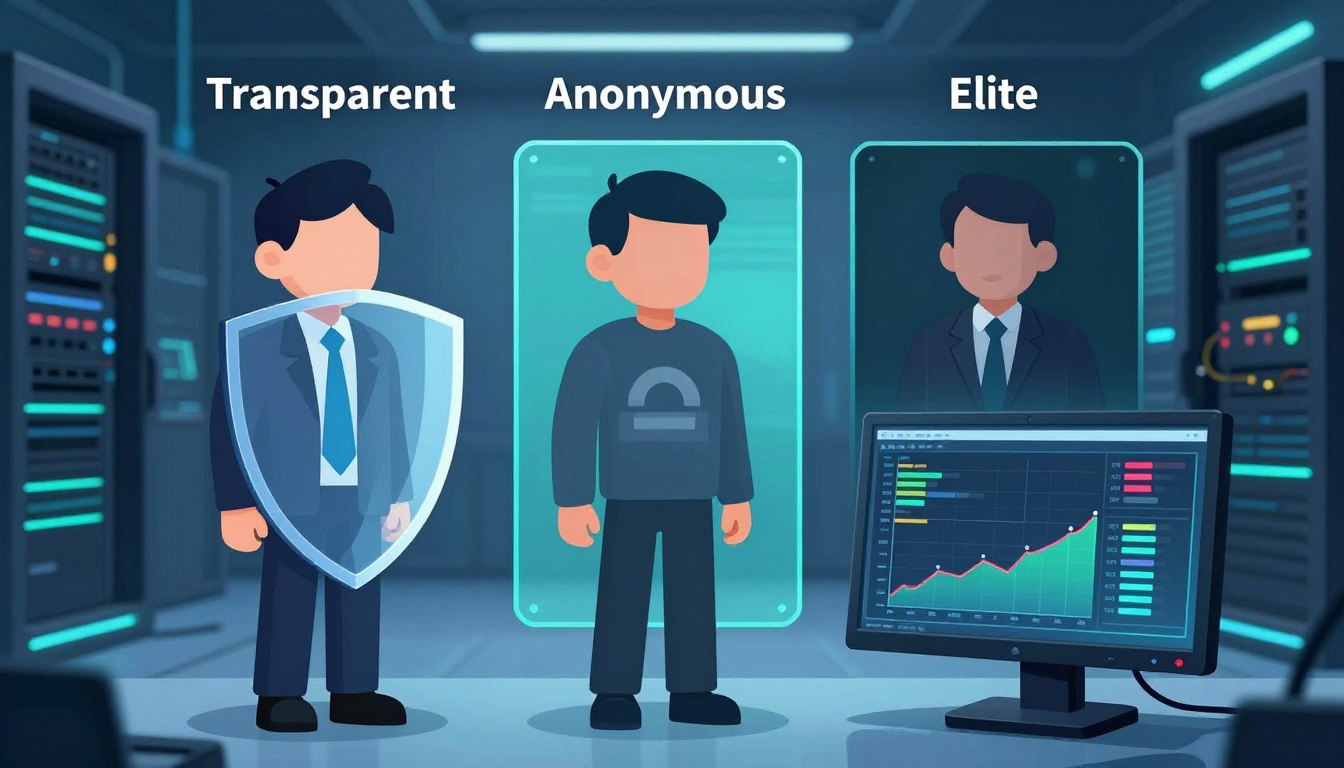
    A transparent proxy shows client headers, which can reveal your original IP or HTTP_X_FORWARDED_FOR. An anonymous proxy hides your IP but might still show it’s a proxy. An elite proxy, or high anonymity, hides your IP and removes all proxy headers.

    We’ll talk about how they work, their speed, security, and real-life uses. This includes business access, education, streaming, marketing, and web scraping. We’ll also give tips on how to choose a provider and test proxies in your own setup.

    This article is a detailed guide to help you decide. We’ll give you steps to check proxy performance, cost, and reliability. We write in the first person plural to offer you direct advice. This will help you choose between transparent and anonymous proxies or go for an elite proxy if you need top-level anonymity.

    Key Takeaways

    • Transparent proxies reveal client headers and are simple to deploy.
    • Anonymous proxies hide IPs but may disclose proxy use.
    • Elite proxy (high anonymity) provides the strongest concealment.
    • Choose based on use case: performance needs, compliance, and scraping scale.
    • Test providers and measure latency, header behavior, and reliability.

    Understanding Proxies: An Overview

    We start with a quick guide on proxy technology. Proxies act as middlemen between clients and servers. They manage traffic, follow rules, and sometimes speed up content delivery. Squid is great for caching, while NGINX and HAProxy are top picks for reverse proxying.

    What is a Proxy?

    A proxy server is like a messenger. It sends requests from a client to a server and brings back the answers. Proxies can be set up on the client side or server side for different tasks.

    They can change traffic, add headers, check who’s accessing, and store pages to save time. Squid, NGINX, and HAProxy are favorites for many users.

    How Proxies Work

    The process is straightforward: client sends a request → proxy → server → proxy → client. Proxies can change or hide the client’s IP by adding or altering headers.

    They support various ways to check who’s accessing, like Basic, Digest, and NTLM. SOCKS proxies handle TCP streams, while HTTP and HTTPS proxies work with HTTP headers. For HTTPS, they might use the CONNECT method or inspect content.

    Types of Proxies in Use

    Proxies are categorized by their function and where they come from. Transparent proxies show the client’s IP and add headers. Anonymous proxies hide the user’s IP but might still show proxy use. Elite proxies hide both the client’s IP and the fact that a proxy is being used.

    Residential proxies use real consumer IPs and are less likely to be blocked but cost more. Datacenter proxies are cheaper and faster but might get blocked more often.

    Proxy Type Typical Use IP Origin Anonymity
    Transparent Content caching, internal filtering Datacenter or corporate network Low — reveals client and headers like X-Forwarded-For
    Anonymous Privacy for casual browsing, basic masking Residential or datacenter Moderate — hides client IP but may show proxy usage
    Elite proxy High-stakes scraping, secure market targeting Residential or datacenter High — strips identifying headers and hides proxy presence
    SOCKS Protocol-agnostic tunneling, apps and games Varies Varies by implementation
    Reverse / Caching Load balancing, TLS offload, faster delivery Server-side infrastructure (NGINX, HAProxy) Not applicable — serves backend

    The Concept of Transparency in Proxies

    Transparent proxies forward client requests without hiding the original IP. They add proxy headers like HTTP_X_FORWARDED_FOR and Via. This helps networks keep a clear audit trail and makes policy enforcement easier.

    When choosing between transparent and anonymous proxies, we consider how traffic is routed. Transparent proxies are simpler to set up and cost less to run. They also offer reliable caching. This model is best for organizations that need to know the client’s true identity.

    We list ideal use cases where keeping client identity matters.

    • Enterprise caching to reduce bandwidth and speed updates.
    • Schools and universities enforcing content filters and SafeSearch.
    • ISPs and parents implementing parental controls.
    • Corporate monitoring, auditing, and internal load balancing.

    However, transparent proxies have some drawbacks. They don’t offer privacy or geo-masking. This makes them unsuitable for users who need anonymity. Sites that check proxy headers may block or flag traffic, limiting their use for scraping or bypassing location restrictions.

    Feature Transparent Proxy Anonymous Proxy
    Client IP Exposure Preserved via HTTP_X_FORWARDED_FOR and similar proxy headers Hidden from target servers
    Setup Complexity Low; easy to configure for networks Higher; requires anonymization tools
    Primary Uses Caching, filtering, monitoring Privacy, geo-masking, secure browsing
    Cost Lower due to minimal processing Higher because of added services
    Blocking Risk Higher when proxy headers are detected Lower if well-configured

    A Deep Dive into Anonymous Proxies

    We look into how anonymous proxies work and what they offer. They hide your IP from servers but might still show their presence with proxy headers. This balance offers privacy but not complete secrecy, showing the trade-offs for different needs.

    Benefits of Using Anonymous Proxies

    Anonymous proxies are great for simple privacy needs at a low cost. They hide your IP and reduce basic tracking. They’re a cost-effective choice compared to more advanced proxies, available in datacenter and residential types.

    Scenarios Where Anonymity Matters

    On public Wi-Fi, anonymous proxies keep your browsing private. They’re also good for small web scraping tasks to avoid rate limits. For market research, they help quickly switch between addresses. They’re useful for light geo-block bypasses for basic content access.

    Drawbacks and Considerations

    However, there are limits. Sites can spot proxy use by checking headers, which weakens anonymity. Datacenter IPs are easier to block. Advanced methods can still uncover your identity. Always choose HTTPS to protect against malicious proxies.

    • Masked IP reduces simple tracking and IP bans.
    • Proxy headers may reveal proxy usage to destination servers.
    • Cheaper than elite proxies but less effective against advanced detection.
    • Useful for basic bypasses when we need to bypass geo-restrictions quickly.

    Elite Proxies: The Best of the Best

    Elite proxy options are top-notch for those who need top secrecy and reliability. They are at the highest level of proxy services. This means they keep your IP hidden and don’t show signs of using a proxy.

    elite proxy

    What Sets Elite Proxies Apart?

    Elite proxies hide your identity by not sending out certain headers. They make it seem like you’re directly connected to the server. This is why residential elite proxies are less likely to get blocked, as they look like real user connections.

    When to Choose Elite Proxies

    Elite proxies are best for critical tasks that need to be very private. This includes big web scraping projects and checking ads. They’re also great for managing many accounts and getting past tough geo-blocks. They help avoid being detected, which is very important.

    Cost Implications of Elite Proxies

    Elite proxies are more expensive than other types. Residential elite addresses are pricier because they offer more variety and are less likely to get blocked. Datacenter elite proxies are also more expensive, especially if you’re using a dedicated server.

    Prices vary based on how you’re billed. You might pay per IP, by bandwidth, or for how many connections you make at once. There might be extra costs for features like rotation and API management, which make managing many proxies easier.

    Comparing Transparent and Anonymous Proxies

    We look at how transparent and anonymous proxies work differently. This helps teams choose the best tool for their needs. We’ll talk about what they do, how well they perform, and their security features.

    Key Differences in Functionality

    Transparent proxies show the client’s original IP and add headers like HTTP_X_FORWARDED_FOR. They’re good for caching, content filtering, and following company rules.

    Anonymous proxies hide the user’s IP but might show that a proxy is being used. Elite proxies hide both the original IP and any signs of a proxy for ultimate secrecy.

    Performance and Speed Comparisons

    Choosing between transparent and anonymous proxies affects speed. Transparent proxies are often faster because they work at the edge of networks and use caching. This makes repeat requests quicker.

    Anonymous proxies, especially datacenter ones, can also be fast for single requests. But elite residential proxies, which use consumer ISPs, might be slower. Still, they can be better for big tasks like scraping or automation, even if they’re slower.

    Security Features

    Transparent proxies are good for logging and preventing data loss. But they don’t keep your IP private, so they’re not great for privacy.

    Anonymous proxies hide your IP but don’t encrypt your data. Elite proxies add more secrecy but you have to trust the provider. Always use HTTPS/TLS and certificate pinning for sensitive data.

    Aspect Transparent Anonymous Elite
    IP exposure Original IP forwarded; headers like HTTP_X_FORWARDED_FOR show source Client IP hidden; proxy presence may be visible Client IP hidden; proxy use concealed
    Typical use Policy, caching, filtering Privacy, simple concealment Stealth, bypassing strict blocks
    Performance High due to caching and local placement Variable; datacenter can be fast Lower latency sometimes, but higher success rates for blocked targets
    Security Strong for logging and DLP; poor for anonymity Basic privacy; depends on TLS Best stealth; depends on provider trust

    We warn against using untrusted free proxies. They can steal or change your data, even if they seem to work. Choosing between transparent and anonymous proxies depends on what you need. It’s about finding the right balance between speed, headers, and trust in providers.

    Use Cases for Transparent Proxies

    We explore how transparent proxies help in real-world scenarios. They offer control, visibility, and efficiency. This is why many organizations prefer them for their balance of privacy and compliance.

    Businesses and Organizations

    Transparent proxies help us cache software updates, saving on bandwidth costs. They work with firewalls from Fortinet and Palo Alto. This centralizes proxy headers for logging and policy enforcement.

    They also help meet compliance audits by logging client IPs. The HTTP_X_FORWARDED_FOR header keeps client IPs in logs. This makes client configuration easy.

    Network teams use them to enforce policies, filter content, and optimize WAN traffic. These setups make managing large fleets of endpoints easier.

    Educational Institutions

    In schools and universities, we use transparent proxies to block content without installing software. This is easy for IT managers to set up, especially with different devices.

    They enforce SafeSearch, block malicious sites, and manage bandwidth during busy times. Proxy headers like HTTP_X_FORWARDED_FOR help administrators track user requests for safety reviews.

    Integrating transparent proxies with learning management systems improves access control. It keeps the student experience simple.

    Streaming Services and Content Diversion

    We set up transparent proxies at ISP and campus edges to cache streaming content. This reduces CDN costs and speeds up delivery for popular content.

    Transparent proxies can improve throughput but can’t fake the origin location. For geo-restricted content, the choice between transparent and anonymous proxies is key. Transparent proxies reveal the client IP via HTTP_X_FORWARDED_FOR and other headers.

    For optimizing delivery rather than location masking, transparent proxies are a good choice. They are practical and easy to use for networks with predictable streaming needs.

    Use Cases for Anonymous Proxies

    Anonymous proxy tools help keep our online activities private. They hide our IP addresses and block ads. The type of proxy we choose affects how fast and reliable it is.

    We’ll look at some common uses for these tools. We’ll also compare Transparent vs anonymous proxies. This way, teams can choose the best option for their needs.

    Personal Privacy and Security

    Using public Wi-Fi? An anonymous proxy keeps your device’s IP hidden. This stops simple tracking. Using HTTPS and privacy-focused browsers like Firefox or Brave adds extra protection.

    For even more privacy, Tor is a good choice. It sends your traffic through many nodes. But, it might be slower and not work with all sites. Anonymous proxies usually work better for everyday browsing.

    Bypassing Geo-Restrictions

    Anonymous proxy services help us access content blocked by region. How well it works depends on the site’s checks. Some sites look at proxy headers or IP ranges.

    Residential proxies are better for streaming and local services. But, results can vary. Testing different proxy levels helps find the best one for each platform.

    E-commerce and Market Research

    For comparing prices and monitoring competitors, we use anonymous proxies. They help us run queries without showing our company’s IP. This lowers the risk of being blocked right away.

    For big data collection projects, elite or rotating residential proxies are better. They help avoid rate limits and IP bans. Using both anonymous and rotating proxies balances cost and reliability in market research.

    The Role of Elite Proxies in Digital Marketing

    We use elite proxy solutions for big campaigns that need precision and reliability. In digital marketing, an elite proxy offers high anonymity. This reduces the risk of being blocked or getting fake responses during tests.

    This setup lets us mimic real user behavior in different markets without showing our true location.

    elite proxy

    Enhancing Web Scraping Efficiency

    Elite proxy networks help us get more successful requests for big crawls. Residential IPs are great because they avoid many proxy-detection tricks. This means fewer captchas and less chance of being banned.

    For tasks like price checking, lead gathering, and keeping an eye on competitors, we use rotating IPs from Bright Data, Oxylabs, or Smartproxy. This keeps our scraping smooth.

    We suggest matching our rotation policies to how the target site behaves. Short sessions are good for wide crawls. Sticky sessions are better for sites that need consistent client state.

    Overcoming Ad Verification Issues

    Elite proxy access is key for ad verification. It lets us see ads just like real users do. High anonymity stops ad networks from spotting our testing nodes and changing the ads.

    Residential elite proxies help avoid false negatives in ad fraud detection. They make sure our teams see the real ad experience in the target locations.

    We test ads from different IP origins to ensure they’re delivered the same way. This lowers the chance of misreporting due to proxy flags or data center IPs.

    Targeting Specific Markets

    We use localized elite proxy IPs for market-specific checks. This includes checking SEO positions, content localization, and ad targeting. City- and ISP-level residential addresses give us the real deal, unlike datacenter IPs.

    This accuracy is crucial for verifying local search engine results or checking creatives for regional differences.

    We see IP origin authenticity as very important. For campaigns that need detailed testing, the right mix of high anonymity residential endpoints is essential for reliable insights.

    Security Considerations for All Proxy Types

    We look at the security trade-offs for proxy types. A small mistake can turn a useful tool into a risk. We share practical risks and ways to protect systems without slowing them down.

    Transparent proxies pass client addresses in headers like HTTP_X_FORWARDED_FOR. This makes them easy to check but loses privacy.

    Risks with transparent proxies include IP exposure and leaks. They also pose a single point of failure. We suggest strict access controls and logging to lower risks.

    Now, let’s talk about anonymous proxy threats. Even with hidden IP, other signs can reveal identity.

    Threats to anonymous proxies include IP blocking and header leakage. Fingerprinting and man-in-the-middle attacks are also risks. Free or unknown proxies might log traffic or steal credentials if not using TLS.

    To fight these threats, we check providers and use HTTPS/TLS. We also test for header artifacts and ensure client data isn’t leaked.

    Elite proxy options offer better privacy but aren’t perfect.

    Elite proxies need encryption to protect data. They hide origins better than others, but we must still use TLS and validate certificates. For extra security, use VPNs or SSH tunnels.

    Choosing an elite proxy provider means checking their logging and data retention policies. For sensitive tasks, look for dedicated IPs and vendors with SOC 2 or ISO certifications.

    We end with controls for all proxy types. Use minimal headers, strip or rewrite HTTP_X_FORWARDED_FOR, and rotate credentials. Always monitor for unusual activity.

    Regular audits, incident plans, and checking vendors are key to a solid proxy security plan. This approach balances performance, privacy, and compliance.

    Choosing the Right Proxy for Your Needs

    We help teams pick the right proxy solutions. This depends on their technical and business goals. The choice between Transparent vs anonymous or elite proxy varies by use case, budget, and needed proxy levels.

    Factors to Consider

    First, we identify the main goals. These can be privacy, caching, web scraping, ad verification, or CDN offload. We match these goals with the right anonymity level.

    Next, we look at IP origin. Residential IPs are good for scraping and have low block rates. Datacenter IPs offer high throughput and are cheaper. We also consider latency, bandwidth, rotation, and concurrency needs.

    We check if headers are verified and if the provider is transparent about HTTP_X_FORWARDED_FOR and similar fields. It’s important to ensure compliance with privacy laws and regional data rules.

    We also evaluate technical support, API features, and SLA terms. Budget plays a big role in choosing between basic proxy levels and an elite proxy for critical tasks.

    Trusted Providers in the Market

    We look at top vendors in different categories. Bright Data and Oxylabs offer residential and datacenter routing. Smartproxy focuses on residential pools with simpler plans.

    Cloudflare and Akamai are great for reverse proxy or CDN needs. For datacenter IPs, cloud providers like AWS, Google Cloud, and Microsoft Azure offer scalable options.

    For enterprise needs, we look for vendors with compliance certifications and clear policies. It’s important to review provider documentation and third-party audits before making a decision.

    Trial Periods and Guarantees

    We suggest testing with trial accounts or small pilot projects. This helps validate performance, block rates, and geographic coverage. Real-world tests show how headers behave, rotation fidelity, and response times.

    We look for money-back guarantees, refundable trials, or pay-as-you-go plans. Pilot runs should include target sites, request rates, and concurrency patterns. This confirms if the provider meets our expectations.

    We recommend documenting results and comparing providers on the same workload. This helps us choose proxy providers that meet our technical and budgetary needs while showing value.

    Future Trends in Proxy Technology

    We’re looking at big changes in how companies use proxies. The future will bring clearer proxy sources, smarter routing, and better compliance. These updates will impact everything from basic proxy levels to large-scale deployments that need reliability and auditability.

    Innovations to Watch

    The residential proxy market will grow with a focus on ethical IP sourcing and consent. Better rotation APIs will help avoid request collisions and make large-scale scraping more reliable.

    Proxies and CDNs will work together to reduce global latency. Tools for managing fingerprints and automating browsers with Puppeteer and Playwright will become common for teams needing consistent sessions.

    The Impact of AI on Proxy Services

    AI and proxies will work together closely. Machine learning will improve rotation strategies and spot blocking patterns in real time.

    Adaptive request pacing, anomaly detection, and smarter routing will lower bans and latency. Providers will use AI to identify malicious IPs and improve geo-targeting.

    AI-driven techniques to evade detection may lead to a battle with anti-bot systems. This will shape how proxy levels and features are presented.

    Evolving User Needs and Proxy Adaptation

    Privacy and fraud prevention will require proxies that prove legal sourcing and offer detailed access controls. Companies will seek integration with SIEM tools and compliance attestations.

    There will be more demand for managed services that combine elite proxy experiences with browser isolation and identity-safe automation. Clearer guidance on Transparent vs anonymous options will be needed based on use case and risk.

    The industry must balance innovation with ethics. It’s important to ensure proxy levels match their purpose and that the future of proxies supports both scale and legitimacy.

    Conclusion: Making the Best Choice

    We’ll wrap up by highlighting key differences in proxy choices. Deciding between transparent and anonymous proxies depends on our needs. Do we want to keep client IP and headers for caching or compliance?

    Transparent proxies keep these details, while anonymous ones hide the client IP but might show proxy use. Elite proxies, the most private, hide both IP and proxy signs. When choosing, consider cost, speed, and how easy they are to detect.

    For picking a proxy, start with a checklist. First, figure out what you need and how much traffic you’ll handle. Then, pick your IP type and anonymity level. Look at providers like Bright Data, Oxylabs, or Smartproxy.

    Test them by checking headers, seeing how often they get blocked, and making sure they use TLS. Make sure the terms and compliance are right before you use them a lot.

    To get better at this, learn about standards and tools that show how proxies work in real life. Look at RFC 7239 on Forwarded headers and OWASP’s proxy security tips. Use cURL, Wireshark, and browser tools to see if headers are there.

    Keep checking how your proxies work as things change. This will help them stay strong against new traffic and detection methods.

    FAQ

    What is the difference between transparent, anonymous, and elite (high-anonymity) proxies?

    Transparent proxies keep the client IP and add headers like HTTP_X_FORWARDED_FOR. Anonymous proxies hide the client IP but might show proxy use. Elite proxies hide the client IP and don’t show proxy headers, making it seem like a direct connection.

    When should we use a transparent proxy?

    Use transparent proxies when you need to keep the client’s identity. They’re good for auditing, caching, and content filtering. They’re also used in schools, ISPs, and for internal load-balancing to help with troubleshooting.

    What are the main benefits of anonymous proxies?

    Anonymous proxies hide the IP to protect privacy and avoid tracking. They’re cheap for web scraping and market research. They come in datacenter and residential types, fitting different needs.

    Why choose elite (high-anonymity) proxies over anonymous ones?

    Elite proxies remove headers and act like native connections. They’re better for scraping, ad verification, and multi-account use. They’re stealthy and hard to detect.

    How do headers like X-Forwarded-For and HTTP_X_FORWARDED_FOR affect proxy anonymity?

    Headers like X-Forwarded-For show the client IP or proxy chain. Transparent proxies keep these headers. Elite proxies remove them to hide the client IP and proxy.

    What trade-offs exist between datacenter and residential proxies?

    Datacenter proxies are fast but easy to block. Residential proxies are harder to detect and better for geo-sensitive tasks. They’re more expensive and slower.

    How does proxy choice affect performance and blocking rates?

    Transparent proxies are fast but may block more. Datacenter proxies are quick but riskier. Residential proxies are slower but more successful. We choose based on speed and success rate.

    Are free proxies safe to use for sensitive data?

    Free proxies are risky. They can log or modify content. For sensitive data, use paid providers with HTTPS and clear logging policies.

    Which authentication and protocols should we expect from proxy providers?

    Providers often support HTTP(S) and SOCKS5 proxies. They use username/password, IP allowlisting, or APIs for authentication. For HTTPS, they use CONNECT tunneling or TLS termination.

    How do we test whether a proxy is truly elite (high-anonymity)?

    Check for missing headers with cURL or browser tools. Run real tests to see if it’s blocked or detected.

    What cost models should we anticipate for elite proxies?

    Elite proxies are pricey. They’re billed per-IP, by bandwidth, or by connections. Residential elite IPs are more expensive for their lower block rates.

    Which providers are recognized in the proxy market for residential and elite services?

    Bright Data, Oxylabs, and Smartproxy are top for residential and enterprise proxies. Cloud providers and CDNs offer datacenter solutions for various needs.

    What security practices should we follow regardless of proxy type?

    Always use HTTPS/TLS and check certificates. Choose providers with clear logging policies. For high-risk tasks, use VPNs or SSH tunnels.

    How do proxies interact with modern anti-bot and fingerprinting techniques?

    Anti-bot systems check IP, headers, and browser signals. Elite proxies reduce detection but can’t fool all systems. Use rotation and browser automation to evade detection.

    Can transparent proxies help with CDN or streaming performance?

    Yes, they cache content and reduce bandwidth. They’re good for controlled networks but can’t bypass geo-restrictions.

    What legal or compliance issues should we consider when buying proxies?

    Make sure IP sourcing is legal and compliant. Check provider terms for logging and data transfer policies. For enterprises, ask for compliance guarantees and addendums.

    How will AI and automation affect proxy selection and use?

    AI will improve rotation and detect blocks. It will also make detection and evasion more complex. Providers will need to adapt with smarter tools.


  • Understanding Reverse Proxies and Their Impact on Website Speed

    Understanding Reverse Proxies and Their Impact on Website Speed

    We start by explaining what reverse proxies are and why they’re important. A reverse proxy sits between users and our servers. It can show a different Proxy IP address than the real server. This helps hide our server’s IP and keeps our backend systems private.

    Reverse proxy performance is key for fast page loading and reliable service. With the right setup, proxies can cache and distribute loads, making pages load faster. But, a bad setup can slow things down and hurt user experience.

    There are more benefits than just speed. Reverse proxies can change what analytics tools see. They can hide the origin IP, affecting logs and who gets credit. They can also change what client IPs look like unless we pass X-Forwarded-For headers right.

    We base our overview on networking texts and RFCs, studies from Cloudflare, Akamai, and Fastly, and tech guides from Nginx and HAProxy. These sources show how edge caching and tuning can boost performance. But, they also warn about the dangers of misconfigurations that can slow things down.

    In this detailed guide, we’ll explore what reverse proxies do, how they speed up content delivery, and how to set them up. We’ll also cover monitoring, security, CDN integration, and real-world examples. Our aim is to help you boost your site’s speed while keeping privacy and digital footprint in check.

    Key Takeaways

    • Reverse proxies can present a different Proxy IP address and mask ip for backend servers.
    • They often improve page load times through caching and load balancing but can add latency if misconfigured.
    • Reverse proxies influence online anonymity and the visible digital footprint for both users and operators.
    • Performance gains are documented by Cloudflare, Akamai, and Fastly; implementation details matter.
    • Nginx and HAProxy docs are essential references for correct header handling and traffic paths.

    What is a Reverse Proxy?

    A reverse proxy is a server that sits between clients and backend servers. It forwards client requests to the backend and returns responses. This way, it hides the details of the origin server.

    Reverse proxies are different from forward proxies. Forward proxies help clients by hiding their IP addresses. Reverse proxies, on the other hand, serve origin servers. They present a single Proxy IP address to the world, enhancing online anonymity for the infrastructure.

    Definition of Reverse Proxy

    A reverse proxy accepts incoming traffic and decides which backend server will handle each request. It can hide the IP details of origin hosts. This makes it easier to manage traffic and balance loads.

    Tools like Nginx and HAProxy are popular for reverse proxy tasks. They help manage services like AWS Elastic Load Balancing.

    How Reverse Proxies Function

    When a client sends a request, DNS directs it to the reverse proxy IP. This IP becomes the public endpoint.

    The reverse proxy then applies rules and features. It might cache content, compress responses, or perform SSL termination. It forwards the request to the backend only when necessary.

    Backend servers send responses back through the proxy. The proxy manipulates headers to hide the backend’s real address. This protects the infrastructure and masks IP addresses.

    We handle both Layer 7 and Layer 4 scenarios. HTTP(S) proxying operates at Layer 7, offering detailed routing and caching. TCP/UDP proxying works at Layer 4, providing fast pass-through for non-HTTP services.

    Common mechanisms include health checks and sticky sessions. These features help manage services internally without changing the public Proxy IP address.

    Function Purpose Example Tools
    Caching Reduce backend load and speed responses Nginx, Varnish
    SSL Termination Offload TLS processing from origin servers HAProxy, AWS ELB
    Load Balancing Distribute requests and enable sticky sessions HAProxy, Google Cloud Load Balancing
    Header Management Preserve client identity or mask origin for online anonymity Nginx, Apache
    Protocol Proxying Support HTTP(S), TCP, and UDP traffic HAProxy, Envoy

    Benefits of Using a Reverse Proxy

    Reverse proxies protect servers, balance load, and speed up delivery. They improve reliability and user experience. They also offer features like mask ip and online anonymity for selected flows. An image below highlights core advantages.

    Reverse proxies act as an application gateway. They hide origin addresses and reduce exposed attack surfaces. By using a reverse proxy, we can keep the origin server’s Proxy IP address private and enforce IP allow/deny lists. This setup makes direct attacks harder and supports SSL/TLS offloading so certificate management is centralized.

    Enhanced Security Features

    We integrate Web Application Firewall (WAF) rules from providers like Cloudflare and Akamai to block common threats. Combining WAF with rate limiting and IP reputation checks strengthens defenses. Services such as AWS Shield can add DDoS mitigation while the proxy keeps the origin Proxy IP address out of public DNS records.

    Masking origin addresses lets us mask ip details in logs and public endpoints. This improves online anonymity for administrative interfaces. When we configure strict access controls, the system removes a direct path to backend servers and reduces lateral attack vectors.

    Load Balancing Capabilities

    Reverse proxies distribute traffic across backend pools using algorithms like round-robin, least connections, and IP-hash. This prevents overload on any single server and helps us scale horizontally. Health checks detect unhealthy nodes and remove them from rotation automatically.

    Session persistence options, or sticky sessions, let us preserve user sessions when required. We can also change location for specific requests through geo-routing. This sends users to the nearest healthy node for lower latency. That approach supports geo-spoofing benefits when testing regional content delivery.

    Improved Site Speed and Performance

    Caching at the edge reduces repeated backend calls and lowers Time to First Byte. Benchmarks from Fastly and Cloudflare show significant TTFB improvements when caching and HTTP/2 multiplexing are active. We terminate SSL at the edge to cut backend CPU load, and we enable gzip or Brotli compression for smaller payloads.

    Persistent keep-alive connections and connection pooling reduce handshake overhead. This speeds up subsequent requests. When we change location routing or apply geo-aware caches, users see faster page loads and fewer round trips to distant servers.

    Benefit How It Helps Example Providers
    Security Hides origin Proxy IP address; WAF, rate limits, DDoS mitigation Cloudflare, Akamai, AWS Shield
    Traffic Distribution Algorithms and health checks prevent overload; supports sticky sessions NGINX, HAProxy, AWS Elastic Load Balancing
    Performance Edge caching, SSL offload, Brotli/gzip compression, HTTP/2 Fastly, Cloudflare, Varnish
    Privacy & Testing Mask ip and enable online anonymity for admin flows; change location for regional testing Residential proxies, CDN geo-routing
    Operational Efficiency Centralized cert management; reduced backend load and maintenance HashiCorp, Certbot automation, commercial CDNs

    How Reverse Proxies Improve Website Speed

    Reverse proxies boost website speed in two main ways: smart caching and efficient compression. These methods cut down on data sent and requests to the origin server. This makes websites load faster for visitors.

    They also help hide the IP address of users, which is good for privacy. This is especially useful in certain situations.

    Caching Mechanisms Explained

    We use caching for static content like images, CSS, and JavaScript. This cuts down on bandwidth and reduces the number of times the origin server is accessed.

    Dynamic caching with stale-while-revalidate returns fresh pages while checking for updates. Microcaching is used for dynamic pages with high request rates. It keeps content fresh without causing delays.

    We set up cache-control headers and use ETag and Last-Modified negotiation. This ensures that assets are updated correctly. Vary headers help with content negotiation for different user agents and cookies.

    We use surrogate keys for targeted cache purges. We also tie cache invalidation to CI/CD workflows. Adding CDN edge caching on top of reverse proxies further reduces latency when users change location.

    Compression Techniques

    We prioritize Brotli for modern browsers and use gzip for older browsers. Server-side negotiation chooses the best compression algorithm based on the browser’s header.

    We compress text-based assets like HTML, CSS, JS, and JSON to reduce payload sizes. We avoid compressing already-compressed formats like JPEG and MP4 to save CPU cycles.

    We balance CPU usage and bandwidth savings. We only compress when it’s beneficial. This reduces server load and speeds up delivery.

    We measure success by looking at payload size, origin hits, and TTFB. When reverse proxies serve cached and compressed content, users see faster page loads. Origin systems also scale better.

    Optimization Primary Effect Key Config Items
    Static Caching Reduces origin requests for images and assets Cache-Control, TTL, CDN edge, surrogate keys
    Dynamic & Microcaching Speeds frequently requested dynamic endpoints stale-while-revalidate, short TTL, cache invalidation hooks
    ETag / Last-Modified Minimizes transferred bytes via validation Proper header generation, conditional GET handling
    Brotli / gzip Compression Reduces payload size for text assets Accept-Encoding negotiation, compression thresholds, exceptions for images
    Edge CDN + Reverse Proxy Lower latency when users change location Geo-routing, cache fill, origin shielding
    Privacy Controls Less direct origin exposure and masked client details Proxy IP address handling, header management to mask ip

    Key Components of a Reverse Proxy

    We explain the key parts needed for a reverse proxy. We talk about physical boxes for on-site setups and software for handling requests, caching, and security. These choices affect the Proxy IP address and how well you can hide the origin server’s details.

    Hardware Needs

    When choosing hardware, we consider the number of connections and SSL transactions. CPU cores are crucial for handling SSL and compression at large scales. More cores help speed up TLS and lower latency.

    Memory is important for storing connection tables and cache objects. We suggest enough RAM to keep cache hit ratios above 70 percent. Fast cache storage for static assets is provided by solid-state drives.

    Network speed and redundant NICs prevent slowdowns and single failure points. For reliability, go for dual power supplies and RAID storage. F5, HAProxy, and NGINX offer guidance on connections and SSL handshakes.

    Software Options

    We look at popular reverse proxy software and commercial solutions. Nginx is great for large deployments needing caching and easy setup. HAProxy excels in load balancing and raw TCP performance.

    Apache Traffic Server is best for caching at the edge. Envoy offers modern L7 features and works well with service meshes. Commercial options from F5 and Citrix provide advanced security, telemetry, and support.

    • Feature fit: choose Nginx for simple caching, HAProxy for high throughput, Envoy for microservices.
    • Licensing and ecosystem: open-source projects fit custom stacks; F5/Citrix are for regulated businesses.
    • Hybrid patterns: mix reverse proxy software with CDNs and cloud load balancers to spread out load and hide origin servers.

    Software choices impact the Proxy IP address you show to the public. Proper setup helps hide the backend server’s IP and keeps online anonymity for sensitive systems.

    Common Use Cases for Reverse Proxies

    We explore how reverse proxies benefit web platforms in real-world scenarios. They enhance performance, flexibility, and security across various hosting options. This includes shared hosting, VPS, dedicated servers, and hybrid cloud setups.

    Reverse proxies are great for handling SSL offload and caching static assets. They also route traffic to backends like Node.js, Apache, or Nginx. In shared hosting, they help isolate noisy tenants while keeping a consistent Proxy IP address for clients.

    Reverse proxies enable blue/green deployments and A/B testing. They allow us to steer traffic to new application pools without changing DNS. This makes rollbacks easier and reduces downtime during releases.

    API gateways and microservices rely on reverse proxies for routing and authentication. They mask IP details from upstream services, improving security. Only the proxy endpoint is exposed, not internal addresses.

    In cloud services, offerings like AWS Application Load Balancer and Google Cloud Load Balancing act as reverse proxies. They connect origin groups and autoscaling backend pools. They also provide native WAF and DDoS protection.

    Hybrid deployments use a reverse proxy on-premises and a CDN for public traffic. This keeps internal servers hidden. It also allows for geo-specific routing or compliance needs.

    Edge caching improves media delivery by reducing origin load and enhancing user experience. We configure caching rules at the reverse proxy. This serves large files from edge nodes, minimizing hits to application servers and reducing bandwidth costs.

    Use Case Typical Environment Key Benefits Relevant Feature
    SSL Offload Shared hosting, VPS, Dedicated Reduced CPU on app servers, simplified cert management hosting reverse proxy
    Blue/Green Deployments Cloud and on-premises Smoother releases, instant rollback Proxy IP address routing
    API Gateway Microservices Centralized auth, rate limiting, observability mask ip for backends
    Edge Caching Media delivery, CDN fronted Lower origin bandwidth, faster load times cloud reverse proxy
    Hybrid Cloud Routing On-prem + Public Cloud Compliance, latency optimization, flexible failover change location for routing

    Comparison: Reverse Proxy vs. Forward Proxy

    We compare forward and reverse proxies to show their different roles on the web. This helps users and site owners pick the best option for their needs.

    A forward proxy acts as a middleman for users, hiding their IP address. It helps with online privacy and lets users access content from other locations. It changes the Proxy IP address seen by servers.

    A reverse proxy sits in front of servers, hiding their IP addresses. It balances traffic, caches content, and boosts security. It’s managed by service owners to protect and speed up their servers.

    Definitions

    Forward proxies, like SOCKS or HTTP proxies, work for clients. They filter traffic, hide IP addresses, and offer privacy.

    Reverse proxies, such as Nginx or HAProxy, direct incoming requests to the right servers. They help hide server IPs and improve reliability.

    Key Differences

    Forward proxies send client requests outward, changing the Proxy IP address. Reverse proxies accept incoming connections and send them to internal servers.

    Forward proxies are used for privacy and to access content from different locations. Reverse proxies are used for load balancing, caching, and security.

    Forward proxies change request headers for privacy and log client-side activities. Reverse proxies add headers to help identify sessions and enforce policies.

    Forward proxies might ask for user credentials. Reverse proxies check identity systems to control access.

    Aspect Forward Proxy Reverse Proxy
    Primary role Client-side privacy and filtering Server-side load distribution and protection
    Typical user End users seeking online anonymity Site operators and DevOps teams
    Effect on Proxy IP address Changes client-visible IP for destinations Masks origin server IPs from clients
    Common features Mask ip, geo-spoofing, content filtering Load balancing, caching, SSL termination
    Header modification Often rewrites headers to protect clients May add X-Forwarded-For and routing headers
    Logging focus Tracks client requests for audits Tracks inbound traffic and backend responses
    Best suited when We need online anonymity or geo-spoofing We need scalability, security, and performance

    Popular Reverse Proxy Tools

    We look at three top reverse proxy tools that are key in web delivery today. Each tool has its own strengths for caching, load balancing, and handling Proxy IP address headers. They support mask ip practices and help keep online anonymity when set up right.

    Nginx is a flexible choice for both small and big sites. It uses proxy_pass, proxy_cache, and compression like gzip or Brotli. Nginx is known for its event-driven architecture, easy SSL termination, and support for HTTP/2 and modular extensions.

    It keeps client Proxy IP address info using X-Forwarded-For or the PROXY protocol. This helps backends log correctly without showing raw mask ip details.

    Nginx

    Nginx is great for fast static content and as a starting point for complex setups. Its config focuses on proxy_pass to upstreams and proxy_cache zones for repeated content.

    It’s used for WordPress speed boosts to big sites needing detailed module extensions. Nginx works well with CDNs and makes managing online anonymity easier with header controls and access rules.

    Apache Traffic Server

    Apache Traffic Server is a powerful caching proxy with a focus on HTTP caching and TTL tuning. It’s known for its high throughput and plugin-driven policy control. It’s perfect for sites needing CDN-like caching.

    It preserves Proxy IP address info via header mapping and supports mask ip strategies for anonymizing origin logs. Its plugin system is great for complex caching rules and high throughput needs.

    HAProxy

    HAProxy is a high-performance L4/L7 load balancer and reverse proxy. It offers advanced health checks, stick-tables for session affinity, and strong observability for traffic patterns.

    HAProxy setups use explicit frontend/backend blocks and flexible routing rules. It supports PROXY protocol and X-Forwarded-For headers to pass client Proxy IP address data upstream. It’s a top choice for teams needing strict control over mask ip handling and traceability.

    Tool Strengths Typical Use Proxy IP Handling Complexity
    Nginx Event-driven, HTTP/2, caching modules Web acceleration, SSL termination, reverse proxy Supports X-Forwarded-For and PROXY protocol; can mask ip via header rules Low to moderate
    Apache Traffic Server High-scale caching, TTL policies, plugin system CDN-like caching, large HTTP caches, origin offload Maps headers for Proxy IP address; plugins enable anonymization Moderate to high
    HAProxy High-performance L4/L7 routing, health checks, observability Enterprise load balancing, session affinity, high availability First-class PROXY protocol and X-Forwarded-For support; useful for mask ip strategies Moderate

    Configuring a Reverse Proxy

    We offer a detailed guide on setting up a reverse proxy. This guide covers installation, routing, and security steps. It helps us test in a staging environment before going live.

    Basic Configuration Steps

    1. First, install proxy software. Pick Nginx or HAProxy and follow the installation guide for your operating system.

    2. Next, define your backend servers. List the IP addresses and ports of each application node. This lets the proxy know where to send traffic.

    3. Then, set up proxy rules and routing. Use location blocks or ACLs to map requests to the right backend. Also, set cache directives for static assets.

    4. Enable SSL/TLS and certificates. Use tools like certbot for Let’s Encrypt or an ACME client for certificate renewals.

    5. Set headers. Forward X-Forwarded-For and X-Real-IP headers. This way, the origin servers can see the client’s Proxy IP address.

    6. Configure health checks. Set up active or passive checks. This marks unhealthy backends and prevents failed requests.

    7. Finally, restart services and test. Do staged restarts, check routes, and use a staging environment. This lets us observe behavior before going live.

    Best Practices for Setup

    We start with secure defaults. Run with least privilege, enable only needed modules, and mask IP addresses. This reduces exposure of origin addresses.

    Automate certificate management. Use Let’s Encrypt or an enterprise ACME client for seamless renewals.

    Log and monitor continuously. Capture logs for requests, errors, and health checks. This helps detect anomalies early.

    Forward headers correctly and configure trust-proxy settings in your app. Proper header handling prevents leaking origin IPs through direct-access DNS records.

    Apply rate limiting and connection timeouts. These controls reduce the impact of abusive clients and maintain backend stability.

    Plan for environment specifics. In cloud deployments, use provider load balancers and private subnets. On-premises setups need stricter network ACLs and physical segregation.

    Use graceful restarts and scripted deployments. Test rollbacks in staging. This ensures we can change location or failover without downtime under load.

    We follow setup best practices and document each step. This ensures a reliable reverse proxy configuration that scales, logs cleanly, and avoids accidental exposure of origin systems.

    Reverse Proxy Performance Metrics

    We track key signs to see how well a reverse proxy works. These signs help us decide when to grow, adjust cache settings, and keep the origin hidden. This ensures online privacy.

    Monitoring Traffic and Load

    We watch for requests per second, how many connections at once, and cache hits. We also check bandwidth, CPU, memory, SSL activity, and how fast responses are. These show us where the proxy is stressed or can grow.

    We use tools like Prometheus, Grafana, and Datadog to gather data. We also look at logs and dashboards to see how the proxy is doing right now.

    Analyzing Server Responses

    We look at how fast the first byte comes, the types of server responses, and how long it takes to get data from the backend. We also check for errors and slow spots. This helps us understand how users experience the proxy.

    By checking cache hits and misses, we see how well it works. A good reverse proxy keeps the origin’s IP hidden. This protects it and keeps users’ data safe.

    Metric What It Shows Typical Tools
    Requests per second (RPS) Traffic volume and burst patterns Prometheus, Grafana, Datadog
    Concurrent connections Concurrency limits and queuing HAProxy stats, nginx_status, New Relic
    Cache hit ratio Cache efficiency and origin load reduction Prometheus exporters, access logs
    TTFB and latency percentiles User-perceived responsiveness OpenTelemetry, Grafana, Datadog
    Response code distribution Error trends and successful delivery rates Access logs, New Relic, Splunk
    CPU / Memory / Bandwidth Resource saturation and scaling triggers Prometheus node exporters, cloud monitoring
    SSL transactions per second TLS CPU load and termination capacity HAProxy stats, nginx_status, Datadog

    We set alerts for important metrics and do regular checks. This helps us catch problems, improve cache settings, and keep the proxy safe. It also helps us balance cost and reliability.

    Security Considerations

    We focus on keeping traffic safe and fast when we use a reverse proxy. It’s all about handling TLS, shaping traffic, and strict rules. These steps help keep our origin IP safe and protect user and service anonymity.

    SSL termination

    SSL Termination

    We often stop TLS at the reverse proxy to save our servers’ CPU. This way, we can manage certificates better and speed up responses. It also keeps our servers’ workloads light.

    Choosing between edge-only TLS and end-to-end TLS depends on our needs. Edge-only TLS stops at the proxy, while end-to-end encrypts all the way to the backend. We use end-to-end TLS for full encryption when needed.

    We follow best practices for managing keys. We store them in secure modules or services like AWS Certificate Manager. We also rotate keys regularly and automate renewals with Let’s Encrypt or managed CA services. This keeps our SSL termination reliable.

    DDoS Protection

    We use multiple layers to fight off DDoS attacks. Rate limiting, connection limiting, and SYN cookies slow down bad traffic. This lets good traffic through.

    We team up with scrubbing and edge providers like Cloudflare and Akamai Kona Site Defender for big DDoS fights. Putting our proxy behind a CDN helps handle traffic spikes and filters globally.

    We also hide our real server addresses to protect them from attacks. Exposed DNS A records can give away our backend. So, we check DNS, use CDN proxy IP addresses, and limit access with firewalls.

    Additional Hardening

    We use web application firewalls and request validation to block threats. This includes SQL injection, XSS, and more. We also sanitize headers to prevent attacks that can change routing or leak data.

    We secure logs by hiding sensitive info, controlling access, and encrypting them. Good logging and monitoring help us spot issues and act fast. This includes triggering DDoS mitigation or incident response.

    We get advice from Cloudflare, Akamai, and AWS Shield for our defense plans. They help us improve our DDoS fight and protect our origin IP without losing performance or anonymity.

    Troubleshooting Common Issues

    We start with a quick checklist for fixing reverse proxy problems. It helps us find and fix issues fast. We focus on network and setup problems that usually cause trouble.

    Connectivity Problems

    First, we check if DNS can find the Proxy IP address. We make sure A/AAAA records are correct and that changes have spread out.

    Then, we use curl to test direct connections to the proxy and the backend. A simple curl -v shows us TLS handshake problems and HTTP codes that point to routing or listener issues.

    We also look at firewall and security group rules on cloud services like AWS and Azure. Blocked ports, wrong mask ip ranges, or missing rules can cause connection problems.

    For deeper analysis, we use tcpdump to capture packets. This shows us SYN/ACK flows, retransmissions, and if the proxy sends traffic to the backend.

    Configuration Errors

    We check if upstream definitions are correct. Wrong addresses can cause 502 and 504 errors when backends can’t be reached.

    We also check proxy header settings to keep client IPs. Wrong X-Forwarded-For or proxy_protocol options make logging and access controls unreliable.

    Finally, we check SSL certificate chains with openssl s_client. We make sure certificates match hostnames. Wrong certs cause TLS failures and client-side errors.

    We also look at caching rules to avoid old content. Timeouts and wrong cache keys can lead to inconsistent responses.

    Practical Diagnostics

    • Run nginx -t or similar CLI checks to find parsing errors before reloads.
    • Enable verbose logs to trace request flows and spot header changes.
    • Use staging environments for config checks and keep a rollback plan.
    • Check system logs and vendor docs for known issues and fixes.

    We follow a specific order: check DNS and Proxy IP, test connections with curl and openssl, capture packets if needed, and then look at logs. This helps us find and fix problems faster.

    Issue Likely Cause Diagnostic Tool Immediate Remediation
    DNS not resolving Incorrect A/AAAA record pointing away from proxy dig, nslookup, traceroute Update DNS to correct Proxy IP address, lower TTL during changes
    TLS handshake failure Expired or mismatched certificate openssl s_client, curl -v Replace certs, ensure full chain and correct CN/SAN entries
    502/504 errors Backend unreachable or timeout curl, tcpdump, nginx -t Verify upstream addresses, increase timeouts, restart backend if needed
    Lost client IPs Missing X-Forwarded-For or proxy_protocol Access logs, curl with custom headers Enable proper proxy headers and configure backend to read them
    Intermittent drops Firewall rules or mask ip misconfigurations tcpdump, cloud firewall audit Adjust security group masks and open required ports only

    Future of Reverse Proxies in Web Development

    Reverse proxies are changing how we deliver web content. Edge computing is moving logic closer to users. This shift affects how Proxy IP addresses appear and how services mask IP for local content.

    Cloudflare and Fastly are adding new features to their platforms. This will help operators fine-tune routing and meet compliance needs.

    Trends to Watch

    Edge computing is growing, with edge proxies handling tasks at the network edge. This reduces latency and makes content more localized.

    Serverless architectures will work with reverse proxies to handle requests. This makes it easier to hide IP details while keeping security and observability intact.

    Privacy and data locality will lead to more geo-aware routing. Teams will manage Proxy IP addresses to meet privacy rules and user needs.

    Evolving Technologies

    Service mesh projects like Envoy are merging with reverse proxy features. We expect deeper integration to offer consistent policy and telemetry across clusters.

    HTTP/3 and QUIC adoption will change proxy implementations. Faster connections and improved multiplexing will alter caching and routing patterns.

    Programmability will grow through WASM extensions and Lua scripting in Nginx. These tools will let us customize proxy behavior and routing without big platform changes.

    Observability will improve with OpenTelemetry and richer tracing. Better tools will help teams monitor proxy impact on latency and regional delivery, enhancing user experience.

    • Edge caching plus distributed caching strategies reduce origin load and speed responses.
    • Service mesh controls can enforce routing rules while preserving the ability to present a unified Proxy IP address.
    • Programmable proxies let us change location behavior dynamically for A/B testing and compliance.

    Reverse Proxy and CDN Integration

    We look at how combining a reverse proxy with a content delivery network (CDN) boosts delivery. It also cuts down on the load on origin servers and adds extra security at the edge. By setting it up right, CDNs can show their proxy IP address to users, hiding the origin details. This setup is great for testing from different locations and supports controlled geo-spoofing.

    Benefits of Combining Strategies

    Edge caching makes pages load faster by storing assets near users. This means fewer requests to the origin and lower costs for providers like Cloudflare and Fastly. Together, they make sites more reliable during busy times and better defend against DDoS attacks by blocking malicious traffic.

    Using a CDN also keeps server addresses private by showing a proxy IP to users. This helps protect server details. Geo-spoofing lets us show content as if it’s from a different place without moving our main servers. With POPs all over the world, we get consistent performance everywhere.

    Implementation Steps

    To integrate a CDN with a reverse proxy, we follow a detailed checklist. First, we set up the CDN to pull from the reverse proxy, keeping it the main source. Then, we make sure cache-control headers match our caching strategy and that the CDN respects them for caching.

    We also set the right origin headers so the CDN gets the right content and can authenticate when needed. To keep the origin safe, we limit direct access with IP allowlists, origin secrets, or cloud provider protections. This stops the actual server IP from being accidentally exposed.

    We make sure cache changes are synced across networks with purge and invalidation workflows. We test cache behavior from different places and check that direct DNS or A-records don’t show the origin IP. We also test geo-spoofing from specific POPs.

    We use Cloudflare, Akamai, and Fastly’s guides for best practices in origin protection and CDN setup. By following these steps, we keep performance high while keeping the origin IP hidden behind proxy IPs.

    Case Studies of Successful Reverse Proxy Implementations

    We share two reverse proxy success stories. They show how speed, cost, and reliability can improve. Each story highlights real-world examples and the benefits they brought.

    E-commerce Example

    Merchants on Shopify Plus and big retailers used Nginx or HAProxy with CDNs like Fastly or Cloudflare. They set up reverse proxies to speed up websites, improve image caching, and handle busy sales times.

    These efforts cut server costs, sped up checkouts, and made sites more reliable. They used smart cache rules, protected origins, and had failover plans. IP masking helped keep backend clusters private while keeping a consistent Proxy IP address at the edge.

    Media Streaming Example

    Streaming services used edge caches and reverse proxies for HLS/DASH segments. They ended TLS at POPs, cached playlist files, and used adaptive bitrate to save bandwidth.

    They combined caching with CDN edge logic to speed up starts and reduce buffering. Teams watched cache hits, origin egress, and latency. A stable Proxy IP address at the edge made geo-routing and audits easier, while mask ip strategies protected origins.

    Both cases show the importance of smart caching, monitoring, origin protection, and failover testing. They suggest clear caching rules, regular audits of mask ip policies, and studying Cloudflare, Fastly, and Akamai for better practices.

    Area Challenge Reverse Proxy Role Measured Benefit
    E-commerce Traffic spikes during sales Nginx + CDN for caching images and load balancing Reduced TTFB by 30–60%, lower server costs, faster checkout
    Media Streaming High origin egress and slow startup Edge reverse proxy with microcaching of manifests and segments Improved startup time by 20–40%, cut origin bandwidth
    Security & Ops Protecting origin and maintaining privacy Mask ip policies, Proxy IP address controls, TLS termination at edge Stronger origin protection, simplified auditing, maintained online anonymity

    Conclusion: Leveraging Reverse Proxies for Optimal Performance

    We conclude by summarizing the key points and offering practical advice. Reverse proxies greatly improve speed, scale, and security when set up right. They manage traffic, cut down on delays, and safeguard servers without making things too complicated.

    reverse proxy benefits

    Summary of Benefits

    Caching and compression are big wins, making pages load faster and saving on bandwidth. Load balancing helps servers handle more traffic smoothly. Offloading SSL and using a proxy to hide IP addresses also boost security.

    Managing Proxy IP addresses and headers is crucial for privacy and location-based content delivery. Correct header management lets us serve content from different locations while keeping the backend hidden. This enhances online privacy.

    Final Thoughts on Implementation

    Begin with a small test to see how it works. Check cache rules, compression, and header handling before scaling up. Keep an eye on performance and adjust as needed.

    Use reverse proxies with CDNs for global reach and strict origin protection to hide backend IPs. Stay updated with software patches and log audits to avoid exposing servers. Combine proxies with secure DNS, minimal logging, and strong access controls to reduce our digital footprint while meeting performance goals.

    Focus Area Practical Step Expected Result
    Performance Enable caching and Brotli/Gzip compression Lower latency, smaller payloads, faster page loads
    Scalability Configure load balancing with health checks Smoother handling of traffic spikes, higher uptime
    Security Terminate SSL at the proxy and block malicious patterns Reduced server exposure, improved threat mitigation
    Privacy Manage Proxy IP address and strip sensitive headers Enhanced online anonymity and protected origin IPs
    Deployment Start small, monitor logs, iterate configurations Fewer errors, clear rollback path, predictable scaling
    Geo Delivery Use header routing to change location per request Localized content delivery and better user experience

    Resource References and Further Reading

    To learn more about reverse proxies, start with key texts. “HTTP: The Definitive Guide” by O’Reilly and “High Performance Browser Networking” by Ilya Grigorik are great. They cover the basics of protocols and how clients interact with proxies.

    For hands-on learning, check out official guides and tutorials. Nginx, HAProxy, and Apache Traffic Server have useful guides. Envoy, Cloudflare, and Fastly also offer valuable resources. Cloud providers like AWS, Google Cloud, and Microsoft Azure have guides on load balancing and proxy services.

    Don’t forget about practical tools and standards. Learn about Let’s Encrypt and ACME client guides for SSL. Tutorials on Prometheus + Grafana are great for monitoring. Also, check out RFCs for HTTP and proxy behavior.

    Engineering blogs from big platforms are also worth reading. They share real-world examples on caching, geo-spoofing, and more. These help you understand how to keep your online presence anonymous.

    Here’s a suggested learning path: start with the recommended books, then follow tutorials to set up a small lab. Try out caching and compression. Next, integrate a CDN and do a staged production rollout. For more, mix RFCs, vendor guides, and engineering blogs for a solid reference.

    FAQ

    What is a reverse proxy and how does it differ from a forward proxy?

    A reverse proxy sits between clients and servers, hiding server details. It forwards client requests to servers and returns responses. Unlike forward proxies, reverse proxies focus on load balancing and protecting servers.

    How does a reverse proxy affect website speed and performance?

    Reverse proxies can speed up websites by caching content and compressing responses. They also reduce CPU load by terminating SSL/TLS. However, misconfigurations can slow things down, so it’s important to monitor performance.

    Can a reverse proxy mask our origin server’s IP address (mask IP)?

    Yes, a reverse proxy can hide server IPs by showing only its own IP. To keep this protection, avoid exposing server IPs and restrict access to proxy or CDN IP ranges.

    What headers should we configure to preserve client IP visibility (X-Forwarded-For and related headers)?

    Use headers like X-Forwarded-For to show the client’s IP to servers. Make sure to trust only known proxy IP ranges to prevent spoofing. Consider using the PROXY protocol for reliable client IP forwarding.

    How do caching strategies on a reverse proxy differ for static vs. dynamic content?

    Cache static content like images and CSS for a long time. For dynamic content, use microcaching or surrogate keys for targeted invalidation. Use cache-control headers to guide caching behavior.

    Which reverse proxy software options should we consider for different use cases?

    Nginx is great for reverse proxying, caching, and SSL termination. HAProxy is good for load balancing and observability. Apache Traffic Server is best for large-scale caching. Envoy is modern and programmable. Choose based on your needs and scale.

    What hardware resources matter when running an on-prem reverse proxy?

    CPU, memory, network throughput, and fast storage are key. Size your setup based on expected traffic and desired performance. Make sure it’s reliable and monitor it closely.

    How do we integrate a reverse proxy with a CDN for optimal performance and origin protection?

    Set the CDN to pull from the reverse proxy. Use cache-control and surrogate headers. Secure the origin by restricting access to CDN and proxy IP ranges. Ensure proper header forwarding and cache invalidation.

    What security features should we enable on our reverse proxy?

    Enable SSL/TLS termination and automate certificate renewal. Use WAF rules or a managed WAF. Apply rate limiting and connection limiting. Sanitize headers and use origin access controls and DDoS mitigation for stronger protection.

    Which metrics should we monitor to assess reverse proxy performance?

    Track requests per second, concurrent connections, cache hit ratio, and bandwidth. Monitor CPU, memory, and SSL transactions. Use tools like Prometheus + Grafana to track performance.

    How can misconfiguration expose our origin IP or degrade performance?

    Misconfigurations can expose server IPs or slow down performance. Avoid direct DNS A-records and restrict origin access. Properly forward headers and cache content to avoid issues.

    Should we terminate TLS at the proxy or maintain end-to-end encryption?

    Terminating TLS at the proxy simplifies certificate management. For sensitive environments, use re-encryption to preserve end-to-end encryption. Consider security, performance, and compliance when deciding.

    Can reverse proxies support geo-spoofing or changing perceived location?

    Yes, reverse proxies can deliver content from different locations. This can be for geo-routing or localization. Note that client anonymity is typically achieved with forward proxies or VPNs.

    What troubleshooting steps do we use for common reverse proxy issues like 502/504 errors?

    Check DNS resolution, proxy-to-backend connectivity, and health checks. Inspect logs for upstream timeouts. Use tools like curl and openssl s_client to troubleshoot. Validate configuration and rollback if needed.

    How will emerging technologies (HTTP/3, edge compute) change reverse proxy roles?

    HTTP/3 and edge compute will shift more work to the edge. This will enable lower latency and programmable proxies. Proxies will become more integrated with service meshes, expanding options for geo-aware delivery.