Tag: Proxy servers

  • How to Scrape Google Search Results Safely Using Anonymous Proxies

    How to Scrape Google Search Results Safely Using Anonymous Proxies

    We will show you how to safely scrape Google Search results. This is done by using anonymous proxies and elite proxies. Our aim is to help you avoid detection and blocks.

    We will give you practical steps to bypass rate limits. This way, you can avoid getting a 429 too many requests response or an IP ban. This guide is for U.S.-based developers and data teams doing SERP scraping for SEO, market research, or product development.

    In this article, we cover the basics of SERP scraping. We also talk about legal and ethical boundaries. Plus, we discuss how to choose the right proxy, whether residential or datacenter.

    We explain how to set up your technical tools. We also share strategies to handle rate limits and CAPTCHA. You’ll learn how to scrape from different locations and scale your operations.

    We emphasize the use of anonymous proxies and elite proxies. These tools help distribute requests and bypass rate limits while staying compliant. We also discuss how to avoid api throttling and 429 too many requests errors. And, we share ways to lower the risk of an IP ban during sustained scraping operations.

    Key Takeaways

    • We use anonymous proxies and elite proxies to distribute requests and reduce detection.
    • Proper setup and rate limiting help avoid api throttling and 429 too many requests errors.
    • Choosing between residential and datacenter proxies affects reliability and cost.
    • Ethical and legal boundaries guide safe scraping practices for U.S. teams.
    • Planning for distributed requests and load testing improves long-term scraping success.

    Understanding SERP Scraping

    We start by explaining the main idea of collecting search engine results automatically. SERP scraping gets rankings, snippets, and more. This helps teams see how visible they are over time.

    What is SERP Scraping?

    SERP scraping is about getting data from search engine results pages. It helps us understand organic and paid positions, and even rich results. It’s used for SEO tracking, competitor analysis, and more.

    Why Is It Important?

    Accurate SERP data is key for measuring visibility and checking SEO plans. It shows changes in search results and how algorithms affect traffic.

    With this info, we can focus on the right content, keep an eye on competitors, and make technical improvements. Good data leads to better decisions in marketing and engineering.

    The Role of Proxies in Scraping

    Proxies hide our IP and spread out traffic. This way, no single IP gets too much traffic. It helps avoid getting banned and keeps requests looking natural.

    Choosing the right proxy is important. It affects how well we scrape and how likely we are to get caught. Proxies help us get around limits and avoid being blocked when we make many requests at once.

    Legal and Ethical Considerations

    We must balance technical goals with clear legal and ethical guardrails before we scrape search results. Respecting site rules and user privacy keeps projects sustainable. This reduces exposure to enforcement actions like account suspension or an ip ban.

    Compliance with search engine policies

    We review Google’s Terms of Service and robots.txt guidance before any crawl. These documents set limits on automated access and outline acceptable behavior. Failure to follow them can trigger legal notices, account suspension, or an ip ban from search endpoints.

    We design scrapers to avoid rapid request bursts that mimic abusive traffic. Implementing sensible pacing prevents 429 too many requests responses. This lowers the chance of escalations involving api throttling or service blocks.

    Respecting copyright and data privacy

    We treat scraped content as potentially copyrighted. Publisher snippets, images, and rich results often belong to third parties. Reusing that material without permission risks infringement claims.

    We minimize collection of personally identifiable information and apply anonymization when retention is necessary. Privacy laws such as GDPR and CCPA can impose obligations when SERPs include names, email fragments, or location clues. Storing only what we need and securing data at rest reduces legal exposure.

    Ethical scraping versus malicious scraping

    We draw a clear line between legitimate research or business intelligence and harmful activity. Ethical scraping uses rate limits, honors robots.txt, and shares intent when required. Malicious scraping involves mass data theft, credential stuffing, or patterns that cause service disruption.

    We avoid tactics that hide intent or overwhelm endpoints. Using proxies to distribute load can be a valid technical measure, yet it must be paired with legal compliance and transparent policies. Poorly designed proxy usage may provoke api throttling measures, 429 too many requests errors, or an ip ban.

    We document our approach, monitor request patterns, and respond quickly to complaints. That combination keeps our work robust, defensible, and aligned with industry expectations.

    Choosing the Right Proxies

    Before we start scraping, we need to understand our proxy options. The type of proxy we choose impacts our success, cost, and ability to avoid rate limits. This is especially true for distributed tasks and load testing.

    Types of Proxies: Residential vs. Datacenter

    Residential proxies use IPs from internet service providers, like those assigned to homes. They are trusted by Google, block less often, and cost more. They’re great for scraping search engine results pages (SERPs) naturally.

    Datacenter proxies come from hosting providers and virtual machines. They’re faster and cheaper, perfect for heavy scraping. However, Google flags them more, increasing detection risk.

    Mobile proxies mimic carrier networks, offering the highest anonymity. They’re ideal for targeting mobile-specific results or needing top anonymity.

    Factors to Consider When Selecting Proxies

    Success rate against Google is our first concern. We look at real-world block and challenge rates to meet our goals.

    IP pool size and geographic diversity are key for scraping in different locations. A large pool helps avoid reuse and supports targeting various regions.

    Concurrent connection limits and session persistence affect how many threads we can run. Stable sessions are crucial for maintaining search context during long crawls.

    Authentication methods, latency, bandwidth caps, and cost per IP are important. We also consider provider reputation and support for rotation and session control for load testing and distributed requests.

    Recommended Proxy Providers

    We test several top providers to see how they perform in real-world scenarios. Bright Data (formerly Luminati), Smartproxy, Oxylabs, Storm Proxies, and NetNut are often mentioned in reviews.

    When evaluating providers, we ask for trial credits and test their SERP scraping success. We also check their support for geo-targeting, session rotation, and persistent connections.

    For projects where avoiding rate limits is crucial, we choose elite proxies. They offer high anonymity and stable sessions. This helps reduce detection and boosts performance during load testing and scaling scraping operations.

    Setting Up Your Scraping Environment

    We start by setting up a solid environment for scraping tasks. A clean setup cuts down on errors and helps avoid hitting rate limits. This makes our tests more reliable.

    We pick a programming environment like Python or Node.js. For making HTTP requests, we use requests in Python or axios in Node. For simulating browsers, we choose tools like Puppeteer, Playwright, or Selenium.

    Tools for managing proxies handle rotation and authentication. We also use systems like ELK or Grafana to track errors and performance. Docker helps us create the same environment on any machine.

    Configuring your proxy settings

    We set up proxy settings with secure login options. These include username/password, IP whitelisting, and tokens. We switch proxies for each request or session, depending on the load.

    Using connection pooling makes our requests more efficient. For secure connections, we enable TLS/SSL passthrough. We choose between SOCKS5 and HTTP(S) based on speed and protocol needs.

    We add timeouts and retry logic to handle failures without hitting limits. We structure retries with exponential backoff to avoid rate limits.

    Ensuring browser compatibility

    We prefer headless Chrome or Chromium for realistic interactions. We use tools like Puppeteer or Playwright to drive them. We rotate user-agents and manage browser fingerprints to avoid detection.

    We apply proxy settings at browser launch for consistent routing. We test our scrapers under simulated loads to see how they handle rate limits. By spreading requests across proxy pools, we avoid hitting rate limits.

    Creating Your Scraping Script

    We start by picking the right language and setting up a clear code structure. This approach prevents common mistakes and helps us avoid hitting rate limits. It also reduces the chance of getting blocked by api throttling or 429 too many requests errors.

    Choosing a Programming Language

    Python, Node.js, or Go are top choices for SERP tasks. Python is great for quick development and has a wide range of tools like requests and BeautifulSoup. Node.js is perfect for browser automation with tools like axios and Puppeteer. Go is ideal for large-scale scraping due to its high concurrency and low latency.

    Each language has its own strengths. Python is best for quick prototypes and parsing HTML. Node.js offers easy access to headless Chromium and event-driven I/O. Go excels in efficient concurrency, which helps avoid api throttling.

    Basic Code Structure for SERP Scraping

    We break down our code into different parts. These include request orchestration, proxy rotation, and rate limiting. We also have response parsing, data validation, and error handling for 429 and network issues.

    Request orchestration manages how requests are sent and received. Proxy rotation changes the outgoing IP to avoid rate limits. Rate limiting middleware controls delays to prevent api throttling and 429 errors.

    Response parsing deals with both static and dynamic content. For dynamic pages, we use headless browsers or Playwright. We keep cookies and session tokens to maintain state and avoid retries.

    Common Libraries and Frameworks

    We use well-known libraries to make development faster and more reliable. Here’s a quick look at some popular tools for SERP scraping.

    Language / Tool Use Case Key Strength
    Python — requests, aiohttp, BeautifulSoup, lxml Lightweight requests, async scraping, fast HTML parsing Easy syntax, rich parsing options, strong community
    Python — Selenium, Playwright Rendering JS, complex interactions, session handling Robust browser automation, good for dynamic SERPs
    Node.js — axios, node-fetch, Cheerio HTTP clients and fast HTML parsing Event-driven I/O, seamless JS environment
    Node.js — Puppeteer, Playwright Headless browser automation and page rendering Native control of Chromium, reliable for complex pages
    Go — net/http, colly High-performance crawling and concurrent requests Fast execution, low memory footprint, strong concurrency
    Auxiliary — Scrapy, ProxyBroker Frameworks for full pipelines and proxy discovery Built-in middleware, easy proxy integration

    We add proxy rotation and retry logic to our middleware. This includes exponential backoff for 429 errors and randomized delays to bypass rate limits. When api throttling happens, we reduce concurrency and increase backoff to recover smoothly.

    We store session cookies and tokens securely and reuse them to lower authentication overhead. For dynamic content, we prefer Playwright or Puppeteer with pooled browser contexts. This way, we can render pages efficiently without starting a full browser process for each request.

    Implementing Rate Limiting

    We need to control how many requests we send to protect servers and keep our scraping sustainable. Rate limiting stops overload and keeps us within expected patterns. APIs often throttle traffic when it looks off.

    Why this control matters

    Too many requests can slow servers, cause errors, or even ban IPs. Setting limits helps avoid 429 errors and long-term blocks. It also saves bandwidth and cuts costs from throttling.

    Practical techniques to pace traffic

    We use exponential backoff for retries after failures. Adding jittered delays makes patterns harder to spot. Token and leaky bucket algorithms manage throughput with bursts.

    Setting per-IP and global caps helps avoid hitting limits. Session-based pacing and staggering workers smooth out peaks. Distributing requests across many proxies mirrors organic traffic and limits load.

    Tools to monitor and alert

    We watch 429 error rates, average latency, and success rates per IP for early signs of throttling. Prometheus and Grafana give us real-time dashboards.

    ELK Stack helps us analyze logs and spot trends. Sentry captures exceptions and error spikes. Proxy vendors offer dashboards for health and request volumes.

    Metric Why It Matters Recommended Tool
    429 Error Rate Shows api throttling or rate limit breaches Prometheus + Grafana alerts
    Average Latency Indicates slow endpoints or overloaded proxies Grafana dashboards
    Success Rate per IP Reveals problematic proxies or bans ELK Stack for log correlation
    Request Volume by Worker Helps balance concurrent load and avoid spikes Prometheus metrics + provider dashboards
    Alert Thresholds Automated triggers to prevent bans Sentry and Grafana alerting

    To avoid rate limit bypasses, we mix pacing algorithms with wide proxy rotation and monitoring. This approach keeps us resilient, costs predictable, and avoids service interruptions.

    Handling CAPTCHAs

    We all deal with CAPTCHAs when scraping search results. These tests, like reCAPTCHA v2 and v3, and hCaptcha, check if we’re human. If we send too many automated requests, we might get a 429 error or be banned.

    Understanding CAPTCHA Challenges

    CAPTCHAs use visual tests and JavaScript to tell humans from bots. They track mouse movements and cookie history. If it looks like a bot, the site might ask for a CAPTCHA or slow down our requests.

    Ignoring CAPTCHAs can lead to 429 errors and even an ip ban. It’s important to treat them as part of the site’s defense.

    Tools for Bypassing CAPTCHAs

    There are automated solvers and human services like 2Captcha and Anti-Captcha. Each has different prices, success rates, and speeds.

    We can use full browser automation with tools like Puppeteer. This makes our requests look more like real users. It’s important to choose wisely and have a plan B for when solvers fail.

    Best Practices for Avoiding CAPTCHA Triggers

    We can make our requests look more natural by randomizing timing and using different user-agents. Keeping sessions open and using good proxies helps too.

    We should avoid blocking resources that might trigger CAPTCHAs. If we hit limits, we slow down or pause. If we get a CAPTCHA, we wait, change our proxy, and try again.

    Topic Approach Benefits Risks
    Browser Automation Use Puppeteer or Playwright with full JS and session persistence Higher realism, fewer CAPTCHAs, consistent cookies Higher resource use, setup complexity
    CAPTCHA Solvers 2Captcha, Anti-Captcha, CapMonster or human-in-loop Fast solving, simple integration Cost per solve, varying reliability
    Proxy Strategy Rotate high-quality residential or mobile proxies Reduces ip ban risk, spreads requests Higher cost, management overhead
    Rate Controls Randomized delays and adaptive backoff Prevents 429 too many requests, avoids throttling Longer crawl times, complexity in tuning
    Fallback Flow Pause, rotate proxy, lower rate, retry Recovers from CAPTCHAs and avoids ip ban Requires robust error handling

    Data Extraction Techniques

    We share practical steps for extracting data from search results and webpages. Our goal is to use strong methods that combine scraping, headless rendering, and API use. This keeps our pipelines strong and easy to manage.

    Parsing HTML Responses

    We use top parsers like lxml, BeautifulSoup, and Cheerio to make raw responses useful. CSS and XPath selectors help us get titles, snippets, URLs, and JSON-LD easily. This avoids the need for tricky string operations.

    Dynamic pages require us to access the DOM after rendering. We use tools like Playwright or Puppeteer for this. Then, we run parsers on the HTML to catch more data and fix errors faster.

    Storing Extracted Data Efficiently

    Choosing where to store data depends on how much we have and how we plan to use it. We pick PostgreSQL for structured data, MongoDB for flexible data, S3 for big exports, and BigQuery for analytics. Each has its own role in our pipeline.

    We keep schema versions up to date, remove duplicates, and add indexes to speed up queries. Good indexing and storage formats save money and make analysis quicker during load tests.

    Working with APIs for Enhanced Data

    When possible, we use official APIs like Google Custom Search API. This lowers the risk of scraping and makes data more consistent. We combine API data with scraped records to fill in missing information and check field accuracy.

    APIs have limits and costs. We manage these by sending requests in batches, caching responses, and setting up retry logic. If APIs aren’t enough, we use elite proxies for targeted scraping. We do this ethically to avoid rate limit issues.

    Throughout our process, we apply rules and checks to ensure data accuracy. This makes our datasets reliable and ready for analysis.

    Scraping Multiple Locations

    When we target search results across regions, we must treat each location as a distinct data source. Search results change by country, city, and language. To mirror local SERPs, we add geo parameters, set Accept-Language headers, and vary queries for local phrasing.

    How to Target Different Regions

    We build requests that include regional signals such as the uule parameter for Google, country-specific query terms, and the right Accept-Language header. Small changes in query wording can yield different local rankings. So, we test variants for each city or state.

    Utilizing Geo-Targeting with Proxies

    We select proxies that match our target locations so requests appear to come from the intended region. Residential proxies and ISP-assigned IPs deliver higher trust scores for local results. Many providers let us pick city-level endpoints, which simplifies geo-targeting and ensures Google returns localized SERPs.

    Challenges of Multi-Location Scraping

    We face operational hurdles when scaling a geographically diverse proxy pool. Maintaining many regional IPs increases cost and complexity, while latency can slow crawls. Regional CAPTCHAs often appear more frequently, which forces us to rotate proxies and integrate human-solvers or smart retry logic.

    Legal rules vary by country, so we map data protection requirements before scraping each market. Rate policies differ per region, so we design regional throttles to bypass rate limits and avoid triggering local IP blocks.

    Batch scheduling helps us control load and keep behavior predictable. We group requests by time zone, apply per-region rate limiting, and monitor response patterns to adapt proxy selection. These methods improve reliability when performing multi-location scraping at scale.

    Testing and Troubleshooting

    We test and fix problems to keep scraping pipelines running smoothly. This phase focuses on common failures, how to debug them, and steps to take when issues arise.

    debugging scraping

    Common issues include 429 too many requests, CAPTCHAs, and blocked IPs. These problems can be caused by too many requests, automated behavior, or changes in the website’s structure. Timeouts and pages that only load with JavaScript are also common issues.

    We start by testing problems locally before making big changes. First, we try the same request from one IP, then from many. We check the request and response headers for any clues.

    Logging full HTML responses helps us spot problems. We use browser devtools to look at the DOM and network timing. We also track user-agent and cookie behavior.

    Granular logs are key. We log proxy used, latency, response code, and the raw body for each request. This helps us find the cause of problems like 429 too many requests.

    When debugging, we change one thing at a time. If the problem goes away, we know what caused it. We use canary runs to test small groups of pages before making changes.

    We do controlled load testing to avoid surprises. Tools like Apache JMeter and k6 help us test traffic slowly. This helps us see how systems handle pressure before real traffic hits.

    For recurring problems like ip bans, we have a runbook. The runbook includes steps like rotating proxies and reducing concurrency. We schedule regular checks to make sure everything is stable.

    Here are some quick tips for troubleshooting:

    • Reproduce the error locally with a single IP and with the proxy pool.
    • Inspect headers, cookies, and full HTML responses for anomalies.
    • Log per-request metadata: proxy, latency, response code, and body.
    • Isolate one variable at a time: proxy, user-agent, then headers.
    • Run load testing with JMeter or k6 and perform canary runs.
    • Keep a runbook for 429 too many requests and ip ban recovery steps.

    We keep improving our fixes and testing. This approach helps us respond faster and keeps data collection consistent.

    Adapting to Algorithm Changes

    Google updates its ranking signals and SERP layouts often. These changes can break parsers and alter how we detect content. It’s crucial to monitor algorithms closely to catch these changes early.

    We check live SERPs and sample results across different areas. Regular checks help us spot important DOM edits. When we find differences, we review and decide if we need to update our methods.

    Our scraping strategy is based on modular parts. We create parsers that keep extraction rules separate from request logic. This makes it easier to update without redeploying the whole scraper. We also use automated DOM diff detection to quickly find layout changes.

    We keep our rate limiting and fingerprinting flexible. Adjusting how often we make requests helps avoid being blocked by APIs. If we start getting blocked more, we look at our proxy quality and distribution to avoid unsafe ways to bypass limits.

    We test our scraping in staging against live SERPs. These tests help us catch problems early. We also simulate distributed requests at a small scale to make sure everything works before we go live.

    We stay updated by following reliable sources. Google’s Official Search Central blog and sites like Moz and Search Engine Journal keep us informed. We also check developer forums and GitHub projects for technical details.

    We get updates from changelogs for tools like Puppeteer and Playwright. These updates can affect how we render and intercept content. Proxy providers also send us notices when things change, helping us adjust our requests.

    Area Why It Matters Action Items
    Structure Changes Alters selectors and extraction accuracy Run DOM diffs, update modular parsers, retest
    Ranking Volatility Signals algorithm updates that affect SERP content Increase monitoring cadence, compare historical SERPs
    Rate Controls Can trigger api throttling and blocks Tune rate limiting, emulate human pacing, log throttles
    Proxy Health Poor proxies raise block rates and skew results Assess provider advisories, rotate pools, test geo coverage
    Tooling Updates Changes in headless browsers affect rendering Track changelogs, run compatibility tests, patch quickly
    Traffic Pattern Tests Helps validate behavior under distributed requests Simulate distributed requests at small scale, monitor metrics

    Ensuring Data Quality

    We focus on keeping our SERP datasets reliable and useful. We check for errors right after we crawl data. This way, we avoid big problems later and don’t have to make too many requests.

    We use different ways to make sure our data is correct. We check URLs for silent errors and remove duplicate records. We also make sure the data fits the expected format and compare it to known samples.

    To clean the data, we make sure everything is in the right format. We remove extra spaces and make dates and numbers consistent. Adding extra information helps us find where problems come from.

    We use tools like Apache Airflow or Prefect to manage our data. This makes it easier to track changes and fix issues. It also helps us see how cleaning data affects our results.

    We have rules to catch any mistakes in our data. If we find a problem, we review it by hand and update our methods. This keeps our data accurate without needing to scrape everything again.

    For analyzing our data, we use Python and SQL. We also use Looker and Tableau for visualizing trends. We have dashboards in Grafana to show how our data is doing.

    We use special tools to spot sudden changes in our data. This helps us avoid getting blocked by rate limits. We only make extra requests when it’s really needed.

    We have a simple checklist for our data. We check for the right format, remove duplicates, and add extra information. This keeps our data consistent and saves us time.

    Scaling Your Scraping Efforts

    As our project grows, we need to scale without breaking patterns or getting blocked. Scaling scraping means making technical choices that balance speed, cost, and reliability. We explore ways to increase crawling capacity while keeping data quality and access safe.

    When to expand operations

    We scale when we need more data, like more keywords or higher refresh rates. Monitoring SERPs in real-time and needing to do more things at once are signs to grow. Business needs often drive the need for more coverage before we can adjust technically.

    Strategies for efficient growth

    We prefer horizontal scaling with worker pools to keep tasks separate and stable. Sharding by keyword or region helps avoid conflicts and makes retries easier. Using message queues like RabbitMQ or Kafka helps manage distributed requests and handle spikes.

    Container orchestration with Kubernetes lets us scale based on load. Having a big proxy pool spreads out traffic and lowers the chance of getting banned. We carefully manage rate limits across workers to avoid getting blocked by APIs.

    Managing resources effectively

    We save money by comparing proxy costs to the value of the data we get. Caching common queries and focusing on important keywords reduces unnecessary requests. Setting a retry budget stops retries from getting too expensive and raising detection risks.

    Regular load testing with tools like k6 or Apache JMeter checks how we perform under heavy traffic. This helps us find and fix problems before they cause issues in production.

    Scaling Area Approach Benefit Tool Examples
    Task Distribution Worker pools with sharding by keyword/region Reduces contention; easier retries Celery, Kubernetes Jobs
    Traffic Coordination Message queues to buffer and sequence jobs Smooths bursts; enables backpressure RabbitMQ, Apache Kafka
    Proxy Management Large proxy pools with rotation and health checks Lowers ban risk; enables distributed requests Residential proxy providers, in-house pools
    Rate Control Centralized rate limiting and per-worker caps Avoids API throttling and failed batches Envoy, Redis token bucket
    Performance Validation Periodic load testing and chaos drills Identifies bottlenecks before outages k6, Apache JMeter
    Cost Optimization Caching, prioritization, and retry budgets Improves ROI on proxy and compute spend Redis, Cloud cost monitoring

    Staying Compliant with Data Regulations

    We need to balance our scraping needs with legal duties when collecting search results. Laws like GDPR and CCPA limit how we process personal data. They also give rights to individuals. Knowing these rules helps us avoid legal trouble and protect our users.

    Understanding GDPR and CCPA

    GDPR is the European law that requires us to have a legal reason for processing data. It also limits our purpose and gives people the right to access and delete their data. Breaking these rules can lead to fines and investigations.

    CCPA is a U.S. law that focuses on consumer rights in California. It requires us to give notice, allow opt-out, and delete data upon request. Since U.S. laws vary, we watch both federal and state actions closely.

    Best Practices for Compliance

    We try to collect as little personal data as possible. When we do need personal data, we anonymize or hash it. We also keep a document explaining why we collect it and how long we keep it.

    We have systems in place for people to opt-out and remove their data. For big projects, we get legal advice and do privacy impact assessments. This helps us avoid legal trouble, like using proxies to bypass rate limits.

    We have rules for when to stop scraping and how to notify people. These rules help us stay safe and show we’re responsible to regulators.

    Monitoring Legal Changes

    We keep an eye on updates from the European Data Protection Board, the FTC, and state regulators. We also subscribe to legal newsletters and privacy services. This way, we catch new rules early.

    We automate checks in our pipeline, like data audits and privacy impact assessments. These steps help us stay up-to-date with changing laws. They also let us respond quickly when rules change.

    Real-World Applications of SERP Scraping

    We use SERP scraping in many ways to help businesses make smart choices. It supports market research, competitor analysis, SEO, and targeted outreach.

    market research

    Market Research and Competitor Analysis

    Tracking how competitors rank is key. SERP scraping helps us see these changes. It shows us where our content might be lacking.

    It also helps us see how well brands like Starbucks or Home Depot do in local markets.

    We look at product mentions and prices to compare offers. This helps us set prices and position our products better.

    SEO and Digital Marketing Strategies

    Scraped SERP data helps us track rankings and see how we do in special features. This info guides our content and paid search plans.

    To monitor more often, we use special proxies and spread out our requests. This way, we avoid getting banned and can spot drops fast.

    Lead Generation and Outreach

    Scraping SERPs helps us find niche directories and local listings. It’s great for finding leads in real estate and professional services.

    We follow the rules and respect sites when we get contact info. This keeps our outreach ethical and compliant.

    Conclusion: Best Practices for Safe SERP Scraping

    We began by discussing legal and ethical guidelines for scraping search results. Our guide includes using residential or elite proxies for privacy and stability. It also covers proxy rotation and data validation to keep information accurate.

    We also talked about creating realistic browser automation to avoid CAPTCHA issues. This helps us avoid getting blocked by rate limits.

    Recap of Key Takeaways

    Before scraping data, we need to know about laws like GDPR and CCPA. Elite proxies or high-quality residential providers are best for sensitive tasks. We should also use strong rate limiting and retry logic to avoid getting blocked.

    Monitoring for api throttling and setting up alerts helps catch problems early. This reduces the risk of getting banned.

    Final Recommendations for Success

    Start with small pilots to test proxy providers and see how they perform. Keep your parsers flexible for quick updates. Focus on privacy and data storage to ensure accuracy.

    Be cautious when trying to bypass rate limits. Find a balance between efficiency and respect for the services you’re using. Invest in monitoring to quickly spot api throttling or 429 errors.

    Future Trends in SERP Scraping

    Expect more defenses against headless browser fingerprinting and stricter laws on automated data collection. Managed data APIs might reduce the need for scraping. Proxy services will improve with better geo-targeting and session management.

    To stay ahead, follow technical blogs, vendor updates, and legal resources. This way, our strategies can adapt to the changing landscape.

    FAQ

    What is the safest way to scrape Google SERPs without getting blocked?

    Use high-quality proxies to spread out your requests. Set strict limits and random delays to avoid being blocked. Use full browser automation to act like a real user. Rotate user agents and cookies often.

    Watch for 429 errors and CAPTCHAs. Start small and grow slowly to avoid getting banned.

    Should we use residential, datacenter, or mobile proxies for SERP scraping?

    It depends on what you need. Residential and mobile proxies are safer and less likely to get blocked. Datacenter proxies are faster but riskier.

    For big projects, mix proxy types. Use elite proxies for the most important tasks.

    How do we handle 429 Too Many Requests and API throttling?

    Slow down when you get 429 errors. Use smart backoff and rate limits. Spread out your requests with a big proxy pool.

    Limit how many requests each proxy can handle. Watch for 429 trends and alert for rate changes or proxy swaps.

    What configuration patterns do you recommend for proxy rotation?

    Rotate proxies per session or request, depending on your needs. Use sticky sessions for tasks needing cookies. Rotate for simple GETs.

    Use username/password, IP whitelisting, or tokens for authentication. Manage connections and timeouts to avoid too many retries.

    How do we reduce CAPTCHA frequency and handle CAPTCHAs when they appear?

    Use top-notch proxies and realistic browser automation. Keep sessions open and use random timing. Make sure to load all resources.

    When CAPTCHAs pop up, pause and swap proxies or sessions. For big jobs, use CAPTCHA-solving services carefully. Prevent CAPTCHAs whenever possible.

    Which tools and libraries are best for building a scraper that handles dynamic SERPs?

    For browser-based scraping, choose Puppeteer or Playwright in Node.js. Playwright or Selenium in Python works well too. For HTTP scraping, use requests, aiohttp, or Go’s net/http.

    Combine parsers like BeautifulSoup or lxml for data extraction. Use proxy management libraries and Docker for reproducible environments.

    How can we target SERPs for different regions and cities reliably?

    Use geo-located proxies and set locale headers. Include the required cities or ISPs in your proxy pool. Apply regional rate limits to avoid bans.

    Test results in each location and account for latency and CAPTCHA patterns.

    What storage and data quality practices should we follow after scraping?

    Store data with metadata like timestamp and proxy ID. Use schema validation and deduplication. Choose the right storage for your needs.

    Build ETL pipelines and monitor data quality. This helps avoid re-scraping and rate limiting.

    How do we test and debug scraping failures like partial renders, timeouts, or DOM changes?

    Reproduce issues locally with the same settings. Log headers and HTML snapshots. Use devtools to inspect the DOM.

    Add detailed logs for each request. Run tests to find rate-limiting issues and adjust settings.

    What compliance and legal safeguards should we implement when scraping SERPs?

    Check Google’s Terms of Service and robots.txt. Minimize PII collection and anonymize data. Document your processes and keep records.

    Implement opt-out and deletion workflows. Consult legal experts for big projects. Following GDPR and CCPA reduces legal risks.

    When should we scale our scraping infrastructure and how do we avoid amplified detection?

    Scale when your needs grow. Use worker pools and message queues for horizontal scaling. Autoscale containers for efficiency.

    Coordinate rate limits and shard by region or keyword. Expand proxy pools as needed. Test to avoid detection.

    Are there alternatives to scraping for SERP data?

    Yes. Use official APIs or third-party providers for legal and easy rate limiting. But they have limits. Combine APIs with selective scraping for full coverage.

    Which proxy providers do you recommend for high-success SERP scraping?

    Check out Bright Data, Oxylabs, Smartproxy, NetNut, and Storm Proxies. Each has different features. Test them live and measure success rates before choosing.

    How do we stay up to date with algorithm and layout changes that break scrapers?

    Watch for changes in SERP structure and ranking. Use automated DOM diffs and continuous integration tests. Follow Google and industry sources.

    Keep your scraper flexible and ready for updates. Deploy fixes quickly when needed.
  • Transparent vs. Anonymous vs. Elite Proxies Explained

    Transparent vs. Anonymous vs. Elite Proxies Explained

    We’re here to help U.S. IT teams, marketers, and privacy lovers pick the best proxy. We’ll show you the key differences between transparent, anonymous, and elite proxies. These differences are crucial for your security, how fast things work, and if you follow the rules.

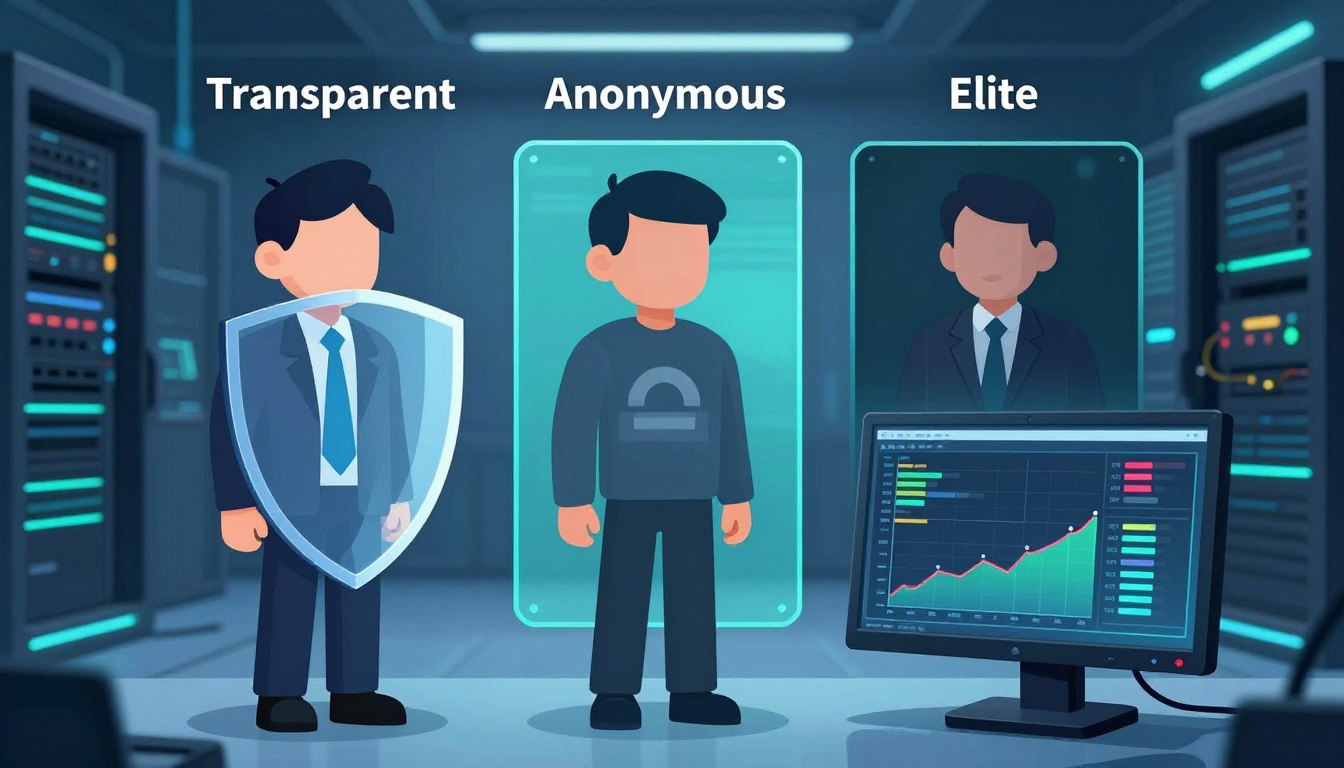
    A transparent proxy shows client headers, which can reveal your original IP or HTTP_X_FORWARDED_FOR. An anonymous proxy hides your IP but might still show it’s a proxy. An elite proxy, or high anonymity, hides your IP and removes all proxy headers.

    We’ll talk about how they work, their speed, security, and real-life uses. This includes business access, education, streaming, marketing, and web scraping. We’ll also give tips on how to choose a provider and test proxies in your own setup.

    This article is a detailed guide to help you decide. We’ll give you steps to check proxy performance, cost, and reliability. We write in the first person plural to offer you direct advice. This will help you choose between transparent and anonymous proxies or go for an elite proxy if you need top-level anonymity.

    Key Takeaways

    • Transparent proxies reveal client headers and are simple to deploy.
    • Anonymous proxies hide IPs but may disclose proxy use.
    • Elite proxy (high anonymity) provides the strongest concealment.
    • Choose based on use case: performance needs, compliance, and scraping scale.
    • Test providers and measure latency, header behavior, and reliability.

    Understanding Proxies: An Overview

    We start with a quick guide on proxy technology. Proxies act as middlemen between clients and servers. They manage traffic, follow rules, and sometimes speed up content delivery. Squid is great for caching, while NGINX and HAProxy are top picks for reverse proxying.

    What is a Proxy?

    A proxy server is like a messenger. It sends requests from a client to a server and brings back the answers. Proxies can be set up on the client side or server side for different tasks.

    They can change traffic, add headers, check who’s accessing, and store pages to save time. Squid, NGINX, and HAProxy are favorites for many users.

    How Proxies Work

    The process is straightforward: client sends a request → proxy → server → proxy → client. Proxies can change or hide the client’s IP by adding or altering headers.

    They support various ways to check who’s accessing, like Basic, Digest, and NTLM. SOCKS proxies handle TCP streams, while HTTP and HTTPS proxies work with HTTP headers. For HTTPS, they might use the CONNECT method or inspect content.

    Types of Proxies in Use

    Proxies are categorized by their function and where they come from. Transparent proxies show the client’s IP and add headers. Anonymous proxies hide the user’s IP but might still show proxy use. Elite proxies hide both the client’s IP and the fact that a proxy is being used.

    Residential proxies use real consumer IPs and are less likely to be blocked but cost more. Datacenter proxies are cheaper and faster but might get blocked more often.

    Proxy Type Typical Use IP Origin Anonymity
    Transparent Content caching, internal filtering Datacenter or corporate network Low — reveals client and headers like X-Forwarded-For
    Anonymous Privacy for casual browsing, basic masking Residential or datacenter Moderate — hides client IP but may show proxy usage
    Elite proxy High-stakes scraping, secure market targeting Residential or datacenter High — strips identifying headers and hides proxy presence
    SOCKS Protocol-agnostic tunneling, apps and games Varies Varies by implementation
    Reverse / Caching Load balancing, TLS offload, faster delivery Server-side infrastructure (NGINX, HAProxy) Not applicable — serves backend

    The Concept of Transparency in Proxies

    Transparent proxies forward client requests without hiding the original IP. They add proxy headers like HTTP_X_FORWARDED_FOR and Via. This helps networks keep a clear audit trail and makes policy enforcement easier.

    When choosing between transparent and anonymous proxies, we consider how traffic is routed. Transparent proxies are simpler to set up and cost less to run. They also offer reliable caching. This model is best for organizations that need to know the client’s true identity.

    We list ideal use cases where keeping client identity matters.

    • Enterprise caching to reduce bandwidth and speed updates.
    • Schools and universities enforcing content filters and SafeSearch.
    • ISPs and parents implementing parental controls.
    • Corporate monitoring, auditing, and internal load balancing.

    However, transparent proxies have some drawbacks. They don’t offer privacy or geo-masking. This makes them unsuitable for users who need anonymity. Sites that check proxy headers may block or flag traffic, limiting their use for scraping or bypassing location restrictions.

    Feature Transparent Proxy Anonymous Proxy
    Client IP Exposure Preserved via HTTP_X_FORWARDED_FOR and similar proxy headers Hidden from target servers
    Setup Complexity Low; easy to configure for networks Higher; requires anonymization tools
    Primary Uses Caching, filtering, monitoring Privacy, geo-masking, secure browsing
    Cost Lower due to minimal processing Higher because of added services
    Blocking Risk Higher when proxy headers are detected Lower if well-configured

    A Deep Dive into Anonymous Proxies

    We look into how anonymous proxies work and what they offer. They hide your IP from servers but might still show their presence with proxy headers. This balance offers privacy but not complete secrecy, showing the trade-offs for different needs.

    Benefits of Using Anonymous Proxies

    Anonymous proxies are great for simple privacy needs at a low cost. They hide your IP and reduce basic tracking. They’re a cost-effective choice compared to more advanced proxies, available in datacenter and residential types.

    Scenarios Where Anonymity Matters

    On public Wi-Fi, anonymous proxies keep your browsing private. They’re also good for small web scraping tasks to avoid rate limits. For market research, they help quickly switch between addresses. They’re useful for light geo-block bypasses for basic content access.

    Drawbacks and Considerations

    However, there are limits. Sites can spot proxy use by checking headers, which weakens anonymity. Datacenter IPs are easier to block. Advanced methods can still uncover your identity. Always choose HTTPS to protect against malicious proxies.

    • Masked IP reduces simple tracking and IP bans.
    • Proxy headers may reveal proxy usage to destination servers.
    • Cheaper than elite proxies but less effective against advanced detection.
    • Useful for basic bypasses when we need to bypass geo-restrictions quickly.

    Elite Proxies: The Best of the Best

    Elite proxy options are top-notch for those who need top secrecy and reliability. They are at the highest level of proxy services. This means they keep your IP hidden and don’t show signs of using a proxy.

    elite proxy

    What Sets Elite Proxies Apart?

    Elite proxies hide your identity by not sending out certain headers. They make it seem like you’re directly connected to the server. This is why residential elite proxies are less likely to get blocked, as they look like real user connections.

    When to Choose Elite Proxies

    Elite proxies are best for critical tasks that need to be very private. This includes big web scraping projects and checking ads. They’re also great for managing many accounts and getting past tough geo-blocks. They help avoid being detected, which is very important.

    Cost Implications of Elite Proxies

    Elite proxies are more expensive than other types. Residential elite addresses are pricier because they offer more variety and are less likely to get blocked. Datacenter elite proxies are also more expensive, especially if you’re using a dedicated server.

    Prices vary based on how you’re billed. You might pay per IP, by bandwidth, or for how many connections you make at once. There might be extra costs for features like rotation and API management, which make managing many proxies easier.

    Comparing Transparent and Anonymous Proxies

    We look at how transparent and anonymous proxies work differently. This helps teams choose the best tool for their needs. We’ll talk about what they do, how well they perform, and their security features.

    Key Differences in Functionality

    Transparent proxies show the client’s original IP and add headers like HTTP_X_FORWARDED_FOR. They’re good for caching, content filtering, and following company rules.

    Anonymous proxies hide the user’s IP but might show that a proxy is being used. Elite proxies hide both the original IP and any signs of a proxy for ultimate secrecy.

    Performance and Speed Comparisons

    Choosing between transparent and anonymous proxies affects speed. Transparent proxies are often faster because they work at the edge of networks and use caching. This makes repeat requests quicker.

    Anonymous proxies, especially datacenter ones, can also be fast for single requests. But elite residential proxies, which use consumer ISPs, might be slower. Still, they can be better for big tasks like scraping or automation, even if they’re slower.

    Security Features

    Transparent proxies are good for logging and preventing data loss. But they don’t keep your IP private, so they’re not great for privacy.

    Anonymous proxies hide your IP but don’t encrypt your data. Elite proxies add more secrecy but you have to trust the provider. Always use HTTPS/TLS and certificate pinning for sensitive data.

    Aspect Transparent Anonymous Elite
    IP exposure Original IP forwarded; headers like HTTP_X_FORWARDED_FOR show source Client IP hidden; proxy presence may be visible Client IP hidden; proxy use concealed
    Typical use Policy, caching, filtering Privacy, simple concealment Stealth, bypassing strict blocks
    Performance High due to caching and local placement Variable; datacenter can be fast Lower latency sometimes, but higher success rates for blocked targets
    Security Strong for logging and DLP; poor for anonymity Basic privacy; depends on TLS Best stealth; depends on provider trust

    We warn against using untrusted free proxies. They can steal or change your data, even if they seem to work. Choosing between transparent and anonymous proxies depends on what you need. It’s about finding the right balance between speed, headers, and trust in providers.

    Use Cases for Transparent Proxies

    We explore how transparent proxies help in real-world scenarios. They offer control, visibility, and efficiency. This is why many organizations prefer them for their balance of privacy and compliance.

    Businesses and Organizations

    Transparent proxies help us cache software updates, saving on bandwidth costs. They work with firewalls from Fortinet and Palo Alto. This centralizes proxy headers for logging and policy enforcement.

    They also help meet compliance audits by logging client IPs. The HTTP_X_FORWARDED_FOR header keeps client IPs in logs. This makes client configuration easy.

    Network teams use them to enforce policies, filter content, and optimize WAN traffic. These setups make managing large fleets of endpoints easier.

    Educational Institutions

    In schools and universities, we use transparent proxies to block content without installing software. This is easy for IT managers to set up, especially with different devices.

    They enforce SafeSearch, block malicious sites, and manage bandwidth during busy times. Proxy headers like HTTP_X_FORWARDED_FOR help administrators track user requests for safety reviews.

    Integrating transparent proxies with learning management systems improves access control. It keeps the student experience simple.

    Streaming Services and Content Diversion

    We set up transparent proxies at ISP and campus edges to cache streaming content. This reduces CDN costs and speeds up delivery for popular content.

    Transparent proxies can improve throughput but can’t fake the origin location. For geo-restricted content, the choice between transparent and anonymous proxies is key. Transparent proxies reveal the client IP via HTTP_X_FORWARDED_FOR and other headers.

    For optimizing delivery rather than location masking, transparent proxies are a good choice. They are practical and easy to use for networks with predictable streaming needs.

    Use Cases for Anonymous Proxies

    Anonymous proxy tools help keep our online activities private. They hide our IP addresses and block ads. The type of proxy we choose affects how fast and reliable it is.

    We’ll look at some common uses for these tools. We’ll also compare Transparent vs anonymous proxies. This way, teams can choose the best option for their needs.

    Personal Privacy and Security

    Using public Wi-Fi? An anonymous proxy keeps your device’s IP hidden. This stops simple tracking. Using HTTPS and privacy-focused browsers like Firefox or Brave adds extra protection.

    For even more privacy, Tor is a good choice. It sends your traffic through many nodes. But, it might be slower and not work with all sites. Anonymous proxies usually work better for everyday browsing.

    Bypassing Geo-Restrictions

    Anonymous proxy services help us access content blocked by region. How well it works depends on the site’s checks. Some sites look at proxy headers or IP ranges.

    Residential proxies are better for streaming and local services. But, results can vary. Testing different proxy levels helps find the best one for each platform.

    E-commerce and Market Research

    For comparing prices and monitoring competitors, we use anonymous proxies. They help us run queries without showing our company’s IP. This lowers the risk of being blocked right away.

    For big data collection projects, elite or rotating residential proxies are better. They help avoid rate limits and IP bans. Using both anonymous and rotating proxies balances cost and reliability in market research.

    The Role of Elite Proxies in Digital Marketing

    We use elite proxy solutions for big campaigns that need precision and reliability. In digital marketing, an elite proxy offers high anonymity. This reduces the risk of being blocked or getting fake responses during tests.

    This setup lets us mimic real user behavior in different markets without showing our true location.

    elite proxy

    Enhancing Web Scraping Efficiency

    Elite proxy networks help us get more successful requests for big crawls. Residential IPs are great because they avoid many proxy-detection tricks. This means fewer captchas and less chance of being banned.

    For tasks like price checking, lead gathering, and keeping an eye on competitors, we use rotating IPs from Bright Data, Oxylabs, or Smartproxy. This keeps our scraping smooth.

    We suggest matching our rotation policies to how the target site behaves. Short sessions are good for wide crawls. Sticky sessions are better for sites that need consistent client state.

    Overcoming Ad Verification Issues

    Elite proxy access is key for ad verification. It lets us see ads just like real users do. High anonymity stops ad networks from spotting our testing nodes and changing the ads.

    Residential elite proxies help avoid false negatives in ad fraud detection. They make sure our teams see the real ad experience in the target locations.

    We test ads from different IP origins to ensure they’re delivered the same way. This lowers the chance of misreporting due to proxy flags or data center IPs.

    Targeting Specific Markets

    We use localized elite proxy IPs for market-specific checks. This includes checking SEO positions, content localization, and ad targeting. City- and ISP-level residential addresses give us the real deal, unlike datacenter IPs.

    This accuracy is crucial for verifying local search engine results or checking creatives for regional differences.

    We see IP origin authenticity as very important. For campaigns that need detailed testing, the right mix of high anonymity residential endpoints is essential for reliable insights.

    Security Considerations for All Proxy Types

    We look at the security trade-offs for proxy types. A small mistake can turn a useful tool into a risk. We share practical risks and ways to protect systems without slowing them down.

    Transparent proxies pass client addresses in headers like HTTP_X_FORWARDED_FOR. This makes them easy to check but loses privacy.

    Risks with transparent proxies include IP exposure and leaks. They also pose a single point of failure. We suggest strict access controls and logging to lower risks.

    Now, let’s talk about anonymous proxy threats. Even with hidden IP, other signs can reveal identity.

    Threats to anonymous proxies include IP blocking and header leakage. Fingerprinting and man-in-the-middle attacks are also risks. Free or unknown proxies might log traffic or steal credentials if not using TLS.

    To fight these threats, we check providers and use HTTPS/TLS. We also test for header artifacts and ensure client data isn’t leaked.

    Elite proxy options offer better privacy but aren’t perfect.

    Elite proxies need encryption to protect data. They hide origins better than others, but we must still use TLS and validate certificates. For extra security, use VPNs or SSH tunnels.

    Choosing an elite proxy provider means checking their logging and data retention policies. For sensitive tasks, look for dedicated IPs and vendors with SOC 2 or ISO certifications.

    We end with controls for all proxy types. Use minimal headers, strip or rewrite HTTP_X_FORWARDED_FOR, and rotate credentials. Always monitor for unusual activity.

    Regular audits, incident plans, and checking vendors are key to a solid proxy security plan. This approach balances performance, privacy, and compliance.

    Choosing the Right Proxy for Your Needs

    We help teams pick the right proxy solutions. This depends on their technical and business goals. The choice between Transparent vs anonymous or elite proxy varies by use case, budget, and needed proxy levels.

    Factors to Consider

    First, we identify the main goals. These can be privacy, caching, web scraping, ad verification, or CDN offload. We match these goals with the right anonymity level.

    Next, we look at IP origin. Residential IPs are good for scraping and have low block rates. Datacenter IPs offer high throughput and are cheaper. We also consider latency, bandwidth, rotation, and concurrency needs.

    We check if headers are verified and if the provider is transparent about HTTP_X_FORWARDED_FOR and similar fields. It’s important to ensure compliance with privacy laws and regional data rules.

    We also evaluate technical support, API features, and SLA terms. Budget plays a big role in choosing between basic proxy levels and an elite proxy for critical tasks.

    Trusted Providers in the Market

    We look at top vendors in different categories. Bright Data and Oxylabs offer residential and datacenter routing. Smartproxy focuses on residential pools with simpler plans.

    Cloudflare and Akamai are great for reverse proxy or CDN needs. For datacenter IPs, cloud providers like AWS, Google Cloud, and Microsoft Azure offer scalable options.

    For enterprise needs, we look for vendors with compliance certifications and clear policies. It’s important to review provider documentation and third-party audits before making a decision.

    Trial Periods and Guarantees

    We suggest testing with trial accounts or small pilot projects. This helps validate performance, block rates, and geographic coverage. Real-world tests show how headers behave, rotation fidelity, and response times.

    We look for money-back guarantees, refundable trials, or pay-as-you-go plans. Pilot runs should include target sites, request rates, and concurrency patterns. This confirms if the provider meets our expectations.

    We recommend documenting results and comparing providers on the same workload. This helps us choose proxy providers that meet our technical and budgetary needs while showing value.

    Future Trends in Proxy Technology

    We’re looking at big changes in how companies use proxies. The future will bring clearer proxy sources, smarter routing, and better compliance. These updates will impact everything from basic proxy levels to large-scale deployments that need reliability and auditability.

    Innovations to Watch

    The residential proxy market will grow with a focus on ethical IP sourcing and consent. Better rotation APIs will help avoid request collisions and make large-scale scraping more reliable.

    Proxies and CDNs will work together to reduce global latency. Tools for managing fingerprints and automating browsers with Puppeteer and Playwright will become common for teams needing consistent sessions.

    The Impact of AI on Proxy Services

    AI and proxies will work together closely. Machine learning will improve rotation strategies and spot blocking patterns in real time.

    Adaptive request pacing, anomaly detection, and smarter routing will lower bans and latency. Providers will use AI to identify malicious IPs and improve geo-targeting.

    AI-driven techniques to evade detection may lead to a battle with anti-bot systems. This will shape how proxy levels and features are presented.

    Evolving User Needs and Proxy Adaptation

    Privacy and fraud prevention will require proxies that prove legal sourcing and offer detailed access controls. Companies will seek integration with SIEM tools and compliance attestations.

    There will be more demand for managed services that combine elite proxy experiences with browser isolation and identity-safe automation. Clearer guidance on Transparent vs anonymous options will be needed based on use case and risk.

    The industry must balance innovation with ethics. It’s important to ensure proxy levels match their purpose and that the future of proxies supports both scale and legitimacy.

    Conclusion: Making the Best Choice

    We’ll wrap up by highlighting key differences in proxy choices. Deciding between transparent and anonymous proxies depends on our needs. Do we want to keep client IP and headers for caching or compliance?

    Transparent proxies keep these details, while anonymous ones hide the client IP but might show proxy use. Elite proxies, the most private, hide both IP and proxy signs. When choosing, consider cost, speed, and how easy they are to detect.

    For picking a proxy, start with a checklist. First, figure out what you need and how much traffic you’ll handle. Then, pick your IP type and anonymity level. Look at providers like Bright Data, Oxylabs, or Smartproxy.

    Test them by checking headers, seeing how often they get blocked, and making sure they use TLS. Make sure the terms and compliance are right before you use them a lot.

    To get better at this, learn about standards and tools that show how proxies work in real life. Look at RFC 7239 on Forwarded headers and OWASP’s proxy security tips. Use cURL, Wireshark, and browser tools to see if headers are there.

    Keep checking how your proxies work as things change. This will help them stay strong against new traffic and detection methods.

    FAQ

    What is the difference between transparent, anonymous, and elite (high-anonymity) proxies?

    Transparent proxies keep the client IP and add headers like HTTP_X_FORWARDED_FOR. Anonymous proxies hide the client IP but might show proxy use. Elite proxies hide the client IP and don’t show proxy headers, making it seem like a direct connection.

    When should we use a transparent proxy?

    Use transparent proxies when you need to keep the client’s identity. They’re good for auditing, caching, and content filtering. They’re also used in schools, ISPs, and for internal load-balancing to help with troubleshooting.

    What are the main benefits of anonymous proxies?

    Anonymous proxies hide the IP to protect privacy and avoid tracking. They’re cheap for web scraping and market research. They come in datacenter and residential types, fitting different needs.

    Why choose elite (high-anonymity) proxies over anonymous ones?

    Elite proxies remove headers and act like native connections. They’re better for scraping, ad verification, and multi-account use. They’re stealthy and hard to detect.

    How do headers like X-Forwarded-For and HTTP_X_FORWARDED_FOR affect proxy anonymity?

    Headers like X-Forwarded-For show the client IP or proxy chain. Transparent proxies keep these headers. Elite proxies remove them to hide the client IP and proxy.

    What trade-offs exist between datacenter and residential proxies?

    Datacenter proxies are fast but easy to block. Residential proxies are harder to detect and better for geo-sensitive tasks. They’re more expensive and slower.

    How does proxy choice affect performance and blocking rates?

    Transparent proxies are fast but may block more. Datacenter proxies are quick but riskier. Residential proxies are slower but more successful. We choose based on speed and success rate.

    Are free proxies safe to use for sensitive data?

    Free proxies are risky. They can log or modify content. For sensitive data, use paid providers with HTTPS and clear logging policies.

    Which authentication and protocols should we expect from proxy providers?

    Providers often support HTTP(S) and SOCKS5 proxies. They use username/password, IP allowlisting, or APIs for authentication. For HTTPS, they use CONNECT tunneling or TLS termination.

    How do we test whether a proxy is truly elite (high-anonymity)?

    Check for missing headers with cURL or browser tools. Run real tests to see if it’s blocked or detected.

    What cost models should we anticipate for elite proxies?

    Elite proxies are pricey. They’re billed per-IP, by bandwidth, or by connections. Residential elite IPs are more expensive for their lower block rates.

    Which providers are recognized in the proxy market for residential and elite services?

    Bright Data, Oxylabs, and Smartproxy are top for residential and enterprise proxies. Cloud providers and CDNs offer datacenter solutions for various needs.

    What security practices should we follow regardless of proxy type?

    Always use HTTPS/TLS and check certificates. Choose providers with clear logging policies. For high-risk tasks, use VPNs or SSH tunnels.

    How do proxies interact with modern anti-bot and fingerprinting techniques?

    Anti-bot systems check IP, headers, and browser signals. Elite proxies reduce detection but can’t fool all systems. Use rotation and browser automation to evade detection.

    Can transparent proxies help with CDN or streaming performance?

    Yes, they cache content and reduce bandwidth. They’re good for controlled networks but can’t bypass geo-restrictions.

    What legal or compliance issues should we consider when buying proxies?

    Make sure IP sourcing is legal and compliant. Check provider terms for logging and data transfer policies. For enterprises, ask for compliance guarantees and addendums.

    How will AI and automation affect proxy selection and use?

    AI will improve rotation and detect blocks. It will also make detection and evasion more complex. Providers will need to adapt with smarter tools.

  • The Ultimate Guide to SOCKS5 Proxies: Benefits and Uses

    The Ultimate Guide to SOCKS5 Proxies: Benefits and Uses

    This guide is all about the SOCKS5 proxy and why it’s important today. A SOCKS5 proxy helps hide your IP address by sending your internet traffic through a server. It supports many types of traffic and even secure connections, making it great for those who need speed and security.

    We’ll dive into what a SOCKS5 proxy does and how it’s different from older methods. You’ll learn about its secure socket capabilities and how they boost privacy and speed. We’ll also talk about setting it up, keeping your data safe, and how it can improve your online experience.

    This guide is for IT experts, people who care about privacy, gamers, and torrent users in the United States. It’s easy to follow, with clear sections for setup, security, and performance tips. You can find what you need quickly.

    Meta title: “The Ultimate Guide to SOCKS5 Proxies: Benefits and Uses”. Meta description: Learn how SOCKS5 proxy solutions deliver improved security, versatile secure socket support, and faster proxy performance for privacy, torrenting, and gaming.

    Key Takeaways

    • SOCKS5 proxy forwards TCP and UDP traffic through an intermediary server for IP masking.
    • The socks5 protocol supports authentication and secure socket-style connections for added flexibility.
    • Users gain faster proxy performance for applications like gaming and torrenting.
    • We cover setup, security steps (including DNS leak protection), and performance tips.
    • The guide targets IT pros, privacy-conscious consumers, gamers, and torrent users in the United States.

    What is a SOCKS5 Proxy?

    We start with the basics to help you understand the importance of a SOCKS5 proxy. It’s not just for web browsing. We’ll cover how these servers work, compare different protocols, and explain how traffic flows through a proxy.

    Understanding Proxy Servers

    Proxies are servers that act as middlemen between clients and websites. They can cache content, filter it, and keep users anonymous. There are two main types: forward proxies and reverse proxies.

    HTTP and HTTPS proxies work at the application layer, handling web traffic. SOCKS proxies, on the other hand, operate at a lower layer and can handle various types of traffic. The SOCKS5 protocol is the latest version, offering more features than its predecessors.

    Differences Between SOCKS4 and SOCKS5

    We’ll look at the differences between SOCKS4 and SOCKS5. SOCKS4 only supports TCP and lacks authentication and IPv6 support. This makes it less useful for today’s applications.

    SOCKS5, however, supports UDP, has multiple authentication methods, and works with IPv6. Its ability to handle UDP makes it great for services that need fast, reliable connections.

    SOCKS5 also offers better protocol negotiation and authentication options. This makes it more flexible and suitable for a wide range of uses.

    How SOCKS5 Works

    We’ll break down how SOCKS5 works in simple steps. First, the client sets up a SOCKS5 endpoint and port in the settings.

    Then, the client connects to the SOCKS5 server and performs a handshake. If needed, it exchanges authentication credentials.

    The client sends a request, which can be for TCP, UDP, or inbound connections. The server then forwards the request to the target host and sends the response back.

    We note that TCP and UDP are treated differently. TCP is proxied as streams, while UDP uses associations for datagrams. This allows non-HTTP protocols to pass through the proxy.

    Finally, we mention that SOCKS5 doesn’t encrypt data by default. To secure data, it’s often paired with TLS, VPNs, or other secure protocols.

    Benefits of Using SOCKS5 Proxies

    We’ll explore how a SOCKS5 proxy improves our online activities. It enhances privacy, speeds up browsing, and offers flexibility. This makes it easier to choose where to use the socks5 protocol for the best results.

    Enhanced privacy and anonymity

    By routing traffic through a remote server, our IP is hidden. This means our device and location are less exposed when we’re online. It’s great for browsing, torrenting, or gaming.

    However, data might not always be encrypted. Adding TLS or end-to-end encryption is key for secure tasks.

    Improved performance

    Using SOCKS5 can make browsing faster. It has fewer layers than many VPNs, which reduces latency. This is especially true for TCP and UDP traffic.

    Proxies spread across different locations and use load balancing. This cuts down on the number of hops, boosting speed for local services.

    Versatility for different applications

    We can set up apps to use a SOCKS5 proxy individually. This gives us control over which apps use the proxy. It’s handy for specific tasks without affecting everything.

    Support for TCP and UDP makes it versatile. It works well for web browsing, email, VoIP, BitTorrent, and gaming. This makes it useful across many platforms.

    Benefit What it Means Typical Use Cases
    Enhanced privacy Masks client IP by presenting the proxy endpoint Anonymous browsing, torrenting, avoiding direct exposure
    Improved speed Less protocol overhead for TCP/UDP, regional endpoints Faster proxy access to region-locked services, gaming
    Protocol flexibility Supports TCP and UDP for broader compatibility VoIP, BitTorrent, browser-specific routing
    Application-level control Configure individual apps instead of the whole OS Selective proxying for privacy and performance testing

    Common Uses for SOCKS5 Proxies

    We explore how teams and individuals use SOCKS5 proxies. They are used for entertainment, file sharing, and competitive play. Each use has its own steps, limits, and tips for a stable connection and IP protection.

    Bypassing Geo-Restrictions

    We use a SOCKS5 proxy to make it seem like we’re in another country. This helps us access news sites, regional services, and streaming catalogs that are blocked in our area.

    Some platforms check our account details and device fingerprints. They might block us even if our IP changes. Streaming services can also detect proxy pools and limit our access. It’s best to choose providers with many servers and fresh IP ranges for better results.

    Torrenting Safely

    Many torrent users choose a torrenting proxy for its support of tcp udp packets. This reduces overhead compared to a full VPN. Clients like qBittorrent, uTorrent, and Transmission let us set up SOCKS5 for each client, isolating P2P traffic.

    SOCKS5 doesn’t encrypt by default. To avoid leaks, we should enable proxy authentication in the torrent client. Pairing the proxy with a VPN or client encryption settings helps keep our true IP hidden while maintaining high speeds.

    Gaming Enhancements

    A gaming proxy can reduce latency and hide our direct IP to protect against DDoS threats. It makes it easier to access region-locked servers by connecting through a server in the target region.

    Many games use UDP for fast updates. It’s important to have SOCKS5 setups that support tcp udp forwarding. This ensures in-game packets pass without interruption. We test server locations and protocols before choosing a provider to ensure stable, low-latency sessions.

    How to Choose the Right SOCKS5 Proxy

    Choosing a reliable SOCKS5 proxy is about finding the right mix of speed, security, and openness. We’ll look at what matters, compare free and paid options, and highlight top providers. This way, you can find a solution that meets your privacy and performance needs.

    Key Features to Look For

    Look for providers that support both TCP and UDP. Many apps and games use UDP for better performance. Also, check if they offer username/password authentication to control access and prevent abuse.

    Make sure they have clear logging and privacy policies. Providers that share retention limits and third-party audit results are more trustworthy. Having servers in different locations helps with accessing geo-restricted content.

    Check the number of connections allowed, speed and bandwidth limits, and DNS leak protection. Also, confirm that the proxy works with common tools and platforms to avoid setup issues.

    Comparing Free vs. Paid Proxies

    Free SOCKS5 proxies are okay for occasional use. They often have bandwidth limits, unpredictable speeds, and may log your data or inject ads. Some free services sell your data to make money.

    Paid proxies usually offer faster speeds and better privacy without ads. They provide clearer support, service expectations, and features like DNS leak protection and dedicated IPs.

    For torrenting or gaming, paid services are better for stable speeds and legal safety. Paid plans help maintain performance under heavy use and offer quick support when needed.

    Trusted Providers in the Market

    Look at well-known brands that clearly document SOCKS5 support and setup. NordLayer and NordVPN offer SOCKS5 proxies with easy-to-follow guides. Private Internet Access (PIA) is a favorite among power users for its SOCKS5 proxy service.

    Windscribe provides proxy features with strong privacy tools and helpful guides for gaming and Tor. Check their documentation for performance benchmarks and US-based support if you need local help.

    When comparing providers, check independent tests, uptime records, and how they handle secure sockets and socks5 protocols. These signs help find truly trusted providers.

    Setting Up a SOCKS5 Proxy

    We’ll show you how to set up a SOCKS5 proxy. We’ll also cover common mistakes and how to fix them. Follow this guide for a secure and reliable connection.

    SOCKS5 proxy

    Step-by-Step Configuration Guide

    First, get the SOCKS5 server details from your provider. Make sure you have the address, port, and login info ready.

    Open the app you want to use with the proxy. Set up proxy settings in your browser, torrent client, or gaming platform. Use extensions or built-in menus if you can.

    To route all your traffic, adjust your OS proxy settings. This works on Windows or macOS. Or, use a tool like Proxifier to force apps to use the proxy. Choose TCP for most traffic, but enable UDP if your app and provider support it.

    Check if everything works with tools like curl or netcat. A simple curl command can test the socks5 protocol and confirm routing.

    Common Mistakes to Avoid

    Typing wrong login details is a common mistake. Double-check your username, password, address, and port before testing.

    Don’t forget to turn on the proxy in your app after setting it up. Many people forget this step.

    Remember, SOCKS5 doesn’t encrypt your traffic. It just routes it. Make sure your DNS is set up right to avoid leaks.

    Be careful when using both a VPN and a proxy. Using one over the other can mess up your connection. Always keep authentication on unless you really trust the network.

    Troubleshooting Connection Issues

    First, check your server details and login info. If problems continue, check the provider’s status page for any issues.

    Make sure your firewall or antivirus isn’t blocking the connection. Try allowing the client or test from another device to find the problem.

    Look at logs for any errors during the SOCKS5 handshake. Logs can show authentication or protocol problems.

    For deeper issues, use tools like Wireshark for packet capture. If it looks like a server problem, reach out to your provider’s support team.

    Security Features of SOCKS5 Proxies

    We look into how SOCKS5 proxies protect our online traffic. We’ll cover common ways to log in, encrypt data, and avoid DNS leaks. This helps keep our browsing and app use safe.

    Authentication methods

    SOCKS5 offers several ways to log in. You can choose no authentication for easy access but it’s not secure. A better option is username/password, which is safer and logs your sessions.

    Encryption capabilities

    SOCKS5 doesn’t encrypt data itself. It just routes TCP UDP streams. To keep data safe, we use TLS/SSL or SSH tunnels. These methods add security but might slow down your internet.

    Protection against DNS leaks

    DNS leaks can reveal where you’ve been online. Some clients send DNS queries through the proxy. If not, we use secure DNS methods or choose providers that block leaks.

    Area Common Options Recommended Practice
    Authentication None; Username/Password (RFC 1929); GSS-API (Kerberos) Username/password or provider-managed keys with logging
    Encryption None native; TLS/SSL at app layer; SSH tunnels; VPN Use SSH or VPN when confidentiality is required; TLS for app-level security
    DNS Handling Client-side proxy DNS; OS resolver; DoH/DoT; Provider DNS Enable proxy DNS or DoH/DoT and verify dns leak protection
    Protocols TCP, UDP routing via SOCKS5 Confirm tcp udp flows are proxied; test with provider tools

    SOCKS5 vs. Other Proxy Types

    We compare common connection tools so readers can pick the right option for their needs. The differences affect speed, protocol support, and privacy.

    Comparing with HTTP Proxies

    HTTP proxies work at the application layer, focusing on web traffic. They handle HTTP and HTTPS, can rewrite headers, and offer caching for faster page loads.

    On the other hand, the socks5 protocol is protocol-agnostic. A SOCKS5 proxy can carry various packets, including UDP traffic. This makes it more flexible for non-web communication.

    SOCKS5 vs. VPNs

    A VPN creates a network-level tunnel that encrypts all device traffic. SOCKS5 runs at the session or application level and usually does not add encryption.

    SOCKS5 avoids tunneling overhead, making it faster for latency-sensitive tasks. A vpn protects everything on the device but may slow connections under heavy encryption. We sometimes use both for encryption and targeted routing.

    Use Cases for Each Proxy Type

    HTTP proxies are great for web-scraping, caching, and tasks focused on HTTP/HTTPS. They are efficient for repeated web requests.

    We choose SOCKS5 for torrenting, gaming, and any app needing UDP or protocol flexibility. It’s a faster proxy for these tasks.

    VPNs are best for full-device privacy, protecting sessions on public Wi‑Fi, and bypassing strict geo-blocks. They offer system-wide security that a single application proxy cannot match.

    Performance Considerations

    We look at how a SOCKS5 proxy impacts real-world speed and response time. Making small changes on both sides can make streaming, gaming, and big transfers faster.

    Bandwidth and Speed Optimization

    High-capacity backbones and servers close to you cut down on transit time. Plans without strict bandwidth caps help avoid slowdowns during busy times.

    Lightweight encryption on the client side reduces CPU use and boosts speed. Choosing TCP for reliable transfers and UDP for real-time streams is key.

    We suggest testing speed and setting up concurrent connections to match server limits. Traffic shaping policies at the provider level should favor low-latency flows for better bandwidth optimization.

    Latency Issues and Solutions

    Latency comes from extra routing hops, overloaded nodes, long distances, and inefficient ISP routing. Each adds milliseconds, affecting gaming and voice calls.

    Choosing nearby servers and using providers with load-balancing helps. Enabling UDP when possible reduces delay for interactive apps.

    Quality-of-service tools let us prioritize gaming or VoIP traffic. Regularly switching endpoints can reveal lower-latency routes.

    Real-World Performance Tests

    We run targeted tests to compare providers and locations. Speedtests to the proxy endpoint show raw throughput. Traceroute exposes routing hops and potential bottlenecks.

    We measure ping and packet loss for gaming scenarios, then benchmark file transfers over TCP and UDP. Documenting results under different servers helps us choose the fastest proxy setup.

    Test What We Measure Why It Matters Tip
    Speedtest to Endpoint Upload/download Mbps Shows available bandwidth for transfers Test at different times of day
    Traceroute Number of hops, routing path Reveals inefficient ISP routes and extra hops Compare routes between nearby servers
    Ping & Packet Loss Latency in ms, loss % Key for gaming and real-time apps Run sustained tests for accuracy
    TCP File Transfer Sustained throughput, errors Shows reliability under congestion Adjust concurrent connections
    UDP Stream Test Jitter, packet ordering, throughput Reflects performance for voice/video Enable UDP on provider when possible

    Integrating SOCKS5 Proxies with Applications

    We show you how to add a SOCKS5 proxy to common apps. This ensures your data stays safe and fast. We’ll cover setting up browsers, torrent clients, and gaming platforms.

    Using browsers

    Firefox lets you set up socks5 in its network settings. Just enter the SOCKS host and port. Also, make sure to select “Proxy DNS when using SOCKS v5” to avoid DNS leaks.

    Chrome and other Chromium browsers use system proxy settings. Or, you can install FoxyProxy to direct specific tabs through the proxy.

    Always test your browser with an IP-reveal site to see if it’s using the proxy. If you use extensions, keep them updated. This helps protect your data when using the proxy.

    Compatibility with torrent clients

    Many torrent clients support SOCKS5. qBittorrent, uTorrent/BitTorrent, Vuze, and Transmission let you choose SOCKS5 as your proxy. Make sure to set it for peer connections, DHT, and trackers.

    Remember to enable authentication if your provider needs it. Also, disable direct connections to prevent leaks. Use torrent IP-checker sites to check if your proxy is working.

    Configuring for gaming platforms

    Many games don’t have proxy settings. But, you can use Proxifier on Windows or proxychains on Linux to route game traffic. SSH dynamic forwarding can also create a local SOCKS5 endpoint.

    UDP traffic is key for fast gaming. Choose solutions that support UDP relay or SOCKS5 UDP. Always test latency before using a provider for competitive games. Also, check stability and adjust settings as needed.

    Application Type Typical Clients / Tools Key Settings Best Practice
    Web Browsing Firefox, Chrome (via system), FoxyProxy Set SOCKS5 host/port, enable proxy DNS Test with IP reveal and limit extension permissions
    Torrenting qBittorrent, uTorrent/BitTorrent, Vuze, Transmission Proxy type = SOCKS5, enable for peers/DHT/trackers, use auth Disable direct connections and verify with torrent IP checker
    Gaming Proxifier, proxychains, SSH dynamic forwarding Route game executable through SOCKS5, enable UDP relay if supported Run latency and stability tests before competitive use

    Potential Downsides of SOCKS5

    We will outline practical drawbacks to weigh when choosing a SOCKS5 proxy for daily use. The protocol can solve many routing problems, but it brings trade-offs that matter for privacy, setup, and reliability.

    SOCKS5 proxy

    Limitations in Security

    A SOCKS5 proxy does not encrypt traffic by default. This means payloads and metadata can be seen by others. Using an untrusted provider can lead to sensitive data being logged or inspected.

    To protect yourself, pair a SOCKS5 proxy with TLS, HTTPS, or a VPN for confidential traffic. This extra layer helps reduce the security risks of the protocol.

    Configuration Complexity

    Setting up proxy settings for each app can be a challenge. You need to configure each program separately and manage DNS and proxy settings carefully. Mistakes can let requests bypass the proxy.

    Setting up system-wide SOCKS5 on macOS and Windows can be tricky. Sometimes, you need third-party tools like Proxifier. Non-technical users may find it hard to use and troubleshoot.

    Reliability of Free Proxies

    Be cautious with free proxies. They often have issues like intermittent availability, slow speeds, and frequent IP blacklisting. Providers might log your data or inject ads, which can harm your privacy and experience.

    For activities like torrenting or gaming, where stability and speed are crucial, free proxies are not reliable. Paid, reputable services are better for these needs to avoid the common problems of free proxies.

    Understanding Legal Implications

    It’s important to know the legal limits when talking about SOCKS5 proxy use. Using a SOCKS5 proxy for privacy or speed is legal in most places, like the United States. But, the activity itself must follow the law.

    It’s crucial to stay away from illegal activities, even with a proxy. Actions like sharing copyrighted content without permission, hacking, or trying to avoid law enforcement are still illegal. These actions can get individuals and companies in trouble, even if they use proxies to hide their actions.

    Before using proxies, we should think about the laws in different places. Some countries, like China, Iran, and Russia, have strict rules about using proxies and VPNs. They might punish people for trying to get around local rules.

    If you work or travel abroad, it’s smart to check the local laws. Businesses need to think about these laws when choosing proxy services. This affects their policies and who they work with.

    Creating clear rules for using proxies is a good idea. Make sure everyone knows what’s allowed and why proxies are used. Companies should have rules for logging, keeping data, and handling legal requests.

    For more complex cases, getting legal advice is a good idea. Lawyers can help make sure proxy use follows laws like GDPR when dealing with personal data. This helps avoid legal problems and keeps companies in line with rules everywhere.

    Best SOCKS5 Proxy Services

    We compare top SOCKS5 proxy services for users. We look at performance, support, and pricing. This helps readers choose the right provider for their needs.

    NordVPN/NordLayer, Private Internet Access (PIA), Proxy.sh, and TorGuard are compared. Each offers SOCKS5 proxy access or similar services. We consider server network size, UDP support, and setup guides.

    NordVPN and NordLayer have large server networks and detailed guides. PIA offers SOCKS5 with strong privacy and easy setup. Proxy.sh focuses on flexible proxy plans with clear billing. TorGuard is great for torrenting and power users needing fast connections.

    Good setup guides are key. They help both beginners and experts. Providers with clear tutorials save time and reduce support calls.

    Customer support should be easy to reach. Live chat, email, and tickets help solve problems fast. Knowledge bases and videos show a provider’s commitment to support.

    Reliability is crucial. Providers with strong uptime records ensure smooth use. Good customer support adds to the reliability for all-day needs.

    Pricing plans are compared by looking at monthly vs. annual rates. We also check bandwidth, connections, and extra features. Many offer discounts for annual plans, while monthly plans are flexible for short projects.

    It’s wise to check refund policies and free trials. A short trial lets us test a proxy’s performance. Users who torrent should look for plans with plenty of bandwidth and clear terms.

    Here’s a table comparing key features of each provider. It helps us quickly see the differences.

    Provider SOCKS5 Access Key Strengths Support Channels Typical Pricing Structure
    NordVPN / NordLayer Included Extensive server network, strong docs, fast backbone Live chat, email, knowledge base Monthly & annual subscriptions, business tiers
    Private Internet Access (PIA) Included Privacy-focused, simple setup, good value Live chat, ticketing, guides Monthly & annual, family plans, add-ons
    Proxy.sh Available Flexible proxy options, pay-as-you-go choices Email, docs, ticketing Tiered plans, bandwidth-based options
    TorGuard Specialized SOCKS5 Torrent-focused, customizable locations Live chat, email, extensive guides Monthly & annual, add-ons like dedicated IPs

    Choose a plan that matches your needs, not just the cheapest. Look at bandwidth, connections, and refunds. A trial period can confirm if a service meets your speed needs.

    FAQs About SOCKS5 Proxies

    We answer the most frequent queries to help readers get practical clarity. This FAQ section covers usage, limitations, and setup tips. It aims to resolve common questions with usable steps and references.

    Common Questions and Misconceptions

    Does SOCKS5 encrypt traffic? The socks5 protocol does not provide encryption by default. It routes traffic at the application level and can pass TCP and UDP streams without altering payloads.

    Is SOCKS5 good for torrenting? Yes, SOCKS5 is popular for torrenting because it hides the client IP. We must configure the torrent client to use authentication and check that peer exchange or tracker settings do not leak the real IP.

    Can SOCKS5 prevent DDoS? Using a proxy can reduce direct exposure by masking an endpoint IP. It is not a full DDoS mitigation solution. We recommend combining proxies with dedicated DDoS protection for critical services.

    How is SOCKS5 different from a VPN? SOCKS5 is lighter-weight and operates per application. A VPN creates a system-wide encrypted tunnel. For sensitive data, pairing SOCKS5 with TLS or a VPN gives stronger protection.

    Expert Answers to User Queries

    Always enable authentication when your provider supports it. Authentication limits unauthorized use and reduces the chance of service abuse.

    Combine SOCKS5 with encryption for private transactions. We suggest TLS, SSH tunnels, or a reputable VPN when handling logins, banking, or sensitive transfers.

    Test DNS routing to prevent leaks. Use tools like curl or traceroute to confirm requests resolve through the intended proxy path. Misrouted DNS queries reveal real locations.

    Select reputed providers for transactional privacy. Brands such as NordVPN, Private Internet Access, and TorGuard maintain support resources and clear policies we can review before subscribing.

    Configuration examples are available for common clients. Firefox, qBittorrent, and Proxifier offer native or extension-based SOCKS5 support. We advise following provider guides and running quick connectivity checks after setup.

    Finding Additional Resources

    We recommend consulting official documentation for SOCKS implementations and the original RFCs for technical depth on the socks5 protocol. Provider support pages from NordVPN, Private Internet Access, and TorGuard offer setup articles and best practices.

    Use networking tools to validate setups. Wireshark helps inspect packet flows, traceroute reveals path hops, and curl verifies HTTP requests through a proxy. These diagnostics help us identify leaks and misconfigurations.

    For hands-on troubleshooting, consult client manuals for Firefox, qBittorrent, and Proxifier. Support centers at major providers contain step-by-step walkthroughs and FAQ sections that complement this SOCKS5 proxy FAQ.

    Future Trends in Proxy Services

    Proxy services are set to change fast as people want more privacy and flexible networks. Online tracking is getting worse, and new rules on data protection are coming. Remote work and a growing interest in privacy tools are also driving changes.

    Growing Demand for Online Privacy

    More people are looking for ways to limit tracking and keep their data safe. Companies, small businesses, and individuals are using proxies and VPNs to meet their needs.

    Groups like the FTC and the European GDPR are making companies more open about how they handle data. This means more focus on logging and provider policies.

    Innovations in Proxy Technologies

    We’re expecting big tech improvements to make proxies more reliable and secure. Secure transport layers and automated geo-located routing will make connections faster and more stable.

    Developers will want API-driven proxy orchestration from providers like Bright Data and Oxylabs for big automation projects. Better UDP relay performance will help real-time apps. Hybrid solutions combining socks5 protocol with TLS tunnels or lightweight VPN encryption will become popular.

    Predictions for SOCKS5 Proxies

    The socks5 protocol will stay important because it’s flexible. Users who care about security will choose SOCKS5 proxies with encryption by default.

    Big companies will pick more advanced options that include SOCKS5 proxy features and identity management from Microsoft and Okta. We also expect providers to be more transparent about their logs and offer clearer compliance options for businesses.

    Trend What It Means Expected Timeline
    Privacy-Driven Adoption Higher consumer and enterprise uptake of proxies and VPNs to counter tracking 1–3 years
    Encrypted Default Deployments SOCKS5 proxy services bundled with TLS or similar encryption by default 1–2 years
    API-Oriented Management Providers offering orchestration APIs for developers and DevOps Immediate to 2 years
    Hybrid Networking Solutions Mix of socks5 protocol routing and lightweight VPN-like tunnels for latency-sensitive apps 2–4 years
    Regulatory Scrutiny Stricter oversight of logging and data retention policies for proxy providers 1–3 years

    User Experiences with SOCKS5 Proxies

    We collected stories and feedback from teams and individuals. They shared how a SOCKS5 proxy works in everyday life. These stories highlight real setups, common challenges, and the benefits of using a SOCKS5 proxy over basic proxies or some VPNs.

    Case Studies and Testimonials

    A remote development team used a SOCKS5 proxy for secure access to internal tools. This setup kept their work smooth and protected their internal IPs. It also allowed them to route specific services securely.

    A gamer found a gaming proxy to reduce DDoS attacks during matches. Using a SOCKS5 endpoint for multiplayer sessions hid their real IP. This made matchmaking more stable in certain areas.

    A power user set up qBittorrent with a SOCKS5 proxy for P2P transfers. This acted as a torrenting proxy, controlling peer visibility. It also used client-level authentication for better control.

    Another group used NordVPN’s SOCKS5 endpoint for selective app routing. They liked that it routed only certain traffic. This kept other connections fast and low-latency.

    Common Feedback from Users

    Users say SOCKS5 proxies offer better anonymity and control. They like choosing which apps use the proxy.

    However, setting up a SOCKS5 proxy can be tricky. Many ask for clearer guides for client setup and DNS handling.

    Streaming service tests show mixed results. Some platforms work with SOCKS5, but others block access.

    When set up right, SOCKS5 proxies can be faster than some VPNs. This is because they have less overhead and selective routing without full encryption.

    Users often ask for better DNS leak protection and more detailed provider guides. These help with easier setup.

    Lessons Learned from Real Users

    Always test for IP and DNS leaks after setting up a SOCKS5 proxy. This ensures you don’t accidentally expose your IP when using a torrenting proxy or P2P tools.

    Most users suggest choosing paid providers for reliability. Paid services usually offer stable endpoints, clear documentation, and good support.

    Enable authentication when possible and use encryption with SSH tunnels. This increases safety without losing performance.

    Remember to follow legal and provider policies when using a SOCKS5 proxy. Knowing local laws and service terms helps avoid problems.

    Use Case Real Setup Main Benefit Common Caveat
    Remote development SSH dynamic forwarding to SOCKS5 endpoint Selective routing to internal tools Requires SSH knowledge and proper key management
    Gaming Routing game client via gaming proxy Reduced DDoS exposure and stable routing Possible added latency if endpoint is distant
    Torrenting qBittorrent bound to SOCKS5 as torrenting proxy Lower direct IP exposure to peers Must test for DNS/IP leaks and respect laws
    Selective app routing NordVPN SOCKS5 endpoint for specific apps Faster proxy paths for chosen services Streaming results vary by platform

    Conclusion and Final Thoughts

    We’ve explored how the socks5 protocol works and its benefits. A SOCKS5 proxy is great for certain needs. It supports both TCP and UDP, improving app performance. However, it’s not encrypted like a secure socket layer.

    Choosing trusted paid providers is key. Make sure to set up DNS and authentication right. This keeps your data safe and your identity hidden.

    When using SOCKS5 proxies, always pair them with encryption for sensitive data. For tasks like torrenting or gaming, pick reliable providers like NordVPN or TorGuard. Always enable authentication, test, and update your software.

    Remember to follow the law and document your setup. This reduces risks. For more knowledge, check out provider guides and tools like Wireshark.

    Reviewing RFCs or protocol details can also help. Test in safe environments and seek legal advice for big projects. This ensures you’re using SOCKS5 proxies safely and legally.

    FAQ

    What is a SOCKS5 proxy and how does the SOCKS5 protocol work?

    A SOCKS5 proxy is a way to hide your IP address by routing your internet traffic through a server. It works by setting up a connection, doing any needed authentication, and then sending your traffic to its destination. SOCKS5 is great for hiding your IP but doesn’t encrypt your data on its own. You might need to use something like a VPN to keep your data safe.

    How is SOCKS5 different from SOCKS4 and HTTP proxies?

    SOCKS5 is better than SOCKS4 because it supports UDP and has more ways to authenticate. It also works with IPv6 and can handle more types of traffic. Unlike HTTP proxies, SOCKS5 can handle non-web traffic, making it more versatile.

    Does SOCKS5 encrypt my traffic?

    No, SOCKS5 doesn’t encrypt your data. It just routes it. To keep your data safe, you need to use encryption or a VPN. Each option has its own trade-offs.

    Is SOCKS5 a good option for torrenting?

    Yes, SOCKS5 is good for torrenting because it supports UDP and can be set up for specific apps. It’s often faster than VPNs and can hide your IP. But, remember to use encryption and authentication to keep your data safe.

    Can SOCKS5 help with gaming latency or DDoS protection?

    SOCKS5 can help with DDoS attacks by hiding your IP. It can also make your game traffic faster by routing it through closer servers. But, the results can vary, so test it out before relying on it for big games.

    Should we choose a free or paid SOCKS5 proxy?

    For better performance and privacy, go with a paid proxy. Free ones often have bandwidth limits, are unreliable, and might even inject malware. Paid services usually offer better service and privacy.

    What features should we look for when choosing a SOCKS5 provider?

    Look for support for TCP and UDP, strong authentication, clear privacy policies, and a wide range of servers. Also, check for DNS leak protection and easy setup guides. Good customer support and transparency are key.

    How do we set up SOCKS5 for a specific application like a browser or torrent client?

    First, get your server details from your provider. Then, set up your app to use the proxy. Firefox and some torrent clients make this easy. For apps that don’t support SOCKS5, use tools like Proxifier or proxychains.

    How do we prevent DNS leaks when using SOCKS5?

    To avoid DNS leaks, make sure your app proxies DNS requests. You can also use DNS over HTTPS or choose a provider that routes DNS through the proxy. Always test your setup to ensure your DNS is being proxied.

    What are common configuration mistakes and troubleshooting steps?

    Common mistakes include wrong server details or forgetting to enable the proxy. To fix, check your credentials and server details. If problems persist, try another app or use tools like curl or Wireshark for deeper checks. Contact your provider for help.

    Is using a SOCKS5 proxy legal?

    Using a SOCKS5 proxy is legal in most places, including the US, for lawful activities. But, it’s illegal for illegal activities like copyright infringement. Always check the laws in your area.

    Can SOCKS5 prevent DDoS attacks?

    SOCKS5 can help hide your IP from DDoS attacks. But, it’s not a full DDoS protection service. For strong protection, use a DDoS mitigation service or your provider’s safeguards.

    How does SOCKS5 compare to a VPN in performance and privacy?

    SOCKS5 is faster and has less overhead than a VPN. But, VPNs encrypt all your traffic and offer stronger privacy. You might want to use both for the best performance and privacy.

    Which providers offer reliable SOCKS5 services?

    Good providers include NordVPN, Private Internet Access, Windscribe, and TorGuard. Look for a big server network, UDP support, clear policies, and good customer support.

    What performance tests should we run to evaluate a SOCKS5 proxy?

    Test the proxy’s speed, ping, and packet loss. Also, do traceroutes and file transfer tests. Try different servers to find the fastest one for your needs.

    Can enterprises use SOCKS5 securely at scale?

    Yes, with the right setup and encryption, enterprises can use SOCKS5 securely. Make sure to have strong authentication, logging policies, and access controls. Independent audits and clear contracts are important for trust.

    What are the future trends for SOCKS5 and proxy services?

    Online privacy will keep growing, leading to new proxy technologies. Expect better encryption, UDP support, and easier geo-routing. SOCKS5 will likely stay useful but will be paired with stronger privacy measures.

  • Understanding Reverse Proxies and Their Impact on Website Speed

    Understanding Reverse Proxies and Their Impact on Website Speed

    We start by explaining what reverse proxies are and why they’re important. A reverse proxy sits between users and our servers. It can show a different Proxy IP address than the real server. This helps hide our server’s IP and keeps our backend systems private.

    Reverse proxy performance is key for fast page loading and reliable service. With the right setup, proxies can cache and distribute loads, making pages load faster. But, a bad setup can slow things down and hurt user experience.

    There are more benefits than just speed. Reverse proxies can change what analytics tools see. They can hide the origin IP, affecting logs and who gets credit. They can also change what client IPs look like unless we pass X-Forwarded-For headers right.

    We base our overview on networking texts and RFCs, studies from Cloudflare, Akamai, and Fastly, and tech guides from Nginx and HAProxy. These sources show how edge caching and tuning can boost performance. But, they also warn about the dangers of misconfigurations that can slow things down.

    In this detailed guide, we’ll explore what reverse proxies do, how they speed up content delivery, and how to set them up. We’ll also cover monitoring, security, CDN integration, and real-world examples. Our aim is to help you boost your site’s speed while keeping privacy and digital footprint in check.

    Key Takeaways

    • Reverse proxies can present a different Proxy IP address and mask ip for backend servers.
    • They often improve page load times through caching and load balancing but can add latency if misconfigured.
    • Reverse proxies influence online anonymity and the visible digital footprint for both users and operators.
    • Performance gains are documented by Cloudflare, Akamai, and Fastly; implementation details matter.
    • Nginx and HAProxy docs are essential references for correct header handling and traffic paths.

    What is a Reverse Proxy?

    A reverse proxy is a server that sits between clients and backend servers. It forwards client requests to the backend and returns responses. This way, it hides the details of the origin server.

    Reverse proxies are different from forward proxies. Forward proxies help clients by hiding their IP addresses. Reverse proxies, on the other hand, serve origin servers. They present a single Proxy IP address to the world, enhancing online anonymity for the infrastructure.

    Definition of Reverse Proxy

    A reverse proxy accepts incoming traffic and decides which backend server will handle each request. It can hide the IP details of origin hosts. This makes it easier to manage traffic and balance loads.

    Tools like Nginx and HAProxy are popular for reverse proxy tasks. They help manage services like AWS Elastic Load Balancing.

    How Reverse Proxies Function

    When a client sends a request, DNS directs it to the reverse proxy IP. This IP becomes the public endpoint.

    The reverse proxy then applies rules and features. It might cache content, compress responses, or perform SSL termination. It forwards the request to the backend only when necessary.

    Backend servers send responses back through the proxy. The proxy manipulates headers to hide the backend’s real address. This protects the infrastructure and masks IP addresses.

    We handle both Layer 7 and Layer 4 scenarios. HTTP(S) proxying operates at Layer 7, offering detailed routing and caching. TCP/UDP proxying works at Layer 4, providing fast pass-through for non-HTTP services.

    Common mechanisms include health checks and sticky sessions. These features help manage services internally without changing the public Proxy IP address.

    Function Purpose Example Tools
    Caching Reduce backend load and speed responses Nginx, Varnish
    SSL Termination Offload TLS processing from origin servers HAProxy, AWS ELB
    Load Balancing Distribute requests and enable sticky sessions HAProxy, Google Cloud Load Balancing
    Header Management Preserve client identity or mask origin for online anonymity Nginx, Apache
    Protocol Proxying Support HTTP(S), TCP, and UDP traffic HAProxy, Envoy

    Benefits of Using a Reverse Proxy

    Reverse proxies protect servers, balance load, and speed up delivery. They improve reliability and user experience. They also offer features like mask ip and online anonymity for selected flows. An image below highlights core advantages.

    Reverse proxies act as an application gateway. They hide origin addresses and reduce exposed attack surfaces. By using a reverse proxy, we can keep the origin server’s Proxy IP address private and enforce IP allow/deny lists. This setup makes direct attacks harder and supports SSL/TLS offloading so certificate management is centralized.

    Enhanced Security Features

    We integrate Web Application Firewall (WAF) rules from providers like Cloudflare and Akamai to block common threats. Combining WAF with rate limiting and IP reputation checks strengthens defenses. Services such as AWS Shield can add DDoS mitigation while the proxy keeps the origin Proxy IP address out of public DNS records.

    Masking origin addresses lets us mask ip details in logs and public endpoints. This improves online anonymity for administrative interfaces. When we configure strict access controls, the system removes a direct path to backend servers and reduces lateral attack vectors.

    Load Balancing Capabilities

    Reverse proxies distribute traffic across backend pools using algorithms like round-robin, least connections, and IP-hash. This prevents overload on any single server and helps us scale horizontally. Health checks detect unhealthy nodes and remove them from rotation automatically.

    Session persistence options, or sticky sessions, let us preserve user sessions when required. We can also change location for specific requests through geo-routing. This sends users to the nearest healthy node for lower latency. That approach supports geo-spoofing benefits when testing regional content delivery.

    Improved Site Speed and Performance

    Caching at the edge reduces repeated backend calls and lowers Time to First Byte. Benchmarks from Fastly and Cloudflare show significant TTFB improvements when caching and HTTP/2 multiplexing are active. We terminate SSL at the edge to cut backend CPU load, and we enable gzip or Brotli compression for smaller payloads.

    Persistent keep-alive connections and connection pooling reduce handshake overhead. This speeds up subsequent requests. When we change location routing or apply geo-aware caches, users see faster page loads and fewer round trips to distant servers.

    Benefit How It Helps Example Providers
    Security Hides origin Proxy IP address; WAF, rate limits, DDoS mitigation Cloudflare, Akamai, AWS Shield
    Traffic Distribution Algorithms and health checks prevent overload; supports sticky sessions NGINX, HAProxy, AWS Elastic Load Balancing
    Performance Edge caching, SSL offload, Brotli/gzip compression, HTTP/2 Fastly, Cloudflare, Varnish
    Privacy & Testing Mask ip and enable online anonymity for admin flows; change location for regional testing Residential proxies, CDN geo-routing
    Operational Efficiency Centralized cert management; reduced backend load and maintenance HashiCorp, Certbot automation, commercial CDNs

    How Reverse Proxies Improve Website Speed

    Reverse proxies boost website speed in two main ways: smart caching and efficient compression. These methods cut down on data sent and requests to the origin server. This makes websites load faster for visitors.

    They also help hide the IP address of users, which is good for privacy. This is especially useful in certain situations.

    Caching Mechanisms Explained

    We use caching for static content like images, CSS, and JavaScript. This cuts down on bandwidth and reduces the number of times the origin server is accessed.

    Dynamic caching with stale-while-revalidate returns fresh pages while checking for updates. Microcaching is used for dynamic pages with high request rates. It keeps content fresh without causing delays.

    We set up cache-control headers and use ETag and Last-Modified negotiation. This ensures that assets are updated correctly. Vary headers help with content negotiation for different user agents and cookies.

    We use surrogate keys for targeted cache purges. We also tie cache invalidation to CI/CD workflows. Adding CDN edge caching on top of reverse proxies further reduces latency when users change location.

    Compression Techniques

    We prioritize Brotli for modern browsers and use gzip for older browsers. Server-side negotiation chooses the best compression algorithm based on the browser’s header.

    We compress text-based assets like HTML, CSS, JS, and JSON to reduce payload sizes. We avoid compressing already-compressed formats like JPEG and MP4 to save CPU cycles.

    We balance CPU usage and bandwidth savings. We only compress when it’s beneficial. This reduces server load and speeds up delivery.

    We measure success by looking at payload size, origin hits, and TTFB. When reverse proxies serve cached and compressed content, users see faster page loads. Origin systems also scale better.

    Optimization Primary Effect Key Config Items
    Static Caching Reduces origin requests for images and assets Cache-Control, TTL, CDN edge, surrogate keys
    Dynamic & Microcaching Speeds frequently requested dynamic endpoints stale-while-revalidate, short TTL, cache invalidation hooks
    ETag / Last-Modified Minimizes transferred bytes via validation Proper header generation, conditional GET handling
    Brotli / gzip Compression Reduces payload size for text assets Accept-Encoding negotiation, compression thresholds, exceptions for images
    Edge CDN + Reverse Proxy Lower latency when users change location Geo-routing, cache fill, origin shielding
    Privacy Controls Less direct origin exposure and masked client details Proxy IP address handling, header management to mask ip

    Key Components of a Reverse Proxy

    We explain the key parts needed for a reverse proxy. We talk about physical boxes for on-site setups and software for handling requests, caching, and security. These choices affect the Proxy IP address and how well you can hide the origin server’s details.

    Hardware Needs

    When choosing hardware, we consider the number of connections and SSL transactions. CPU cores are crucial for handling SSL and compression at large scales. More cores help speed up TLS and lower latency.

    Memory is important for storing connection tables and cache objects. We suggest enough RAM to keep cache hit ratios above 70 percent. Fast cache storage for static assets is provided by solid-state drives.

    Network speed and redundant NICs prevent slowdowns and single failure points. For reliability, go for dual power supplies and RAID storage. F5, HAProxy, and NGINX offer guidance on connections and SSL handshakes.

    Software Options

    We look at popular reverse proxy software and commercial solutions. Nginx is great for large deployments needing caching and easy setup. HAProxy excels in load balancing and raw TCP performance.

    Apache Traffic Server is best for caching at the edge. Envoy offers modern L7 features and works well with service meshes. Commercial options from F5 and Citrix provide advanced security, telemetry, and support.

    • Feature fit: choose Nginx for simple caching, HAProxy for high throughput, Envoy for microservices.
    • Licensing and ecosystem: open-source projects fit custom stacks; F5/Citrix are for regulated businesses.
    • Hybrid patterns: mix reverse proxy software with CDNs and cloud load balancers to spread out load and hide origin servers.

    Software choices impact the Proxy IP address you show to the public. Proper setup helps hide the backend server’s IP and keeps online anonymity for sensitive systems.

    Common Use Cases for Reverse Proxies

    We explore how reverse proxies benefit web platforms in real-world scenarios. They enhance performance, flexibility, and security across various hosting options. This includes shared hosting, VPS, dedicated servers, and hybrid cloud setups.

    Reverse proxies are great for handling SSL offload and caching static assets. They also route traffic to backends like Node.js, Apache, or Nginx. In shared hosting, they help isolate noisy tenants while keeping a consistent Proxy IP address for clients.

    Reverse proxies enable blue/green deployments and A/B testing. They allow us to steer traffic to new application pools without changing DNS. This makes rollbacks easier and reduces downtime during releases.

    API gateways and microservices rely on reverse proxies for routing and authentication. They mask IP details from upstream services, improving security. Only the proxy endpoint is exposed, not internal addresses.

    In cloud services, offerings like AWS Application Load Balancer and Google Cloud Load Balancing act as reverse proxies. They connect origin groups and autoscaling backend pools. They also provide native WAF and DDoS protection.

    Hybrid deployments use a reverse proxy on-premises and a CDN for public traffic. This keeps internal servers hidden. It also allows for geo-specific routing or compliance needs.

    Edge caching improves media delivery by reducing origin load and enhancing user experience. We configure caching rules at the reverse proxy. This serves large files from edge nodes, minimizing hits to application servers and reducing bandwidth costs.

    Use Case Typical Environment Key Benefits Relevant Feature
    SSL Offload Shared hosting, VPS, Dedicated Reduced CPU on app servers, simplified cert management hosting reverse proxy
    Blue/Green Deployments Cloud and on-premises Smoother releases, instant rollback Proxy IP address routing
    API Gateway Microservices Centralized auth, rate limiting, observability mask ip for backends
    Edge Caching Media delivery, CDN fronted Lower origin bandwidth, faster load times cloud reverse proxy
    Hybrid Cloud Routing On-prem + Public Cloud Compliance, latency optimization, flexible failover change location for routing

    Comparison: Reverse Proxy vs. Forward Proxy

    We compare forward and reverse proxies to show their different roles on the web. This helps users and site owners pick the best option for their needs.

    A forward proxy acts as a middleman for users, hiding their IP address. It helps with online privacy and lets users access content from other locations. It changes the Proxy IP address seen by servers.

    A reverse proxy sits in front of servers, hiding their IP addresses. It balances traffic, caches content, and boosts security. It’s managed by service owners to protect and speed up their servers.

    Definitions

    Forward proxies, like SOCKS or HTTP proxies, work for clients. They filter traffic, hide IP addresses, and offer privacy.

    Reverse proxies, such as Nginx or HAProxy, direct incoming requests to the right servers. They help hide server IPs and improve reliability.

    Key Differences

    Forward proxies send client requests outward, changing the Proxy IP address. Reverse proxies accept incoming connections and send them to internal servers.

    Forward proxies are used for privacy and to access content from different locations. Reverse proxies are used for load balancing, caching, and security.

    Forward proxies change request headers for privacy and log client-side activities. Reverse proxies add headers to help identify sessions and enforce policies.

    Forward proxies might ask for user credentials. Reverse proxies check identity systems to control access.

    Aspect Forward Proxy Reverse Proxy
    Primary role Client-side privacy and filtering Server-side load distribution and protection
    Typical user End users seeking online anonymity Site operators and DevOps teams
    Effect on Proxy IP address Changes client-visible IP for destinations Masks origin server IPs from clients
    Common features Mask ip, geo-spoofing, content filtering Load balancing, caching, SSL termination
    Header modification Often rewrites headers to protect clients May add X-Forwarded-For and routing headers
    Logging focus Tracks client requests for audits Tracks inbound traffic and backend responses
    Best suited when We need online anonymity or geo-spoofing We need scalability, security, and performance

    Popular Reverse Proxy Tools

    We look at three top reverse proxy tools that are key in web delivery today. Each tool has its own strengths for caching, load balancing, and handling Proxy IP address headers. They support mask ip practices and help keep online anonymity when set up right.

    Nginx is a flexible choice for both small and big sites. It uses proxy_pass, proxy_cache, and compression like gzip or Brotli. Nginx is known for its event-driven architecture, easy SSL termination, and support for HTTP/2 and modular extensions.

    It keeps client Proxy IP address info using X-Forwarded-For or the PROXY protocol. This helps backends log correctly without showing raw mask ip details.

    Nginx

    Nginx is great for fast static content and as a starting point for complex setups. Its config focuses on proxy_pass to upstreams and proxy_cache zones for repeated content.

    It’s used for WordPress speed boosts to big sites needing detailed module extensions. Nginx works well with CDNs and makes managing online anonymity easier with header controls and access rules.

    Apache Traffic Server

    Apache Traffic Server is a powerful caching proxy with a focus on HTTP caching and TTL tuning. It’s known for its high throughput and plugin-driven policy control. It’s perfect for sites needing CDN-like caching.

    It preserves Proxy IP address info via header mapping and supports mask ip strategies for anonymizing origin logs. Its plugin system is great for complex caching rules and high throughput needs.

    HAProxy

    HAProxy is a high-performance L4/L7 load balancer and reverse proxy. It offers advanced health checks, stick-tables for session affinity, and strong observability for traffic patterns.

    HAProxy setups use explicit frontend/backend blocks and flexible routing rules. It supports PROXY protocol and X-Forwarded-For headers to pass client Proxy IP address data upstream. It’s a top choice for teams needing strict control over mask ip handling and traceability.

    Tool Strengths Typical Use Proxy IP Handling Complexity
    Nginx Event-driven, HTTP/2, caching modules Web acceleration, SSL termination, reverse proxy Supports X-Forwarded-For and PROXY protocol; can mask ip via header rules Low to moderate
    Apache Traffic Server High-scale caching, TTL policies, plugin system CDN-like caching, large HTTP caches, origin offload Maps headers for Proxy IP address; plugins enable anonymization Moderate to high
    HAProxy High-performance L4/L7 routing, health checks, observability Enterprise load balancing, session affinity, high availability First-class PROXY protocol and X-Forwarded-For support; useful for mask ip strategies Moderate

    Configuring a Reverse Proxy

    We offer a detailed guide on setting up a reverse proxy. This guide covers installation, routing, and security steps. It helps us test in a staging environment before going live.

    Basic Configuration Steps

    1. First, install proxy software. Pick Nginx or HAProxy and follow the installation guide for your operating system.

    2. Next, define your backend servers. List the IP addresses and ports of each application node. This lets the proxy know where to send traffic.

    3. Then, set up proxy rules and routing. Use location blocks or ACLs to map requests to the right backend. Also, set cache directives for static assets.

    4. Enable SSL/TLS and certificates. Use tools like certbot for Let’s Encrypt or an ACME client for certificate renewals.

    5. Set headers. Forward X-Forwarded-For and X-Real-IP headers. This way, the origin servers can see the client’s Proxy IP address.

    6. Configure health checks. Set up active or passive checks. This marks unhealthy backends and prevents failed requests.

    7. Finally, restart services and test. Do staged restarts, check routes, and use a staging environment. This lets us observe behavior before going live.

    Best Practices for Setup

    We start with secure defaults. Run with least privilege, enable only needed modules, and mask IP addresses. This reduces exposure of origin addresses.

    Automate certificate management. Use Let’s Encrypt or an enterprise ACME client for seamless renewals.

    Log and monitor continuously. Capture logs for requests, errors, and health checks. This helps detect anomalies early.

    Forward headers correctly and configure trust-proxy settings in your app. Proper header handling prevents leaking origin IPs through direct-access DNS records.

    Apply rate limiting and connection timeouts. These controls reduce the impact of abusive clients and maintain backend stability.

    Plan for environment specifics. In cloud deployments, use provider load balancers and private subnets. On-premises setups need stricter network ACLs and physical segregation.

    Use graceful restarts and scripted deployments. Test rollbacks in staging. This ensures we can change location or failover without downtime under load.

    We follow setup best practices and document each step. This ensures a reliable reverse proxy configuration that scales, logs cleanly, and avoids accidental exposure of origin systems.

    Reverse Proxy Performance Metrics

    We track key signs to see how well a reverse proxy works. These signs help us decide when to grow, adjust cache settings, and keep the origin hidden. This ensures online privacy.

    Monitoring Traffic and Load

    We watch for requests per second, how many connections at once, and cache hits. We also check bandwidth, CPU, memory, SSL activity, and how fast responses are. These show us where the proxy is stressed or can grow.

    We use tools like Prometheus, Grafana, and Datadog to gather data. We also look at logs and dashboards to see how the proxy is doing right now.

    Analyzing Server Responses

    We look at how fast the first byte comes, the types of server responses, and how long it takes to get data from the backend. We also check for errors and slow spots. This helps us understand how users experience the proxy.

    By checking cache hits and misses, we see how well it works. A good reverse proxy keeps the origin’s IP hidden. This protects it and keeps users’ data safe.

    Metric What It Shows Typical Tools
    Requests per second (RPS) Traffic volume and burst patterns Prometheus, Grafana, Datadog
    Concurrent connections Concurrency limits and queuing HAProxy stats, nginx_status, New Relic
    Cache hit ratio Cache efficiency and origin load reduction Prometheus exporters, access logs
    TTFB and latency percentiles User-perceived responsiveness OpenTelemetry, Grafana, Datadog
    Response code distribution Error trends and successful delivery rates Access logs, New Relic, Splunk
    CPU / Memory / Bandwidth Resource saturation and scaling triggers Prometheus node exporters, cloud monitoring
    SSL transactions per second TLS CPU load and termination capacity HAProxy stats, nginx_status, Datadog

    We set alerts for important metrics and do regular checks. This helps us catch problems, improve cache settings, and keep the proxy safe. It also helps us balance cost and reliability.

    Security Considerations

    We focus on keeping traffic safe and fast when we use a reverse proxy. It’s all about handling TLS, shaping traffic, and strict rules. These steps help keep our origin IP safe and protect user and service anonymity.

    SSL termination

    SSL Termination

    We often stop TLS at the reverse proxy to save our servers’ CPU. This way, we can manage certificates better and speed up responses. It also keeps our servers’ workloads light.

    Choosing between edge-only TLS and end-to-end TLS depends on our needs. Edge-only TLS stops at the proxy, while end-to-end encrypts all the way to the backend. We use end-to-end TLS for full encryption when needed.

    We follow best practices for managing keys. We store them in secure modules or services like AWS Certificate Manager. We also rotate keys regularly and automate renewals with Let’s Encrypt or managed CA services. This keeps our SSL termination reliable.

    DDoS Protection

    We use multiple layers to fight off DDoS attacks. Rate limiting, connection limiting, and SYN cookies slow down bad traffic. This lets good traffic through.

    We team up with scrubbing and edge providers like Cloudflare and Akamai Kona Site Defender for big DDoS fights. Putting our proxy behind a CDN helps handle traffic spikes and filters globally.

    We also hide our real server addresses to protect them from attacks. Exposed DNS A records can give away our backend. So, we check DNS, use CDN proxy IP addresses, and limit access with firewalls.

    Additional Hardening

    We use web application firewalls and request validation to block threats. This includes SQL injection, XSS, and more. We also sanitize headers to prevent attacks that can change routing or leak data.

    We secure logs by hiding sensitive info, controlling access, and encrypting them. Good logging and monitoring help us spot issues and act fast. This includes triggering DDoS mitigation or incident response.

    We get advice from Cloudflare, Akamai, and AWS Shield for our defense plans. They help us improve our DDoS fight and protect our origin IP without losing performance or anonymity.

    Troubleshooting Common Issues

    We start with a quick checklist for fixing reverse proxy problems. It helps us find and fix issues fast. We focus on network and setup problems that usually cause trouble.

    Connectivity Problems

    First, we check if DNS can find the Proxy IP address. We make sure A/AAAA records are correct and that changes have spread out.

    Then, we use curl to test direct connections to the proxy and the backend. A simple curl -v shows us TLS handshake problems and HTTP codes that point to routing or listener issues.

    We also look at firewall and security group rules on cloud services like AWS and Azure. Blocked ports, wrong mask ip ranges, or missing rules can cause connection problems.

    For deeper analysis, we use tcpdump to capture packets. This shows us SYN/ACK flows, retransmissions, and if the proxy sends traffic to the backend.

    Configuration Errors

    We check if upstream definitions are correct. Wrong addresses can cause 502 and 504 errors when backends can’t be reached.

    We also check proxy header settings to keep client IPs. Wrong X-Forwarded-For or proxy_protocol options make logging and access controls unreliable.

    Finally, we check SSL certificate chains with openssl s_client. We make sure certificates match hostnames. Wrong certs cause TLS failures and client-side errors.

    We also look at caching rules to avoid old content. Timeouts and wrong cache keys can lead to inconsistent responses.

    Practical Diagnostics

    • Run nginx -t or similar CLI checks to find parsing errors before reloads.
    • Enable verbose logs to trace request flows and spot header changes.
    • Use staging environments for config checks and keep a rollback plan.
    • Check system logs and vendor docs for known issues and fixes.

    We follow a specific order: check DNS and Proxy IP, test connections with curl and openssl, capture packets if needed, and then look at logs. This helps us find and fix problems faster.

    Issue Likely Cause Diagnostic Tool Immediate Remediation
    DNS not resolving Incorrect A/AAAA record pointing away from proxy dig, nslookup, traceroute Update DNS to correct Proxy IP address, lower TTL during changes
    TLS handshake failure Expired or mismatched certificate openssl s_client, curl -v Replace certs, ensure full chain and correct CN/SAN entries
    502/504 errors Backend unreachable or timeout curl, tcpdump, nginx -t Verify upstream addresses, increase timeouts, restart backend if needed
    Lost client IPs Missing X-Forwarded-For or proxy_protocol Access logs, curl with custom headers Enable proper proxy headers and configure backend to read them
    Intermittent drops Firewall rules or mask ip misconfigurations tcpdump, cloud firewall audit Adjust security group masks and open required ports only

    Future of Reverse Proxies in Web Development

    Reverse proxies are changing how we deliver web content. Edge computing is moving logic closer to users. This shift affects how Proxy IP addresses appear and how services mask IP for local content.

    Cloudflare and Fastly are adding new features to their platforms. This will help operators fine-tune routing and meet compliance needs.

    Trends to Watch

    Edge computing is growing, with edge proxies handling tasks at the network edge. This reduces latency and makes content more localized.

    Serverless architectures will work with reverse proxies to handle requests. This makes it easier to hide IP details while keeping security and observability intact.

    Privacy and data locality will lead to more geo-aware routing. Teams will manage Proxy IP addresses to meet privacy rules and user needs.

    Evolving Technologies

    Service mesh projects like Envoy are merging with reverse proxy features. We expect deeper integration to offer consistent policy and telemetry across clusters.

    HTTP/3 and QUIC adoption will change proxy implementations. Faster connections and improved multiplexing will alter caching and routing patterns.

    Programmability will grow through WASM extensions and Lua scripting in Nginx. These tools will let us customize proxy behavior and routing without big platform changes.

    Observability will improve with OpenTelemetry and richer tracing. Better tools will help teams monitor proxy impact on latency and regional delivery, enhancing user experience.

    • Edge caching plus distributed caching strategies reduce origin load and speed responses.
    • Service mesh controls can enforce routing rules while preserving the ability to present a unified Proxy IP address.
    • Programmable proxies let us change location behavior dynamically for A/B testing and compliance.

    Reverse Proxy and CDN Integration

    We look at how combining a reverse proxy with a content delivery network (CDN) boosts delivery. It also cuts down on the load on origin servers and adds extra security at the edge. By setting it up right, CDNs can show their proxy IP address to users, hiding the origin details. This setup is great for testing from different locations and supports controlled geo-spoofing.

    Benefits of Combining Strategies

    Edge caching makes pages load faster by storing assets near users. This means fewer requests to the origin and lower costs for providers like Cloudflare and Fastly. Together, they make sites more reliable during busy times and better defend against DDoS attacks by blocking malicious traffic.

    Using a CDN also keeps server addresses private by showing a proxy IP to users. This helps protect server details. Geo-spoofing lets us show content as if it’s from a different place without moving our main servers. With POPs all over the world, we get consistent performance everywhere.

    Implementation Steps

    To integrate a CDN with a reverse proxy, we follow a detailed checklist. First, we set up the CDN to pull from the reverse proxy, keeping it the main source. Then, we make sure cache-control headers match our caching strategy and that the CDN respects them for caching.

    We also set the right origin headers so the CDN gets the right content and can authenticate when needed. To keep the origin safe, we limit direct access with IP allowlists, origin secrets, or cloud provider protections. This stops the actual server IP from being accidentally exposed.

    We make sure cache changes are synced across networks with purge and invalidation workflows. We test cache behavior from different places and check that direct DNS or A-records don’t show the origin IP. We also test geo-spoofing from specific POPs.

    We use Cloudflare, Akamai, and Fastly’s guides for best practices in origin protection and CDN setup. By following these steps, we keep performance high while keeping the origin IP hidden behind proxy IPs.

    Case Studies of Successful Reverse Proxy Implementations

    We share two reverse proxy success stories. They show how speed, cost, and reliability can improve. Each story highlights real-world examples and the benefits they brought.

    E-commerce Example

    Merchants on Shopify Plus and big retailers used Nginx or HAProxy with CDNs like Fastly or Cloudflare. They set up reverse proxies to speed up websites, improve image caching, and handle busy sales times.

    These efforts cut server costs, sped up checkouts, and made sites more reliable. They used smart cache rules, protected origins, and had failover plans. IP masking helped keep backend clusters private while keeping a consistent Proxy IP address at the edge.

    Media Streaming Example

    Streaming services used edge caches and reverse proxies for HLS/DASH segments. They ended TLS at POPs, cached playlist files, and used adaptive bitrate to save bandwidth.

    They combined caching with CDN edge logic to speed up starts and reduce buffering. Teams watched cache hits, origin egress, and latency. A stable Proxy IP address at the edge made geo-routing and audits easier, while mask ip strategies protected origins.

    Both cases show the importance of smart caching, monitoring, origin protection, and failover testing. They suggest clear caching rules, regular audits of mask ip policies, and studying Cloudflare, Fastly, and Akamai for better practices.

    Area Challenge Reverse Proxy Role Measured Benefit
    E-commerce Traffic spikes during sales Nginx + CDN for caching images and load balancing Reduced TTFB by 30–60%, lower server costs, faster checkout
    Media Streaming High origin egress and slow startup Edge reverse proxy with microcaching of manifests and segments Improved startup time by 20–40%, cut origin bandwidth
    Security & Ops Protecting origin and maintaining privacy Mask ip policies, Proxy IP address controls, TLS termination at edge Stronger origin protection, simplified auditing, maintained online anonymity

    Conclusion: Leveraging Reverse Proxies for Optimal Performance

    We conclude by summarizing the key points and offering practical advice. Reverse proxies greatly improve speed, scale, and security when set up right. They manage traffic, cut down on delays, and safeguard servers without making things too complicated.

    reverse proxy benefits

    Summary of Benefits

    Caching and compression are big wins, making pages load faster and saving on bandwidth. Load balancing helps servers handle more traffic smoothly. Offloading SSL and using a proxy to hide IP addresses also boost security.

    Managing Proxy IP addresses and headers is crucial for privacy and location-based content delivery. Correct header management lets us serve content from different locations while keeping the backend hidden. This enhances online privacy.

    Final Thoughts on Implementation

    Begin with a small test to see how it works. Check cache rules, compression, and header handling before scaling up. Keep an eye on performance and adjust as needed.

    Use reverse proxies with CDNs for global reach and strict origin protection to hide backend IPs. Stay updated with software patches and log audits to avoid exposing servers. Combine proxies with secure DNS, minimal logging, and strong access controls to reduce our digital footprint while meeting performance goals.

    Focus Area Practical Step Expected Result
    Performance Enable caching and Brotli/Gzip compression Lower latency, smaller payloads, faster page loads
    Scalability Configure load balancing with health checks Smoother handling of traffic spikes, higher uptime
    Security Terminate SSL at the proxy and block malicious patterns Reduced server exposure, improved threat mitigation
    Privacy Manage Proxy IP address and strip sensitive headers Enhanced online anonymity and protected origin IPs
    Deployment Start small, monitor logs, iterate configurations Fewer errors, clear rollback path, predictable scaling
    Geo Delivery Use header routing to change location per request Localized content delivery and better user experience

    Resource References and Further Reading

    To learn more about reverse proxies, start with key texts. “HTTP: The Definitive Guide” by O’Reilly and “High Performance Browser Networking” by Ilya Grigorik are great. They cover the basics of protocols and how clients interact with proxies.

    For hands-on learning, check out official guides and tutorials. Nginx, HAProxy, and Apache Traffic Server have useful guides. Envoy, Cloudflare, and Fastly also offer valuable resources. Cloud providers like AWS, Google Cloud, and Microsoft Azure have guides on load balancing and proxy services.

    Don’t forget about practical tools and standards. Learn about Let’s Encrypt and ACME client guides for SSL. Tutorials on Prometheus + Grafana are great for monitoring. Also, check out RFCs for HTTP and proxy behavior.

    Engineering blogs from big platforms are also worth reading. They share real-world examples on caching, geo-spoofing, and more. These help you understand how to keep your online presence anonymous.

    Here’s a suggested learning path: start with the recommended books, then follow tutorials to set up a small lab. Try out caching and compression. Next, integrate a CDN and do a staged production rollout. For more, mix RFCs, vendor guides, and engineering blogs for a solid reference.

    FAQ

    What is a reverse proxy and how does it differ from a forward proxy?

    A reverse proxy sits between clients and servers, hiding server details. It forwards client requests to servers and returns responses. Unlike forward proxies, reverse proxies focus on load balancing and protecting servers.

    How does a reverse proxy affect website speed and performance?

    Reverse proxies can speed up websites by caching content and compressing responses. They also reduce CPU load by terminating SSL/TLS. However, misconfigurations can slow things down, so it’s important to monitor performance.

    Can a reverse proxy mask our origin server’s IP address (mask IP)?

    Yes, a reverse proxy can hide server IPs by showing only its own IP. To keep this protection, avoid exposing server IPs and restrict access to proxy or CDN IP ranges.

    What headers should we configure to preserve client IP visibility (X-Forwarded-For and related headers)?

    Use headers like X-Forwarded-For to show the client’s IP to servers. Make sure to trust only known proxy IP ranges to prevent spoofing. Consider using the PROXY protocol for reliable client IP forwarding.

    How do caching strategies on a reverse proxy differ for static vs. dynamic content?

    Cache static content like images and CSS for a long time. For dynamic content, use microcaching or surrogate keys for targeted invalidation. Use cache-control headers to guide caching behavior.

    Which reverse proxy software options should we consider for different use cases?

    Nginx is great for reverse proxying, caching, and SSL termination. HAProxy is good for load balancing and observability. Apache Traffic Server is best for large-scale caching. Envoy is modern and programmable. Choose based on your needs and scale.

    What hardware resources matter when running an on-prem reverse proxy?

    CPU, memory, network throughput, and fast storage are key. Size your setup based on expected traffic and desired performance. Make sure it’s reliable and monitor it closely.

    How do we integrate a reverse proxy with a CDN for optimal performance and origin protection?

    Set the CDN to pull from the reverse proxy. Use cache-control and surrogate headers. Secure the origin by restricting access to CDN and proxy IP ranges. Ensure proper header forwarding and cache invalidation.

    What security features should we enable on our reverse proxy?

    Enable SSL/TLS termination and automate certificate renewal. Use WAF rules or a managed WAF. Apply rate limiting and connection limiting. Sanitize headers and use origin access controls and DDoS mitigation for stronger protection.

    Which metrics should we monitor to assess reverse proxy performance?

    Track requests per second, concurrent connections, cache hit ratio, and bandwidth. Monitor CPU, memory, and SSL transactions. Use tools like Prometheus + Grafana to track performance.

    How can misconfiguration expose our origin IP or degrade performance?

    Misconfigurations can expose server IPs or slow down performance. Avoid direct DNS A-records and restrict origin access. Properly forward headers and cache content to avoid issues.

    Should we terminate TLS at the proxy or maintain end-to-end encryption?

    Terminating TLS at the proxy simplifies certificate management. For sensitive environments, use re-encryption to preserve end-to-end encryption. Consider security, performance, and compliance when deciding.

    Can reverse proxies support geo-spoofing or changing perceived location?

    Yes, reverse proxies can deliver content from different locations. This can be for geo-routing or localization. Note that client anonymity is typically achieved with forward proxies or VPNs.

    What troubleshooting steps do we use for common reverse proxy issues like 502/504 errors?

    Check DNS resolution, proxy-to-backend connectivity, and health checks. Inspect logs for upstream timeouts. Use tools like curl and openssl s_client to troubleshoot. Validate configuration and rollback if needed.

    How will emerging technologies (HTTP/3, edge compute) change reverse proxy roles?

    HTTP/3 and edge compute will shift more work to the edge. This will enable lower latency and programmable proxies. Proxies will become more integrated with service meshes, expanding options for geo-aware delivery.

  • Why You Need a Reliable Proxy Checker for Public Nodes

    Why You Need a Reliable Proxy Checker for Public Nodes

    We use both residential and datacenter proxies in our work. A good proxy checker is key to finding out which ones pass IP detection tests. It also shows which ones hide ISP details and which ones get blocked a lot during scraping or automated tasks.

    Public nodes can send traffic through an ISP proxy or cloud providers. This mix changes how geolocation, latency, and anonymity work. Without checking first, we might face bans, wasted requests, and issues with following rules.

    Teams in the industry say checking proxies saves money by avoiding trial-and-error. Testing for anonymity, latency, and geographic consistency helps us avoid blocks and complete tasks better. A proxy checker makes our work more precise.

    In this article, we’ll talk about what a proxy checker does and how to pick the right one. We’ll also look at how proxy type affects public nodes. We’ll share tips for setting up and keeping an eye on our systems to ensure they’re safe, fast, and follow the rules.

    Key Takeaways

    • We must test public nodes to reduce IP detection and lower block rate.
    • Residential vs datacenter behavior differs: ISP proxy routes feel more natural, datacenter proxies can be flagged faster.
    • A proxy checker measures anonymity, latency, and geolocation before deployment.
    • Pre-checking proxies saves time and cuts operational costs for scraping and automation.
    • Ongoing monitoring of public nodes ensures consistent performance and compliance.

    Understanding Proxy Checkers

    A proxy checker is key in today’s networking world. It checks if proxy servers work well, including their speed and privacy. It also checks if they match our needs for location and protocol.

    What is a Proxy Checker?

    A proxy checker is a tool that tests proxy servers. It checks if they are up and running, how fast they are, and if they keep your identity private. It also finds out where they are located and what protocols they support.

    How Proxy Checkers Work

    Proxy checkers do many tests to understand a proxy’s performance. They first check if they can connect and how fast they respond.

    Then, they look at the request headers to see how private the proxy is. They also use services like MaxMind to find out where the proxy is located. This helps tell if it’s from an ISP or a datacenter.

    They also do more detailed tests. These include checking how well the proxy blocks requests and verifying its security. They also check for DNS leaks and WebRTC issues to make sure the proxy is reliable.

    Types of Proxy Checkers

    There are different types of proxy checkers, each for a specific use. Online SaaS checkers are great for quick checks. Open-source command-line tools are perfect for automated checks in DevOps.

    Browser extensions are handy for quick checks while you’re browsing. API services are for big companies that need to monitor many proxies at once.

    Checker Type Best For Key Features
    Online SaaS Fast list validation Dashboards, geo lookups, ASN/subnet insights
    Open-Source CLI Automation and DevOps Scriptable tests, latency reports, header analysis
    Browser Extension Quick in-browser checks WebRTC and DNS leak tests, simple ip detection
    API Service Real-time monitoring Enterprise dashboards, block-rate simulation, reporting

    The Importance of Reliable Proxy Checking

    For businesses and individuals, checking proxies is key. We face many challenges that can harm our services. A good proxy checker helps us stay safe and keep our operations running smoothly.

    Security Risks of Unchecked Proxies

    Unchecked proxies can lead to serious security issues. They can allow hackers to intercept data and inject malware. This puts our data at risk and can lead to legal problems.

    Platforms like Amazon Web Services share IP blocks. This can link our IP to bad behavior, making it harder to access our services.

    We use a proxy checker to spot and remove risky proxies. It helps us avoid problems before they start.

    Enhancing Privacy with a Proxy Checker

    Privacy is crucial, and a proxy checker helps protect it. It checks for leaks that could reveal our IP. This ensures our online activities stay private.

    Residential proxies help us blend in with regular internet users. But, we must check them to make sure they’re not fake or part of a botnet.

    Regular checks keep our services running smoothly. They help us avoid sudden blocks and meet legal requirements for data handling. This keeps our customers happy and our business safe.

    Key Features to Look for in a Proxy Checker

    We seek features that ensure proxy validation is reliable and consistent. A good proxy checker should provide clear speed metrics and real-world performance data. It should also highlight issues like cloud proxy pools and bad subnet ranges. This makes it easier to pick proxies that fit our needs.

    Let’s dive into the essential features. Each one is crucial for achieving better performance, such as lower latency and higher success rates. It also ensures safer ip detection.

    Speed and Performance Metrics

    Latency, throughput, success rate, and connection timeout are key metrics. They show how a proxy handles heavy loads and targets like e-commerce sites.

    Checkers that simulate real traffic help predict proxy failures. They measure connection time and request completion for a complete performance picture.

    User-Friendly Interface

    We look for dashboards with easy-to-use features. Sortable tables, visual indicators, and exportable reports in CSV or JSON are a must. These features help teams make quick decisions.

    Automated alerts and trend charts help spot performance drops fast. Filters by ASN and subnet help identify cloud proxy providers or specific ISPs. Historical views make it easier to track when a proxy’s reliability drops.

    Compatibility with Different Platforms

    Compatibility is key. We need REST APIs for automation, CLI tools for DevOps, and browser plugins for quick checks. Integrations with Scrapy and Puppeteer make testing in scraping workflows easier.

    Support for HTTP, HTTPS, and SOCKS5 is a must, along with common authentication schemes. Cross-platform compatibility makes deployment smoother across cloud instances, local servers, and CI pipelines.

    We also value features like ASN and subnet lookup, ip detection tests, country and region filtering, and concurrent checks. These features increase confidence in our proxy fleet and reduce the risk of unexpected failures.

    Different Use Cases for Proxy Checkers

    We use proxy checkers to find the right tool for each job. Each task needs specific checks for speed, location, and privacy. Here, we explore three common scenarios and the best proxy choices for each.

    web scraping

    Web Scraping

    For web scraping, we look for proxies with low block rates and varied subnets. We check if scripts can access specific sites without fail. The checker also reports on response time, success rate, and ISP detection.

    Choosing between residential and datacenter proxies depends on risk and budget. Residential proxies mimic real ISP traffic, reducing detection risks for sensitive scraping. Datacenter or cloud proxies are cheaper for large jobs where some risk is okay.

    Bypassing Geo-Restrictions

    Proxy checkers help us confirm location and latency from desired areas. They ensure probes resolve to the correct country, city, and ISP. This is crucial for accessing region-locked content.

    Residential proxies offer better local routing and lower IP block rates. Before starting content capture or streaming, checkers verify the proxy’s location.

    Anonymity in Online Activities

    Anonymity is key for market research, ad verification, and price comparison. Proxy checkers reveal if proxies leak information or reveal their origin. This helps us pick elite proxies for complete privacy.

    Proxy choice depends on task sensitivity. For financial tasks, residential proxies are best for their reliability and trust. For high-volume, low-cost tasks, datacenter or cloud proxies are fine if checkers confirm good anonymity and performance.

    Evaluating Online Proxy Checkers

    We start by looking at community feedback and objective metrics when we evaluate proxy checker options. User experiences help us spot patterns that lab benchmarks miss. We learn which tools report accurate ip detection, which show realistic block rate numbers, and which misidentify subnets.

    We recommend reading reviews on reputable tech blogs, scanning GitHub issues for recurring bugs, and joining forums where admins test proxies in real scenarios. Independent tests often reveal differences in ASN and subnet detection that vendor pages omit. We stay critical of cherry-picked benchmarks and favor community-shared data.

    Below we outline common tool categories and representative names that we encounter in the field. Each has strengths for different workflows, from simple browser checks to scalable API-driven services used in enterprise scraping and security audits.

    • Commercial SaaS: providers with dashboards, API endpoints, and support for bulk checks.
    • Open-source tools: local utilities for validation and integration into CI pipelines.
    • Browser utilities: lightweight extensions for quick IP and WebRTC checks.
    • Lookup services: MaxMind, IPinfo, and RIPE/ARIN WHOIS for geo, ASN, and subnet lookups.

    When we compare candidates we use specific criteria. Accuracy of ASN and subnet detection sits at the top of our list. We test depth of anonymity checks, including WebRTC and DNS leak detection. We measure real-world block rate against sample proxy lists. We test scalability with concurrent checks and review pricing models for per-check or subscription billing.

    Category Representative Names Key Strength What we test
    Commercial SaaS Bright Data, Oxylabs, Smartproxy Dashboards, APIs, support ip detection accuracy, block rate under load, integration options
    Open-source ProxyBroker, mitmproxy, Nmap scripts Local control, auditability ASN/subnet detection, extensibility, community reviews
    Browser Tools FoxyProxy, WebRTC leak testers Quick checks, developer-friendly WebRTC/DNS leak tests, simple ip detection
    Lookup Services MaxMind, IPinfo, RIPE/ARIN WHOIS Authoritative geo and ASN data Subnet mapping, ASN validation, enrichment for reports

    We advise testing each shortlisted checker with our own proxy samples. Personal tests confirm vendor claims about block rate and ip detection. We log discrepancies and favor tools that let us export raw results for audit. This hands-on approach helps us choose tools that suit our scale and budget.

    The Role of Public Nodes in Proxy Use

    We use a variety of endpoints when testing proxies. Public nodes are accessible to anyone. They include free proxy lists, Tor exit nodes, and shared VPN endpoints. These differ from private proxies in how they are set up and who can use them.

    Definition of Public Nodes

    Public nodes are on shared servers and handle traffic from many users. They are often found in lists that offer free routing or anonymity. They can be on ISP networks, cloud providers, or datacenter subnets.

    We check if an endpoint acts like an isp proxy or a cloud proxy. This affects how fast data moves and how websites see the connection. A quick test can show if an address is from a residential ISP or a datacenter.

    Benefits and Drawbacks of Public Nodes

    Public nodes are easy to access and cheap. They’re good for quick tests or short tasks. They also offer a wide range of locations, which is useful for some users.

    But, there are big downsides. Public nodes often get blocked more and their uptime is not reliable. Many are on datacenter or cloud subnets, making it easier for websites to detect them. This also means they might be grouped with bad traffic.

    Security is another big concern. Open nodes can be used for bad activities like sniffing traffic or adding content. Always check public nodes before using them. A good proxy checker can find and block slow, malicious, or detectable nodes. It helps tell residential from datacenter proxies.

    Risks Associated with Public Proxies

    Public proxies seem appealing for quick access or low-cost testing. But, we must consider the risks before using them. Here, we discuss the main dangers and how to test for them.

    Data Breaches and Privacy Concerns

    Untrusted public proxies can steal sensitive information. They can capture login details and session cookies. This is a big privacy risk.

    These proxies can also alter content and inject scripts. This is a legal issue for companies handling personal data.

    Rules like HIPAA and GDPR are strict about personal data. We advise against using public proxies for regulated data. This helps avoid data breaches and legal trouble.

    Connection Reliability Issues

    Public proxies often have uptime and latency problems. They can be blocked suddenly, affecting tasks like scraping and automation.

    Datacenter proxies get blocked by big services like Google and Amazon. Residential proxies can be reliable one minute and down the next.

    Unreliable connections lead to retries and timeouts. This increases costs and makes scheduling hard for important tasks.

    How Proxy Checkers Help

    We use proxy checkers to spot suspicious activity and test TLS. Good checkers also monitor uptime and flag bad proxies.

    Advanced tools do ip detection, check response consistency, and measure metrics. These help us avoid risky proxies in important workflows.

    For critical tasks, we skip public proxies and choose trusted providers. This lowers privacy risks and boosts connection reliability for ongoing operations.

    How to Choose the Right Proxy Checker

    Choosing the right proxy checker starts with a clear plan. We need to define what we want to protect, the scale of our operations, and how results will plug into our automation. This first pass helps us choose proxy checker tools that match real needs and avoid wasted effort.

    choose proxy checker

    Assessing Your Needs

    We start by assessing our needs across five dimensions. These are scale, sensitivity, target services, protocol support, and budget. Scale covers the number of proxies and how often we test them.

    Sensitivity covers privacy and compliance rules for data handling. Target services matter because social media platforms and e-commerce sites flag different patterns. Protocol support tells us whether SOCKS5, HTTPS, or HTTP are required.

    Budget sets realistic expectations for features and support. Deciding between residential vs datacenter proxies affects which metrics matter most. For residential use, anonymity tests and IP reputation are more critical.

    For datacenter scenarios, throughput and concurrency limits often weigh heavier.

    Comparing Features and Tools

    We compare tools using a practical checklist. Accuracy of IP detection and ASN/subnet mapping helps us tell isp proxy from cloud proxy origins. Measuring block rate against custom endpoints shows how proxies behave with our targets.

    Concurrency limits and API or CLI support determine how well a checker integrates with our workflows. Reporting, alerting, pricing transparency, and vendor reputation round out the evaluation.

    We always trial promising checkers with real proxy lists. Trials validate claims on block rate, latency, and false positives. Historical performance trends reduce reliance on single-run tests.

    Evaluation Area What to Look For Why It Matters
    IP & ASN Mapping Clear ISP and ASN identification; cloud vs ISP tags Helps distinguish an isp proxy from a cloud proxy and supports routing decisions
    Block Rate Measurement Custom endpoint testing, repeatable metrics, exportable results Shows real-world failure rates against our targets and informs proxy rotation
    Protocol Support HTTP, HTTPS, SOCKS5, and IPv6 where needed Ensures compatibility with our applications and scraping libraries
    Integration API, CLI, SDKs, and webhooks Allows automation and reduces manual checks in large deployments
    Concurrency & Throughput Limits per account; testing parallelism Determines how many proxies we can validate at once without bottlenecks
    Reporting & History Trend graphs, exportable logs, alert thresholds Helps spot degradation over time and avoid one-off anomalies
    Pricing & Trials Transparent tiers, trial period, overage policies Prevents surprises and allows true validation before commitment
    Vendor Reputation User reviews, case studies, support responsiveness Indicates reliability and speed of issue resolution

    We recommend prioritizing checkers that integrate with our workflow through APIs or CLI tools. Tools that offer ASN/subnet intelligence let us see whether an address is a cloud proxy or an isp proxy. That intelligence helps with routing decisions and risk assessment.

    When features tie, we favor vendors that publish historical trends and let us measure block rate consistently. That approach gives us confidence beyond a single scan and lowers operational risk.

    Setting Up Your Proxy Checker

    Let’s start with what you need to know when setting up a proxy checker. We’ll cover both SaaS services and self-hosted tools. We’ll also talk about how to avoid false positives.

    Setting it up is easy if you follow the right steps. For SaaS, just create an account and link your proxy provider. For self-hosted tools, download the package and get your host ready.

    1. Create an account or download the package and check the checksums.
    2. Set up API keys for SaaS or environment variables for local use.
    3. Install any needed software like Python or Node.
    4. Do a test run with a sample proxy list to check everything works.
    5. Add proxies using file upload, API, or direct feeds for updates.

    Configuring the checker lets you control its depth and speed. You can set limits on how many checks run at once, how long each check takes, and which sites to test.

    • Concurrency/thread limits to avoid overwhelming targets or our host.
    • Timeout thresholds set realistically to balance speed and accuracy.
    • Test endpoints choose custom endpoints or default verification pages.
    • Protocol selection for HTTP, HTTPS, SOCKS4 and SOCKS5.
    • Authentication credentials support for username/password or token-based proxies.
    • Scheduling for recurring checks to keep lists fresh.

    It’s a good idea to enable ASN and subnet detection. This helps spot cloud proxy ranges and reduces false positives. Also, turn on WebRTC and DNS leak checks to make sure your anonymity is strong.

    Choose your timeout values based on how fast your typical targets are. Short timeouts mean quicker results but might miss slow but good proxies. Long timeouts are more accurate but slower. Find a balance that works for you and adjust as needed.

    Set up alerts for when success rates drop or block rates rise. Connect your results to tools like Datadog or Prometheus. This way, you can see how proxy health affects your system.

    Setup Step SaaS Approach Self-Hosted Approach
    Initial access Create account, obtain API key Download package, verify checksum
    Proxy input Upload list, use provider integration or API Import file or pull from provider API
    Dependencies None on client; service handles runtime Install Python/Node, libraries, and runtime
    Key config Concurrency, timeout, test endpoints Same options plus local env tuning and cron schedules
    Advanced checks Enable geolocation, ASN, ip detection Enable geolocation, ASN, subnet scanning and ip detection
    Alerting & integration Built-in webhooks and integrations Integrate with Datadog, Prometheus, or custom webhooks

    Best Practices for Using Proxy Checkers

    We use proxy checkers to keep our proxy pools healthy. Here are some steps to update proxy lists, monitor performance, and handle changes in latency or blocking.

    We keep our inventory fresh by removing dead or blacklisted IPs. We also rotate proxies to avoid being detected. We set up automatic re-validation with our proxy checker to remove failing entries before they cause problems.

    Regular Updates of Proxy Lists

    We keep our subnets diverse and spread traffic across different providers. This reduces the risk of single-point failures. We also limit the reuse of the same proxy for many accounts to avoid attribution risk.

    We store credentials securely and rotate them as recommended by providers. We scan against known blocklists and check geographic and ISP data regularly. If an isp proxy or cloud range shows a high block rate, we move traffic to healthier ranges.

    Monitoring Performance and Speed

    We always check speed metrics like latency and request success rate. We also track block rate over time and look for correlations with changes in target sites or ISP ranges. This helps us detect gradual degradation and take action.

    We use proxy checker outputs in real-time to make data-driven selections. Our dashboards show speed metrics, block rate, and uptime. Alerts notify us when a proxy’s health is low, so we can act quickly.

    • Rotate proxies regularly and keep diverse subnets.
    • Schedule automatic re-validation and purge failing entries.
    • Monitor latency, success rate, and block rate continuously.
    • Correlate issues to ASN and isp proxy ranges for targeted remediation.
    • Secure credentials and limit reuse across accounts.
    • Log activity and feed outputs into orchestration for automatic selection.

    We follow these steps as part of our operational playbook. They help us reduce downtime, improve scraping yields, and keep privacy in workflows that use public and private proxies.

    Troubleshooting Common Issues

    We start by outlining quick checks to resolve common connection problems. These issues affect proxy workflows. Keep diagnostics simple and repeatable to find faults fast and reduce downtime.

    Connection Failures

    When connection failures occur, common culprits include wrong credentials and protocol mismatch. Firewalls, NAT blocks, expired proxies, and rate-limiting at the target also cause problems. We first verify credentials and test TCP reachability with telnet or netcat.

    We check protocol settings to ensure we’re using SOCKS5 when needed, not plain HTTP. Adjusting timeouts and concurrency limits can help. If blocks persist, we look at ASN and subnet data to see if the hosting provider is blacklisted.

    For persistent high block rate, we rotate proxies across diverse subnets and lower request frequency. Emulating realistic browser headers and pacing requests often reduces flags. If datacenter IPs trigger constant ip detection, we consider moving to residential or ISP-owned addresses.

    Checking Proxy Anonymity

    Testing proxy anonymity includes looking for header leaks like X-Forwarded-For and Via, plus DNS and WebRTC leaks. We use both browser-based checks and API validators to confirm that no identifying data escapes.

    If a proxy fails anonymity tests, we switch to elite proxies or reconfigure proxy software to strip identifying headers. ASN and subnet lookup reveal whether an IP belongs to a cloud proxy provider or a home ISP, which helps predict ip detection risk.

    When ip detection is frequent, rotating across diverse providers and subnets lowers block rate. We maintain a mix of residential and vetted cloud proxy endpoints. This makes our footprint look organic and resilient during troubleshooting.

    The Future of Proxy Checking Technology

    Proxy checking will change fast as networks grow and attacks get smarter. Tools will move from simple tests to deeper analysis. We’ll focus on better scoring, quicker results, and better working with automation.

    Trends in Proxy Technology

    More focus will be on ASN and subnet smarts to catch ISP blocks. Real-time analytics will help teams spot issues early. This way, campaigns won’t fail.

    Hybrid proxy pools will mix residential and datacenter proxies. This balances cost and risk. Cloud and isp proxy services will work to hide their identities better.

    Browser automation will team up with proxy checkers. This will handle proxy rotation, session keeping, and location automatically. We’ll get more detailed location data, like city and ISP, for better targeting and following rules.

    The Impact of AI on Proxy Checking

    AI will change how we detect IPs by using latency, ASN, request headers, and block rate history. Machine learning will help score proxies better than old rules.

    We’ll use AI to pick and replace proxies automatically. This will cut downtime by moving traffic before blocks happen. Smart rotation and dynamic rerouting will become common.

    An arms race is coming: as detection gets better, proxy providers will find new ways to hide. We’ll need to keep improving AI detection to keep proxy services working well.

    Conclusion: Making Informed Choices

    We’ve looked at why a good proxy checker is key when picking between residential and datacenter proxies. Residential proxies come from home ISPs and are less likely to be blocked. They are more expensive, though.

    Datacenter proxies are faster and cheaper but can be traced back to their source. This makes them riskier for detection.

    When picking a proxy checker, look for tools that check for anonymity, speed, location, and security. The best tools do ip detection tests and report on block rates. They also show ASN and subnet details.

    This helps us compare proxy options and find any weaknesses before they cause problems.

    To move forward, we should think about our needs and try out different proxy checkers. Use them with sample proxy lists, including both ISP-based and cloud proxies. Start with a short test period and connect the checker via API.

    Then, set up dashboards to watch block rates and other important metrics. By making proxy checks a regular part of our work, we lower risks and make our proxy management smarter.

    FAQ

    Why do we need a reliable proxy checker when using public nodes?

    Public nodes have different IP attributes that affect how well they work. A good proxy checker checks if the proxy is available, anonymous, and in the right location. It also checks if the proxy is owned by a residential ISP or a cloud provider.

    This helps us avoid getting banned and saves us money. It also helps us find the best proxies for our needs.

    What exactly is a proxy checker and what does it test?

    A proxy checker is a tool that checks if proxies work well. It tests if the proxy connects, how fast it is, and if it supports different protocols. It also checks if the proxy keeps your identity hidden and if it’s in the right location.

    Good checkers also test for leaks and simulate how often a proxy might get blocked.

    How do proxy checkers tell residential proxies apart from datacenter or cloud proxies?

    Checkers look at the ASN and subnet to figure out who owns the IP. Residential proxies usually belong to consumer ISPs, while datacenter proxies belong to hosting providers. This helps us know if a proxy is likely to get detected.

    What types of proxy checkers are available and when should we use each?

    There are online tools for ongoing monitoring, open-source tools for one-time checks, browser extensions for quick tests, and API services for automation. Use online tools for large-scale monitoring, open-source tools for audits, and APIs for integrating checks into your workflow.

    Can proxy checkers detect advanced ip detection techniques and fingerprinting?

    Basic checkers look at IP attributes, but advanced checkers use more methods. They analyze HTTP headers, check for leaks, and test TLS fingerprints. This helps reduce false positives and gives a better idea of block rate risk.

    What security risks do unchecked public proxies pose?

    Unchecked public proxies can lead to man-in-the-middle attacks and data theft. They can also inject malware or tracking scripts. A proxy checker identifies risky proxies and helps avoid these dangers.

    How does a proxy checker improve privacy and reduce leaks?

    Checkers verify if proxies hide your identity by checking for leaks. They make sure your traffic looks like it’s coming from the claimed location. This reduces the chance of getting detected when using high-anonymity proxies.

    What performance metrics should we look for in a proxy checker?

    Look for metrics like latency, throughput, and success rate. Also, check how well the proxy performs in real-world scenarios. Monitoring block rate and concurrency helps spot issues early.

    Which features make a proxy checker user-friendly for teams?

    A good checker has dashboards, exportable reports, and automated alerts. It should also have API/CLI access and visual indicators for health. Features like historical trend views and integrations with other tools make it easier to use.

    How do proxy checkers help reduce block rate for web scraping?

    Checkers find proxies with low block rates by testing them against multiple targets. They help diversify subnets and rotate proxies wisely. This keeps scraping operations running smoothly.

    Are public nodes ever acceptable to use?

    Public nodes are okay for low-risk tests due to their availability and cost. However, they often have high block rates and security risks. Use them only for non-sensitive tasks after checking with a proxy checker.

    How should we evaluate and choose a proxy checker for our needs?

    Consider your scale, sensitivity, and target services. Look at the checker’s accuracy, ASN/subnet intelligence, and block rate simulation. Also, check its concurrency limits, API/automation capabilities, and pricing. Test it with real proxies to see if it meets your needs.

    What configuration options are important when setting up a proxy checker?

    Important options include concurrency/thread limits, timeout thresholds, and custom test endpoints. Also, enable ASN/subnet lookup, select protocols, and set up authentication. Realistic timeouts and WebRTC/DNS leak tests are crucial for accuracy.

    How often should we re-check our proxy lists and monitor performance?

    Regularly validate proxies—daily or weekly depending on your scale. Remove dead or blacklisted IPs quickly. Monitor latency, success rate, and block rate to catch issues early.

    What common troubleshooting steps help when proxies fail?

    Check if credentials and protocol match. Test basic TCP connectivity and check for firewall or NAT issues. Review timeouts and concurrency settings. For anonymity failures, test for leaks and switch to better proxies if needed.

    How can AI and machine learning improve proxy checking?

    AI can predict which proxies will fail by analyzing signals like latency and ASN. Machine learning helps with smarter rotation and predictive replacement. This improves uptime in large-scale deployments.

    Which third-party data sources do proxy checkers use for geolocation and ASN info?

    Reliable checkers use MaxMind, IPinfo, and regional registries for location and ASN data. This helps determine if a proxy is residential or cloud-based and ensures accurate routing.

    What are the legal and compliance considerations when using public proxies?

    Using public proxies for personal or regulated data can be risky. Ensure data protection compliance and avoid sensitive data on untrusted nodes. Proxy checkers help maintain compliance by flagging suspicious nodes and TLS issues.

    How do we interpret ASN/subnet signals when assessing proxy risk?

    ASNs and subnet patterns show if an IP is from a consumer ISP or a cloud provider. Large cloud ASNs and subnets indicate higher detection risk. Prioritize residential ISPs for sensitive tasks and use ASN filtering to avoid risky ranges.

  • How to Hide Your Real IP Address Using a Free Proxy Server

    How to Hide Your Real IP Address Using a Free Proxy Server

    When we browse from home, work, or public Wi-Fi, we often want to hide our IP address. A free proxy server can do this by acting as an intermediary. It masks our real IP and routes our traffic through another endpoint.

    This makes it great for privacy, getting around regional blocks, and for tasks like web scraping or testing geo-restricted content.

    In this article, we’ll give you a practical guide to setting up a proxy for everyday users in the United States and worldwide. We’ll compare HTTP vs SOCKS to help you choose the right proxy for your needs. You’ll get a list of options, step-by-step guides, troubleshooting tips, and security advice.

    We’ll talk about the trade-offs, like performance, protocol differences, and logging policies. SOCKS5 works at the transport layer and handles more types of traffic. HTTP proxies work at the application layer for web requests. But, neither option guarantees complete anonymity—logging, encryption, and provider practices vary.

    So, we encourage legal, ethical, and informed use.

    Key Takeaways

    • A free proxy server can help hide IP address for improved privacy and access to region-locked content.
    • HTTP vs SOCKS matters: choose HTTP for web proxy tasks and SOCKS5 for broader traffic handling.
    • Browser proxy extensions offer quick proxy setup, but reliability and speed vary by provider.
    • Free solutions have limits—check logging policies and encryption before trust.
    • We will provide step-by-step setup, troubleshooting, and safe-usage tips in the following sections.

    What is a Proxy IP Address?

    A proxy server acts as a middleman between our device and the servers we visit. It shows a different IP address to the outside world. This IP address hides our real one and is what servers see.

    Proxies have different roles. A forward proxy helps with privacy and controlling access. A reverse proxy balances traffic and protects servers. Each role changes how the proxy IP address works and who sees it.

    We look at how proxy servers vary in function and scope. Knowing these differences helps us choose between a web proxy and a browser proxy for Chrome or Firefox.

    Understanding Proxy Servers

    A proxy acts as a relay, sending our requests and getting responses. It can check HTTP headers and change requests before sending them. This is common for web filtering.

    Some proxies work at a lower level, not checking the content of our requests. They support more protocols and don’t interfere with our data as much.

    Types of Proxy Servers

    We compare common proxy types to help us decide. HTTP and HTTPS proxies work at the web layer and are good for caching and controlling headers. SOCKS4 and SOCKS5 work at a lower level and support any protocol.

    SOCKS5 supports UDP and has authentication, while SOCKS4 doesn’t. Transparent proxies work without our setup and are often used by ISPs. Web proxy sites offer quick access without changing system settings.

    We include a short protocol comparison to clarify trade-offs.

    Proxy Type Main Use Case Protocol Support Configuration
    HTTP/HTTPS Web traffic filtering, caching HTTP headers, TLS Browser proxy or system proxy
    SOCKS4 Simple TCP tunneling TCP only App-level or system proxy
    SOCKS5 Flexible tunneling, apps and games TCP and UDP, authentication App-level or system proxy
    Transparent Network-level interception Varies No client setup
    Web Proxy Quick browser access HTTP/HTTPS via web interface Access via website

    Benefits of Using a Proxy IP Address

    Proxy IP address masking boosts privacy and hides our devices. It’s useful on public Wi-Fi or for separating work and personal browsing.

    Geolocation spoofing lets us access content blocked by location. A proxy in another country can unlock region-locked services. Proxies also speed up repeated requests and save bandwidth.

    Proxies help control access in corporate networks. They enforce policies and log activity. Proxies differ from VPNs and Tor. A VPN encrypts all traffic, while Tor routes through many nodes for anonymity. Choosing between HTTP and SOCKS depends on the apps and control needed.

    How Does a Proxy IP Address Work?

    We explain how proxies work so you can understand their role in protecting your identity. We’ll cover the request process, the differences between proxy types, and the security risks involved.

    Data Transmission Process

    When you use a proxy, your browser sends a request to the proxy server. The proxy can change headers, serve cached content, or forward the request. It then gets a response from the server and sends it back to you.

    With a SOCKS proxy, a handshake establishes a tunnel for TCP or UDP. The SOCKS server then sends data between you and the destination. SOCKS works with any protocol, not just HTTP, making it versatile.

    Encryption and Security Features

    Not all free proxies encrypt your data. An HTTP proxy might only send unencrypted HTTP unless you use HTTPS. SOCKS5 doesn’t encrypt by default; encryption depends on the application layer, like HTTPS inside a SOCKS tunnel.

    Proxies often use simple login to control access. For better security, use a proxy with TLS or a VPN. If a proxy tries to intercept TLS without validation, it can lead to man-in-the-middle attacks.

    Aspect HTTP Proxy SOCKS Proxy
    Layer Application layer; interprets and can modify HTTP headers Transport layer; tunnels raw TCP/UDP packets without parsing HTTP
    Data transmission model Request-response flow with possible caching and header changes Handshake then tunnel; relays raw packets between endpoints
    Protocol awareness HTTP-aware; suited for web traffic Protocol-agnostic; supports non-HTTP services
    Encryption Depends on HTTPS; plain HTTP is unencrypted No native encryption; relies on application-layer TLS for security
    Authentication Common: basic, digest, token-based methods Common: username/password; varies by implementation
    Use cases Web browsing, content filtering, caching SMTP, FTP, gaming, arbitrary TCP/UDP services

    Advantages of Hiding Your IP Address

    Hiding your IP address offers many benefits for everyday browsing and sensitive tasks. It makes it harder for websites and advertisers to track you. This way, your online activities stay private, especially when you’re shopping or researching.

    Proxies are just one part of a bigger privacy plan. Cookies and browser fingerprinting can still collect data. To boost privacy, use proxies with privacy settings and tools. This approach keeps things simple without sacrificing security.

    H3: Enhanced Privacy Online

    By hiding your IP address, third parties see the proxy’s address, not yours. This makes it harder for attackers to target you. It also keeps your online activities private, whether for research, advocacy, or personal accounts.

    H3: Bypassing Geographic Restrictions

    Proxies let you show an IP from another country, unlocking region-locked content. For streaming, HTTP proxies work well. But for apps that use different protocols, SOCKS5 is better because it supports more protocols.

    Choosing between HTTP and SOCKS depends on your needs. HTTP proxies are great for web traffic. SOCKS5 is more flexible for various applications because it handles non-HTTP traffic too.

    H3: Safe Browsing on Public Wi-Fi

    Public Wi-Fi can be risky, with threats like packet sniffing and session hijacking. Hiding your IP address makes it harder for local attackers to find you. This reduces the risk of them targeting your device.

    Even with a proxy, unencrypted traffic is still at risk. So, always use HTTPS or a VPN on public Wi-Fi. This combination of encrypted connections and careful habits enhances your safety online.

    Choosing the Right Free Proxy Server

    When picking a proxy for everyday use or light scraping, we look at privacy, speed, and setup ease. Free proxy servers vary a lot. We need clear criteria to compare providers and protocols before committing.

    free proxy server

    Factors to Consider

    First, we check protocol support. A comparison between HTTP vs SOCKS5 is key because each handles traffic differently.

    We review logging and privacy policy to see what data the provider stores. Free services often keep logs or limit features.

    We look at the geographic location of proxy servers to match content access needs and latency targets.

    We verify bandwidth and concurrent connection limits so our workflows do not stall under load.

    We confirm authentication options and HTTPS support for secure sessions.

    We assess provider reputation by reading recent user feedback and verifying terms before use.

    Popular Free Proxy Services

    We consider several widely used options that offer free tiers. Hidester provides a web proxy interface and promises minimal setup. KProxy offers browser extensions for Chrome and Firefox and a simple toggle for casual use. Hide.me’s free tier supports multiple locations and has clear protocol notes. ProxySite runs a clean web proxy and focuses on quick access to blocked pages.

    We note supported protocols and extension support for each provider. Availability and policies change frequently, so we always verify current terms before relying on a service.

    Evaluating Reliability and Speed

    We test latency and throughput with common tools. Using ping and traceroute gives quick latency insight. Curl or browser downloads show real throughput behavior.

    We run session stability tests to watch for abrupt disconnects. We try concurrent connections to see how a free proxy server handles multiple streams.

    We check uptime history, read recent reviews, and run short trials to measure real-world reliability and speed. This hands-on approach reduces surprises when using a proxy in production.

    Provider Supported Protocols Access Methods Known Limits Best Use
    Hidester HTTP, limited HTTPS Web interface, proxy setup Bandwidth caps on free tier Quick web unblocking
    KProxy HTTP, some SOCKS via extensions Browser extensions, web proxy Concurrent connection limits Casual browsing and lightweight tasks
    Hide.me (free) HTTP, SOCKS5 on some plans Apps, browser setup, extensions Location and throughput limits Privacy-focused casual use
    ProxySite HTTP, supports HTTPS passthrough Web proxy Session timeouts, slower at peak Bypassing simple blocks

    How to Set Up a Free Proxy Server

    We guide you through setting up a proxy server. We cover how to install hosted and self-hosted options. Then, we show you how to set up proxies in Chrome and Firefox. Finally, we explain how to set up proxies on iOS and Android devices.

    Step-by-Step Installation Guide

    First, choose a provider and decide between HTTP and SOCKS. HTTP is good for simple web browsing. SOCKS5 is better for apps that support it.

    Get the server address, port, and any login details from your provider. Put these into your client or OS proxy settings. Test it by looking up a website or using a connectivity checker.

    If you’re setting up on Linux, use Squid for an HTTP proxy. Install it with apt or yum, then edit squid.conf. For SOCKS, install Dante or 3proxy and set up interfaces, clients, and auth.

    Set up basic firewall rules to allow the proxy port and block unwanted access. Restart the service and test from a remote machine to confirm everything works right.

    Browser Configuration

    Chrome uses your system proxy on Windows and macOS. Open Settings > System > Open proxy settings. Enter the host and port for HTTP/HTTPS or a SOCKS proxy when supported by the OS. Save and restart Chrome to ensure the browser proxy takes effect.

    Firefox supports SOCKS natively. Go to Preferences > General > Network Settings > Manual proxy configuration. Enter HTTP fields for HTTP proxies or set the SOCKS host and choose SOCKS5 for better compatibility. Clear DNS settings if you need DNS resolution through the proxy.

    Consider proxy auto-config (PAC) files when you need rule-based routing. Many browser extensions from reputable vendors can manage multiple proxy profiles and switch on demand without editing OS settings.

    Mobile Device Setup

    On iOS, go to Settings > Wi‑Fi, tap the active network, then Configure Proxy > Manual. Enter the host, port, and credentials. That applies to the selected Wi‑Fi network and works well for HTTP and HTTPS proxies.

    Android varies by version. Open Wi‑Fi, long-press the network, choose Modify network, expand Advanced options, and set Proxy to Manual. Enter host and port. Some Android builds limit SOCKS support at the OS level; in those cases use a third-party app or a VPN-based proxy app to route SOCKS traffic.

    Many mobile browsers only support HTTP(S) via system settings. For device-wide SOCKS, we recommend trusted apps that create a local VPN tunnel and forward traffic to your SOCKS server. Test browsing and specific apps to confirm the mobile proxy setup works for both HTTP content and app-level connections.

    Troubleshooting Common Proxy Issues

    When using a free proxy, we often face basic problems. Quick fixes can save a lot of time. Below are steps to tackle common issues and get back online without hassle.

    First, we do targeted checks to find most connection faults. Simple network tests help us see if the problem is on our device, the proxy, or the connection between them.

    Connection Errors

    Connection errors often come from wrong proxy settings, bad login details, or protocol mismatch. We check the proxy host and port, make sure our login info is correct, and see if our firewall or ISP blocks the proxy port.

    We use ping and traceroute to test reachability. Curl with proxy flags helps us see if the proxy accepts requests. It’s important to use the right HTTP or SOCKS settings to avoid immediate failures.

    Slow Speed Problems

    A slow proxy can be due to overloaded servers, high latency, or provider throttling. We compare different proxy servers to find the slow ones and switch to a closer one.

    For non-HTTP traffic, we try SOCKS5. This can reduce overhead for certain protocols. Local network checks, like rebooting the router and testing without the proxy, help confirm if the proxy is the problem.

    Proxy Not Responding

    If the proxy is not responding, we check for server downtime, blocked ports, expired credentials, or maintenance. Checking the provider’s status page quickly tells us if there’s an outage.

    As a backup, we keep a list of alternative proxies. If we keep having problems, we might consider paid services from brands like Cloudflare or Bright Data for better reliability and service guarantees.

    Issue Likely Cause Practical Check Immediate Fix
    Connection errors Wrong host/port, bad credentials, protocol mismatch Ping, traceroute, curl with –proxy, verify auth Correct settings, update credentials, switch HTTP vs SOCKS
    Slow proxy Overload, high latency, throttling, distant server Speed tests, compare endpoints, test without proxy Change server location, try SOCKS5, use paid tier
    Proxy not responding Server downtime, blocked ports, expired creds Check provider status, test port reachability, renew creds Switch proxy, contact provider, use alternative service

    Understanding Proxy Server Limitations

    Free proxies have their downsides. They hide our IP but come with privacy, security, and performance issues.

    Potential Security Risks

    Using untrusted proxies can be risky. They might inject malware, change pages, or steal our login info.

    Free proxies that don’t encrypt data are especially dangerous. They send our info in plain text. This makes us more vulnerable.

    Data Logging Concerns

    Free proxies often log our online activities. They might keep records of our IP, when we visited sites, and what we did.

    It’s important to check privacy policies. Look for services that promise not to log your activities. Paid options like NordVPN Teams and Bright Data usually have better logging policies.

    Performance Drawbacks

    Free proxies can slow us down. They might limit our bandwidth, cause delays, and have unstable connections.

    They also might not support all protocols. SOCKS is better than HTTP but speed depends on the provider’s network.

    Issue What to Watch For Practical Impact
    Security risks Content injection, man-in-the-middle, credential theft Compromised accounts, altered web content, privacy breaches
    Data logging IP, timestamps, visited domains, shared logs Loss of anonymity, targeted ads, potential legal exposure
    Performance Bandwidth caps, latency, instability Poor streaming, slow browsing, interrupted tasks
    Protocol support HTTP vs SOCKS differences, UDP and IPv6 availability Limited app compatibility, slower connections for certain uses
    Reliability Uptime, maintenance, provider transparency Unpredictable access, frequent reconfiguration

    The Role of Proxy IP Addresses in Web Scraping

    We use proxies to collect more data without harming our systems. The right proxies help us succeed more often and avoid failures. They also make our crawlers stronger.

    How Proxies Facilitate Data Collection

    Proxies spread out our requests across many IP addresses. This way, one address can’t get blocked by rate limits. It lowers the risk of being blocked when we scrape public pages, APIs, or product listings.

    We use HTTP proxies for scraping standard web pages with tools like Requests or Puppeteer. For broader support or custom clients, we choose SOCKS5. Choosing the right proxy depends on the task at hand.

    Avoiding IP Bans with Proxies

    To dodge IP bans, we use several methods. Proxy rotation spreads out the load and prevents one IP from being suspicious. This keeps our activities under the radar.

    We prefer residential proxies for realistic scraping on sensitive sites. Datacenter proxies are better for faster, cheaper scraping where risk is lower. We also set rate limits, randomize request times, and change headers to look more human.

    We combine proxy strategies with best practices for headless browsers to reduce our digital footprint. We follow website rules and get permissions when needed. Ethical scraping keeps our reputation and operations running smoothly.

    Free Proxy vs Paid Proxy: Which is Better?

    We compare free and paid proxies to help you decide. We look at reliability, speed, privacy, and value. Our guide aims to make choosing easier.

    Comparing Features and Services

    Paid services like Luminati and Smartproxy offer better uptime and speed. They also provide dedicated IPs and customer support. These services support SOCKS5 and HTTPS, which is great for complex tasks.

    Free proxies, on the other hand, have bandwidth limits and may log your activity. They mainly support HTTP proxies. Free services are not reliable for important tasks.

    Cost-Effectiveness of Free Proxies

    Free proxies are good for quick tests or casual browsing. They’re free, which is great for one-time needs.

    But, they can be slow and may risk your privacy. Troubleshooting and slower work can add up. We consider these costs when judging their value.

    Long-Term Use Considerations

    For ongoing tasks or critical privacy, paid proxies are better. They offer reliable performance and support a variety of protocols.

    Consider starting with free proxies for testing. Then, switch to paid options for better performance and support.

    Aspect Free Proxy Paid Proxy
    Uptime Unreliable, frequent drops High, with SLAs
    Speed Limited bandwidth Optimized, faster
    Protocols Mostly HTTP; limited SOCKS Full support: HTTP, SOCKS5, HTTPS
    Privacy Unclear logging policies Transparent privacy terms
    Support None or community forums 24/7 support and SLAs
    Best Use Testing, casual use Production, scraping, business

    Tips for Safe Proxy Usage

    We take steps to keep our online activities private and fast with proxies. Good practices help us avoid risks and keep our browsing smooth. This is true for work, scraping, or just browsing.

    Avoiding Malicious Proxies

    We choose trusted providers. Companies like NordLayer and Bright Data have been checked by others. We read reviews before using any proxy.

    We make sure the proxy supports HTTPS and check the certificates. Never send sensitive info over unencrypted channels.

    We avoid free proxies that show ads or ask for too much. If a proxy acts strange, we remove it and tell others.

    Regularly Changing Proxies

    Using different proxies helps avoid being tracked and slowed down. Changing IPs regularly spreads out our online activity.

    We use tools for automatic proxy switching. For scraping, we use libraries or platforms that offer this feature.

    We also change user agents with IPs to avoid being detected.

    Additional Privacy Tools

    We encrypt our traffic with TLS/HTTPS. This makes our proxy use safer and protects our data.

    We use browsers like Brave or a secure Firefox. We clear cookies often and block trackers with tools like uBlock Origin and Privacy Badger.

    We pick VPNs and Tor based on our needs. Sometimes, we use more than one tool for extra security.

    Focus Area Practical Steps Recommended Tools
    Provider Trust Choose audited vendors, read reviews, verify HTTPS NordLayer, Bright Data
    Credentials Safety Avoid sending sensitive logins over plain HTTP TLS/HTTPS, certificate checks
    Rotation Strategy Use proxy rotation, time-based cycles, IP pools Rotating proxy middleware, scraping platforms
    Browser Hygiene Clear cookies, use privacy settings, block trackers Brave, Firefox, uBlock Origin, Privacy Badger
    Protocol Choice Understand HTTP vs SOCKS for use case and speed HTTP proxies for web, SOCKS5 for broader TCP/UDP support
    Layered Privacy Combine proxies with VPN or Tor where needed Commercial VPNs, Tor Browser

    Alternatives to Proxy IP Addresses

    Looking beyond basic proxies, we find tools that offer stronger privacy and broader coverage. These options help protect your traffic, keep your identity private, and manage network access. Here, we compare what many readers use for these purposes.

    Virtual Private Networks

    VPNs create an encrypted tunnel for all your device’s traffic. This is different from many proxies, which only affect certain apps or browsers. VPNs offer end-to-end encryption and consistent privacy across your operating system.

    VPNs have strong encryption, easy setup, and protect all background services. However, they might slow down your internet and you have to trust the VPN provider. We test popular VPNs like ExpressVPN, NordVPN, and Proton VPN. Each has its own balance of speed, privacy, and server reach.

    Tor Network Overview

    Tor is a decentralized network that hides your traffic through multiple relays. It offers deeper anonymity but can be slower and may not work with all web services.

    Tor mainly handles TCP traffic and blocks some protocols for safety. Many apps use Tor with SOCKS5 by connecting to the Tor SOCKS interface at localhost:9050. This shows the difference between HTTP proxies and SOCKS clients, which forward raw TCP streams at the transport layer.

    Choosing between these alternatives depends on your needs and threats. We recommend VPNs for reliable encryption and ease of use. For deep anonymity, Tor is a good choice, even if it’s slower.

    Real-Life Use Cases for Proxy IP Addresses

    We explore how professionals use proxy IP addresses every day. Each example shows how different proxies meet different needs. Our goal is to help teams choose the right tool for their tasks.

    proxy use cases

    For accessing region-locked content, professionals rely on proxies. Marketing teams check streaming services like Netflix and Hulu to see what’s available in different countries. SEO analysts use proxies to see how Google results vary by location. Researchers also use proxies to access government sites that are only available in certain areas.

    For streaming, HTTP proxies work well. But for apps that use different protocols, SOCKS5 is better. This shows the importance of choosing between HTTP and SOCKS for different tasks.

    Proxies also help protect sensitive tasks. Journalists and whistleblowers use them to keep their IP addresses hidden. This is crucial for investigations and confidential communications. For the highest level of anonymity, Tor is the best choice. Using a VPN and a proxy together can offer even more protection.

    Market research proxies help gather data on a large scale. Analysts use them to collect pricing information, competitor listings, and ad verification across different regions. Rotating residential proxies help avoid being blocked or limited by geo-restrictions. This makes it seem like real users are accessing the data.

    It’s important to follow ethical guidelines when using proxies for market research. This includes respecting site terms of service and local laws.

    To compare options, we present a concise table that contrasts common proxy choices and their best fit for real tasks.

    Use Case Best Proxy Type Key Benefit Notes
    Streaming and localized browsing HTTP/HTTPS Simple setup for browsers Good for accessing region-locked content and testing catalogs
    Application-level tasks and torrent clients SOCKS5 Protocol-agnostic support Preferred when HTTP vs SOCKS trade-offs favor broader protocol coverage
    High-anonymity communications Tor or layered VPN + proxy Strong anonymity and route obfuscation Use for investigative journalism and whistleblowing research
    Large-scale market research Rotating residential market research proxy Mimics real-user traffic, reduces blocks Ideal for pricing checks, ad verification, and competitor analysis

    Staying Legal and Ethical with Proxy Use

    We need to balance privacy with the law and ethics when using proxies. This guide helps us use proxies legally and ethically in our daily tasks. It also explains when to choose HTTP vs SOCKS for different needs.

    Understanding Local Laws

    Proxies are legal in the U.S. and many other countries. But, hiding your IP doesn’t make illegal actions legal. We must know laws like the Computer Fraud and Abuse Act, which punish unauthorized access and fraud.

    When working with copyrighted material, financial systems, or personal data, we should talk to a lawyer. This ensures we follow the law.

    International laws differ. Some places ban geo-block circumvention or have strict data export rules. We must know these laws before working across borders.

    Responsible Usage Guidelines

    We follow strict rules for ethical proxy use. When scraping, we respect robots.txt and site terms. We also avoid making too many requests and use backoff strategies to not overload servers.

    We don’t use proxies for harassment, DDoS attacks, or fraud. For business, we promote transparency about automated tools. We also follow privacy laws like CCPA for personal data.

    For choosing between HTTP and SOCKS, we explain the differences. HTTP is good for web traffic and handling headers easily. SOCKS supports more protocols and streams, making it better for complex tasks. We choose based on security, performance, and compliance needs.

    We keep logs minimal and only keep data as long as needed. Regular audits and documented policies help us stay legal and ethical.

    Conclusion: Enhancing Your Online Anonymity

    We’ve explored how proxy servers help us hide our IP and access content blocked by region. The main benefits include better privacy, safer use of public Wi-Fi, and tools for automation and scraping. For everyday web browsing, a browser proxy or HTTP(S) proxy is usually enough. But for more applications, SOCKS5 is better.

    When choosing between HTTP and SOCKS, remember that HTTP proxies are best for web traffic. They work at the application layer. SOCKS5, on the other hand, is better for non-HTTP applications like torrents. This makes it easier to pick the right tool for your needs.

    We suggest trying free proxy services for basic trials but look at reputable paid providers for better speed and logging policies. Adding a trusted proxy with a VPN or Tor can increase security for sensitive tasks. Always use these tools ethically and legally. We’re here to help compare providers or guide you through setup when you’re ready.

    FAQ

    What is the difference between an HTTP proxy and a SOCKS5 proxy?

    HTTP proxies work at the application layer and understand HTTP/HTTPS headers. They can cache, filter, or modify web traffic. On the other hand, SOCKS5 works at the transport layer and tunnels raw TCP/UDP packets without interpreting application protocols.

    SOCKS5 is more flexible for non-HTTP applications like torrent clients and game clients. HTTP proxies are easier to use for browser-based tasks and web scraping.

    Will using a free proxy make us completely anonymous online?

    No. Free proxies can hide our IP address from destination sites. But they rarely provide complete anonymity. Many free proxies log metadata, may not encrypt traffic end-to-end, and cannot prevent browser fingerprinting or cookie tracking.

    For stronger privacy, combine proxies with HTTPS, a VPN, or Tor. Also, adopt additional browser privacy measures.

    Are SOCKS proxies encrypted by default?

    No. SOCKS5 tunnels raw traffic but does not encrypt it by default. Encryption depends on the application-layer protocol inside the SOCKS tunnel.

    For example, HTTPS traffic remains encrypted even when routed through SOCKS. If encryption is required, use HTTPS/TLS on top of the proxy or pair the proxy with a VPN.

    How do we configure a browser to use a proxy?

    In Chrome, open Settings > System > Open your computer’s proxy settings. Enter the proxy host, port, and credentials for HTTP/HTTPS or SOCKS.

    In Firefox, go to Preferences > General > Network Settings > Manual proxy configuration. Firefox natively supports SOCKS. Many providers also offer browser extensions or PAC files to simplify switching between proxies.

    Can proxies help us bypass geographic restrictions for streaming?

    Yes, proxies can present an IP address from another region to access geo-restricted content. HTTP/HTTPS proxies are usually sufficient for browser-based streaming.

    However, free proxies may be blocked by streaming services or suffer from slow performance. Paid residential proxies or reputable VPNs tend to be more reliable for consistent streaming access.

    Are free proxies safe to use on public Wi-Fi?

    Free proxies can obscure our local IP on public networks. But safety depends on encryption. If the proxy or the destination site doesn’t use TLS, traffic can still be intercepted.

    On untrusted Wi-Fi, we recommend using HTTPS everywhere or a VPN in addition to any proxy. This protects credentials and sensitive data.

    How can proxies help with web scraping and avoiding IP bans?

    Proxies let us distribute requests across many IP addresses. This reduces request concentration from a single IP and lowers the chance of rate limits or bans.

    Strategies include rotating proxies, using residential IP pools for realism, randomizing request timing, and respecting robots.txt and site terms. Ethical scraping practices and legal compliance remain essential.

    What common problems occur when a proxy won’t connect?

    Typical causes are incorrect host/port, wrong credentials, protocol mismatch, blocked ports by firewall or ISP, DNS issues, or provider downtime.

    We recommend testing connectivity with ping/traceroute, using curl with proxy flags, and checking the provider’s status or docs for required ports like 1080 for SOCKS.

    How do logging and privacy policies differ between free and paid proxies?

    Many free proxies log connection metadata and may aggregate or sell data to monetize the service. Paid providers often offer clearer no-logs commitments, contractual SLAs, and better privacy controls.

    Always read the provider’s privacy policy. For sensitive or long-term use, prefer reputable paid services with explicit no-logs and privacy guarantees.

    Should we use SOCKS5 or HTTP proxies for non-HTTP applications?

    Use SOCKS5 for non-HTTP applications because it supports raw TCP/UDP traffic and is protocol-agnostic. HTTP proxies are designed for web traffic and can misbehave or fail when used with non-HTTP protocols.

    For example, game clients, some APIs, and torrent applications perform better over SOCKS5.

    Can we run our own free proxy server, and which software is recommended?

    Yes. For self-hosted HTTP proxies, Squid is a widely used open-source option. For SOCKS, Dante or 3proxy are common choices.

    Self-hosting gives us control over logging and authentication but requires maintenance, secure configuration, firewall rules, and possibly a VPS with adequate bandwidth.

    How do we test a proxy’s reliability and speed?

    Test latency with ping/traceroute, measure throughput via curl or browser downloads, and run stability tests with repeated requests or concurrent connections.

    Check uptime history, read user reviews, and run short trials to assess real-world performance. For scraping, simulate realistic request patterns to see if the proxy sustains load without throttling.

    What are safer alternatives to proxies for privacy?

    VPNs offer system-wide encrypted tunnels and stronger end-to-end protection, making them a good alternative for general privacy. Tor provides strong anonymity via multi-hop relays but is slower and can be blocked by some sites.

    Combining a VPN or Tor with proxies can provide layered privacy depending on the threat model.

    How often should we rotate proxies to avoid detection?

    Rotation frequency depends on use case. For web scraping or automation, rotate per request or per small batch of requests to mimic distributed users.

    For interactive browsing, rotating less frequently (per session) can reduce complexity. Always balance rotation with session continuity needs and use a pool of reputable IPs to avoid repeated detection.

    Are there legal risks to using proxies in the United States?

    Using proxies is legal in most jurisdictions, including the United States, but illegal activity conducted through proxies remains unlawful. Proxy use that facilitates copyright circumvention, fraud, unauthorized access, or violations of terms of service can carry legal consequences.

    We recommend consulting legal counsel for high-risk applications and always complying with applicable laws and site policies.

  • How to Configure SOCKS5 Proxies in Scrapy for Data Mining

    How to Configure SOCKS5 Proxies in Scrapy for Data Mining

    We offer a simple, step-by-step guide on using SOCKS5 proxies with Scrapy for data mining. Our aim is to help developers and data engineers in the United States. They can add SOCKS5 proxies, rotate them, and avoid bans while scraping sites with Python. We assume you know the basics of Scrapy and Python, and we’ll refer to python requests when needed.

    In this guide, we’ll cover setting up, configuring middleware, and rotating proxies. We’ll also talk about testing connections and solving common problems. By the end, you’ll know how to set up a Scrapy project with SOCKS5 proxies. You’ll learn how to pick proxies randomly, adjust timeouts and authentication, and understand the legal and ethical sides of proxy scraping.

    Key Takeaways

    • We will show how to add SOCKS5 proxies to Scrapy and reduce IP-based bans.
    • Readers will learn proxy rotation techniques and middleware patterns for Scrapy.
    • We include testing steps to verify proxy connectivity and debug issues.
    • We explain advanced settings like timeouts and authentication for proxies.
    • We emphasize responsible proxy scraping and legal considerations for Python proxy scraping.

    Understanding Scrapy and Proxies

    We use Scrapy to create reliable crawlers for extracting structured data. This open-source Python framework is maintained by Zyte. It provides the tools we need, like spiders, items, pipelines, middlewares, and settings.

    Scrapy runs on the asynchronous Twisted reactor. This allows us to make many requests at once while keeping resource use low.

    What is Scrapy?

    Scrapy makes complex crawling tasks easier. Spiders follow links and parse pages. Items and pipelines help us validate and store data.

    Middlewares let us modify requests and responses. The Twisted event loop supports high-throughput scraping without threads.

    Why use proxies with Scrapy?

    We use proxies to avoid IP-based rate limits and bans. They help us reach geolocation-restricted pages and distribute request load. Proxy scraping reduces fingerprinting risk with user-agent rotation and request throttling.

    Anti-bot providers like Cloudflare detect repeated requests from the same IP. Using proxies via middleware helps mask our origin and lower block rates.

    Types of proxies for Scrapy

    We look at different proxy classes based on cost and use case. HTTP and HTTPS proxies come in various flavors. SOCKS4 and SOCKS5 proxies offer TCP tunneling and support UDP and authentication.

    Residential proxies blend in, while datacenter proxies are faster and cheaper but riskier. Rotating proxy services like Bright Data automate IP rotation for sustained scraping.

    Choosing a proxy involves considering speed, cost, and reliability. Residential or rotating proxies are better for sensitive targets. Datacenter proxies are suitable for bulk tasks. We integrate proxies into Scrapy using middleware or external libraries.

    We test configurations with python requests or Scrapy calls to confirm they work as expected.

    Introduction to SOCKS5 Proxies

    SOCKS5 proxies are a type of proxy that routes TCP and UDP traffic through an intermediary server. This happens at the socket layer. They are protocol-agnostic, making them great for raw connections that don’t need header rewriting.

    This is especially useful for our scraping workflows. It means we leave fewer artifacts in requests compared to HTTP proxies.

    We will explain the practical differences and benefits of SOCKS5 proxies. This way, teams can pick the right tool for their python proxy scraping tasks. The next sections will cover the protocol, authentication options, and how to integrate them with Scrapy and requests-based libraries.

    What are SOCKS5 Proxies?

    SOCKS5 is a socket-level proxy protocol. It forwards raw TCP streams and can carry UDP packets. It doesn’t modify application headers, keeping payloads intact for services that expect native TCP traffic.

    We use SOCKS5 proxies for transparent tunneling of protocols beyond HTTP. They are also great for cleaner traffic for APIs and custom protocols. SOCKS5 supports username/password authentication, helping manage access to premium proxy pools.

    Benefits of Using SOCKS5 Proxies

    SOCKS5 proxies are great for broad protocol support. They work with SSH, FTP, and other non-HTTP services without rewriting headers. This is useful when a service checks headers to detect proxies.

    Using SOCKS5 proxies reduces basic anti-bot signals. This is because they leave fewer header artifacts. Combining them with a random proxy rotation strategy helps diversify exit IPs and lowers pattern-based detection.

    Support for authentication in SOCKS5 proxies is an advantage. Credentialed access lets us control and audit use across teams. Many providers offer per-host credentials that integrate with Scrapy via scrapy-socks or with requests through PySocks.

    However, we must consider performance. SOCKS5 can be efficient for raw TCP streams. But, throughput depends on provider quality and network latency. For python proxy scraping projects, using specialized libraries often yields better stability than trying to shoehorn SOCKS into plain sockets.

    Aspect SOCKS5 Proxies HTTP Proxies
    Protocol Layer Socket-level (TCP/UDP) Application-level (HTTP/HTTPS)
    Header Rewriting No rewriting; preserves payload Modifies HTTP headers and may add forward headers
    Use Cases APIs expecting raw TCP, FTP, SSH, custom protocols Web page scraping, REST APIs over HTTP
    Anti-bot Advantage Reduces simple header-based detection More visible to header inspection
    Integration with Python Works with PySocks, scrapy-socks for Scrapy Native support in requests and Scrapy middlewares
    Rotation Strategy Pairs well with random proxy pools to lower pattern risk Common with standard proxy pools and rotating services
    Authentication Built-in username/password support Often supports basic auth or IP auth

    Setting Up Your Scrapy Project

    We start by setting up a clean environment for our Scrapy project. A virtual environment keeps our dependencies separate and avoids conflicts. We suggest using venv or pipenv and keeping versions in a requirements.txt file for consistent installs.

    Creating a New Project

    To create a new Scrapy project, we use a single command. Then, we create a spider to crawl a site. Here are the commands to use in your terminal:

    • scrapy startproject myproject
    • cd myproject
    • scrapy genspider example example.com

    The project has a spiders folder, pipelines.py, and settings.py. A spider has start_urls and a parse method. In parse, we yield items and new requests to follow links. This pattern is common in web scraping tutorials.

    Installing Necessary Packages

    We install packages for effective scraping and proxy use. Key packages include:

    • scrapy
    • PySocks (socks) and requests[socks] for proxy testing
    • scrapy-socks or scrapy-proxies for proxy setup
    • requests-html or httpx for parsing and async tasks
    • scrapy-splash for JavaScript-heavy pages

    We create a requirements.txt with pinned versions and install them in the venv. Make sure Twisted is compatible, as Scrapy uses it. Also, match Python and Scrapy versions to avoid errors.

    It’s wise to test quickly after install. Try a simple requests call through a SOCKS5 proxy. This check helps avoid debugging when adding proxy rotation to the project.

    Installing SOCKS5 Proxy Support

    We will add SOCKS5 proxy support to our Scrapy project. This ensures requests go through SOCKS endpoints reliably. Below, we’ll cover the common libraries, installation steps, and minimal configuration changes. This will get python proxy scraping working with Scrapy’s downloader.

    Using the scrapy-socks library

    scrapy-socks is recommended for easy integration. It’s a middleware that connects PySocks to Scrapy. This changes how downloader behavior works, making requests go through SOCKS proxies. To install, use the command for your environment:

    • pip install scrapy-socks pysocks

    Alternatively, we can use PySocks directly in custom handlers. Or, we can use an HTTP-to-SOCKS gateway for services needing HTTP proxies. Each method impacts latency and compatibility with other middlewares.

    Configuration for SOCKS5 support

    To enable the middleware, add it to your settings.py or per request. The handler provided by scrapy-socks is usually Socks5DownloadHandler. Enable it where download handlers are listed. A typical SOCKS5 proxy URI format is:

    • socks5://user:pass@host:port

    We can put those URIs in a list in settings.py or attach one to a request via the meta key ‘proxy’. Use environment variables for credentials instead of hardcoding. For example, read PROXY_USER and PROXY_PASS from the environment and build the URI at runtime. This keeps secrets out of source control.

    Sample settings snippets include enabling the middleware and download handler, then mapping schemes to handlers. Be aware that some middlewares, like HTTP cache or browser rendering tools, may conflict with SOCKS5 handlers. Test interactions when adding python proxy scraping to a complex pipeline.

    Item Config Example Purpose
    Install pip install scrapy-socks pysocks Provides middleware and PySocks dependency for SOCKS5 support
    Proxy URI socks5://user:pass@host:port Standard way to specify SOCKS5 credentials and host
    Settings placement settings.py or request.meta[‘proxy’] Global vs per-request proxy assignment
    Security ENV vars for credentials (export PROXY_USER) Avoids hardcoding secrets in repository
    Compatibility Test with HTTP cache, Splash, and custom middleware Ensures python proxy scraping does not break pipelines

    Configuring Proxies in Scrapy Settings

    We start by setting up Scrapy to use proxies. This makes our spiders work smoothly with SOCKS5 or HTTP proxies. Below, we show how to edit settings.py and a simple middleware example for scrapy-socks and HTTP proxies.

    settings.py proxies

    Modifying settings.py for Proxies

    Open settings.py and make the necessary changes. Add or adjust downloader and retry settings. Include the SOCKS middleware from scrapy_socks or a custom one in DOWNLOADER_MIDDLEWARES.

    Set retry and timeout values to avoid slow proxies from slowing down crawls.

    Example entries:

    • DOWNLOADER_MIDDLEWARES = { ‘scrapy_socks.Socks5ProxyMiddleware’: 750, ‘scrapy.downloadermiddlewares.retry.RetryMiddleware’: 550 }
    • DOWNLOAD_TIMEOUT = 20
    • RETRY_TIMES = 3
    • DEFAULT_REQUEST_HEADERS = { ‘User-Agent’: ‘Mozilla/5.0 (compatible; Scrapy/2.x)’ }

    Store proxy lists or a global proxy in settings.py. Use PROXY_LIST = [‘socks5://127.0.0.1:9050’, ‘http://10.0.0.2:8000’] or GLOBAL_PROXY = ‘socks5://127.0.0.1:9050’.

    For secure storage, use environment variables, .env files with python-dotenv, or AWS Secrets Manager or HashiCorp Vault. Load secrets at runtime to keep settings.py safe.

    Adding Proxy Middleware in Scrapy

    Middlewares let us add proxy info to each request. For HTTP proxies, set request.meta[‘proxy’]. For SOCKS5, use scrapy-socks middleware with socks5 URIs in the meta key or a supported header.

    Here’s a simple custom middleware example:

    from random import choice

    class RotateProxyMiddleware(object):

    def __init__(self, proxies):

    self.proxies = proxies

    @classmethod

    def from_crawler(cls, crawler):

    return cls(crawler.settings.getlist(‘PROXY_LIST’))

    def process_request(self, request, spider):

    proxy = choice(self.proxies)

    if proxy.startswith(‘socks5://’):

    request.meta[‘proxy’] = proxy

    else:

    request.meta[‘proxy’] = proxy

    Put this middleware in DOWNLOADER_MIDDLEWARES with a suitable order. Make sure RotateProxyMiddleware runs before Socks5ProxyMiddleware with scrapy-socks, or after for connection setup.

    When proxies need authentication, include credentials in the URI or set request.headers[‘Proxy-Authorization’]. Test both methods to ensure they work with your Scrapy middleware and proxy provider.

    We keep settings.py proxies and Scrapy middleware in sync with our needs. Small, clear changes help avoid runtime errors and make proxy behavior predictable.

    Implementing Proxy Rotation

    We show how to rotate proxies in Scrapy to avoid detection and stay effective against anti-bot defenses. This method reduces IP bans, spreads out requests, and mimics organic traffic. Below are simple, effective patterns for python proxy scraping and custom middleware.

    Importance of rotating connections

    Rotating proxies lowers the risk of IP bans and evades rate limits. By spreading traffic across many endpoints, we reduce the load from any single IP. This helps when sites use anti-bot checks based on request frequency or location.

    Rotation affects session cookies and login flows. Switching proxies per request can break sessions and logins. Rotating per session or spider keeps cookies while spreading the load. However, rapid identity changes may flag fingerprinting systems, so we balance rotation with session stability.

    Common rotation strategies

    We employ several methods based on scale and budget. Static proxy pools are simple lists we cycle through. External rotating providers like Bright Data, Oxylabs, and Smartproxy offer APIs for new endpoints on each call. For quick setups, random proxy selection or round-robin lists work well.

    Handling failures is key. We blacklist proxies after repeated errors, use exponential backoff, and retry with an alternate proxy. This approach saves time on bad endpoints and prevents hitting rate-limited addresses too often.

    Middleware patterns for rotation

    We implement rotation in downloader middleware for proxy selection before sending a request. Middleware can choose from an in-memory list or an external rotate endpoint. It should mark used proxies, record failures, and respect concurrency limits to avoid overloading any single IP.

    Here’s a concise pattern we use:

    • Load a proxy list at spider start or query a provider API.
    • On each request, pick a proxy with random.choice for non-sequential distribution or use round-robin for even spread.
    • If a request fails, increment a failure counter for that proxy. After N failures, add it to a blacklist and skip for a cooldown period.
    • Maintain cookie jars per active session when rotating per session to preserve login state.

    Balancing rotation with performance

    We adjust rotation rate against concurrency. High concurrency with rapid proxy changes can lead to inconsistent sessions. Rotating every few minutes or per login session is often better than every request. When using external pools, we cache results briefly to reduce API calls and latency.

    When using third-party rotating services, we prefer authenticated API usage for stable endpoints and failover. Our middleware handles authentication headers and refresh tokens, keeping spider code clean.

    Strategy When to Use Pros Cons
    Static proxy pool Small projects, trusted proxies Simple, no external calls Manual management, limited scale
    Random selection Unpredictable distribution needs Easy to implement, evades simple patterns May reuse a proxy unevenly
    Round-robin / weighted Balanced load across many IPs Fair distribution, predictable Requires tracking state
    External rotating service High-scale or enterprise scraping Automatic rotation, high reliability Costly, external dependency

    We suggest testing rotation strategies against real target behavior and measuring anti-bot responses. Adjust middleware logic, rotation cadence, and cookie handling until requests seem like genuine users while maintaining steady scraping throughput.

    Testing Your Proxy Configuration

    Before we start a full crawl, we do quick checks. We make sure proxies are working right. This saves time and catches problems early.

    We first do simple network tests. These tests check if the proxy sends traffic and shows the right external IP. Use curl with a SOCKS5 proxy to hit an IP echo endpoint. Then, compare the results to a direct request. A good proxy will show its IP instead of yours.

    Example curl commands:

    • curl –socks5 127.0.0.1:9050 https://ifconfig.me
    • curl –socks5-hostname 192.0.2.10:1080 https://httpbin.org/ip

    For Python tests, we use requests with SOCKS support. This checks our python proxy scraping workflows. Install requests[socks] and run a script that prints the IP and key headers.

    Sample python requests test:

    • import requests
    • proxies = {“http”:”socks5h://user:pass@192.0.2.10:1080″, “https”:”socks5h://user:pass@192.0.2.10:1080″}
    • r = requests.get(“https://httpbin.org/ip”, proxies=proxies, timeout=10)
    • print(r.status_code, r.json(), r.headers.get(“Via”))

    We then check latency and throughput. If latency is high or bandwidth is low, it will slow down crawls. We use repeated requests to measure average response time. We aim for proxies under 500 ms for scraping tasks.

    When problems arise, we focus on debugging proxies. Authentication failures show as 407 status or empty responses. Check your credentials and header formats. DNS leaks can route hostnames to your local resolver. Use socks5h in python requests to force remote DNS resolution.

    Timeouts and SSL/TLS handshakes can break connections. Increase LOG_LEVEL in Scrapy to DEBUG to trace downloader middleware. If SSL fails, test with openssl s_client to check the certificate chain and supported ciphers.

    We use packet captures for detailed inspection. Tools like tcpdump or Wireshark show SYN/ACK flows and retransmits. Captures help when middlewares interfere or when a proxy silently drops connections.

    Test proxies one by one to find flaky ones. Keep a small script to mark failing proxies and record reasons. This script can help automatically blacklist and select fallbacks in your rotation logic.

    Test Tool/Command What to Check
    IP reveal curl –socks5 & requests[socks] Observed external IP matches proxy; endpoint returns 200
    DNS leak requests with socks5h Hostname resolution occurs remotely; no local DNS queries
    Latency Repeated curl/requests calls Average RTT; variance under threshold for stable scraping
    Authentication requests with credentials No 407 responses; correct auth header format
    SSL/TLS openssl s_client & Scrapy DEBUG logs Valid cert chain; supported ciphers and no handshake errors
    Low-level network tcpdump/Wireshark TCP handshake success; packet loss or retransmits identified

    Automating checks helps us log failures and categorize them for quick fixes. A simple health endpoint, periodic python proxy scraping probes, and Scrapy logging help track proxy health over time.

    For ongoing issues, we add fallbacks. Skip failing proxies, lower request concurrency, raise timeouts for slow proxies, and rotate to a known-good pool. These steps reduce downtime while we continue debugging proxies and strengthen our scraping pipeline.

    Best Practices for Using Proxies

    Using proxies with Scrapy is all about finding the right balance. We aim to be fast and discreet. Here are some tips to avoid getting banned and to manage our requests wisely.

    Avoiding Bans and Rate Limits

    We start by setting a low number of concurrent requests and a download delay. This matches the site’s capacity. We also add random delays and jitter to make our requests less predictable.

    By rotating proxies, we spread out our traffic. This way, no single IP address gets too much attention from anti-bot systems. We also change User-Agent strings and keep session cookies for each proxy. This makes our requests look more like normal browsing.

    When a site says it’s rate-limited, we slow down and try again later. This helps avoid overwhelming the server.

    Managing Requests Responsibly

    We always check robots.txt and follow rate-limit headers. We also use caching and incremental crawls to reduce the number of requests. This makes our crawls more efficient and less burdensome for the sites we visit.

    We make our requests look legitimate by including polite headers like Accept-Language. We keep an eye on our proxies’ performance. Success rates, error types, and latency help us decide when to replace a proxy or adjust our settings.

    If a proxy keeps getting 403 responses, we pause it and switch to another. This keeps the rest of our proxies working well.

    • Set reasonable concurrency and delays based on observed site behavior.
    • Rotate proxies and User-Agents; keep cookie sessions consistent per proxy.
    • Honor rate-limit headers and back off on 429s with exponential delays.
    • Cache responses and use incremental crawls to reduce unnecessary requests.
    • Track proxy metrics to identify failing nodes and reduce overall errors.

    Advanced Proxy Settings

    We focus on two key areas for better scraping with proxies: adjusting timeouts and securing proxy login. These settings impact how Scrapy and other tools work under heavy loads and slow networks.

    Customizing Timeout Settings

    Start with Scrapy’s default timeouts for downloading and DNS. Then, adjust them based on how fast your proxies are. For slow SOCKS5 chains, increase the download timeout to avoid early stops. For DNS-heavy tasks, up the DNS timeout to avoid failures on slow networks.

    For tasks with fast API calls and slow pages, use per-request timeouts. This lets you keep a low global timeout while allowing long requests to finish.

    Begin with a download timeout of 30 seconds and a DNS timeout of 10 seconds for general scraping. Watch response times and adjust timeouts as needed. Raise them for slow proxies and lower them for fast ones.

    Keep track of timeouts and latency to make better decisions. Use middleware to collect timing data, calculate averages, and adjust timeouts accordingly. This ensures both speed and reliability in your scraping tasks.

    Setting Up Authentication for Proxies

    For SOCKS5 proxies with username and password, use the socks5://user:pass@host:port format. Don’t hardcode credentials in your code. Instead, store them securely and load them when needed.

    In Scrapy, add credentials to the proxy meta or set the Proxy-Authorization header. For example, use socks5://user:pass@host:port in request.meta[‘proxy’] and handle headers in a custom downloader middleware. This ensures clean proxy authentication.

    Outside Scrapy, use the requests library with socks extras. Install requests[socks] and pass proxies like {‘http’: ‘socks5://user:pass@host:port’, ‘https’: ‘socks5://user:pass@host:port’}. This keeps proxy authentication consistent across all your requests.

    NTLM or corporate proxy cases need special handling. Use requests-ntlm or a dedicated HTTP CONNECT method for HTTP proxies that require NTLM. For HTTPS through an HTTP proxy, use the CONNECT method to preserve TLS encryption.

    We keep credentials secure by rotating them often and limiting their exposure. Mask secrets, avoid printing proxy URIs, and read credentials from environment variables. This makes proxy authentication strong and audit-friendly in our scraping pipelines.

    Troubleshooting Common Issues

    When a crawl stalls, we quickly check to get it moving again. This guide helps with common proxy issues and fast fixes for connection problems or blocked requests during proxy scraping.

    troubleshooting proxies

    We start by looking at network problems. Issues like unreachable proxy hosts, DNS failures, and authentication errors are common. We also check for network ACLs, firewall blocks, or exhausted connection pools.

    Here are the steps we take:

    • Ping and traceroute from the scraping host to the proxy IP.
    • Test requests with curl or Python requests to confirm proxy reachability.
    • Check the proxy provider status and rotate to a different proxy.
    • Increase logging to capture socket timeouts and HTTP error codes.

    For ongoing connection failures, we use retry logic and health checks. We add middleware for exponential backoff, retries on transient errors, and mark proxies as dead after repeated failures.

    Here’s how we handle it:

    • Retry up to N times with backoff delays (1s, 2s, 4s).
    • On repeated socket errors, flag proxy as unhealthy and remove it from rotation.
    • Log full stack traces and response snippets for post-mortem analysis.

    Detecting blocked requests involves looking at response content and status codes. We watch for HTTP 403, 429, unexpected CAPTCHA pages, or unusual HTML.

    Here’s what we do programmatically:

    • Automatically retry the request using a different proxy and a fresh user-agent string.
    • Escalate to headless browser rendering with Selenium or Splash for pages that rely on JavaScript.
    • Simulate human-like behavior: vary viewport size, throttle mouse events, and randomize timing between actions.
    • When blocks persist, switch to residential or premium rotating proxy providers for better session persistence.

    We log blocked requests in detail. We capture the response body, headers, and the proxy used. This helps us improve our crawling strategy and choose better proxies.

    Keeping a python proxy scraping pipeline running smoothly involves automated retries, proxy health tracking, and selective browser automation. These steps help reduce downtime and boost success rates when dealing with blocked requests and connection failures.

    Real-World Applications of Proxies in Scrapy

    We looked at how proxies helped teams in retail, real estate, and social listening. Each story shows a problem, our solution, and the results. These results show better data collection and reliability.

    Data Mining Case Study: E-commerce Price Monitoring

    An analytics team tracked prices for major retailers. But, sites had geo-restrictions and rate limits. Using one proxy led to blocks and missing data.

    We used rotating proxies from Bright Data and Smartproxy. We mixed SOCKS5 for stability and HTTP for headers. The rotation speed changed based on site throttling.

    Our efforts paid off. Blocks fell from 28% to 4%. Data completeness jumped by 32%. This helped keep price series for reports.

    Data Mining Case Study: Real-Estate Aggregation

    A portal aggregator wanted nationwide coverage without IP bans. Crawling from one region caused incomplete listings and blocks.

    We set up distributed scraping with regional proxies and Redis for task distribution. Oxylabs residential proxies ensured IP diversity. We used SOCKS5 for faster access to some sources.

    Success metrics showed improvement. Page fetch success rose to 92%. Latency stayed within limits. This setup updated thousands of listings.

    Data Mining Case Study: Social Media Trend Analysis

    A market research group needed timely mentions from forums and microblogs. Rate limits and CAPTCHAs slowed them down during busy times.

    We mixed Smartproxy rotating proxies with user-agent rotation and headless browsers. Proxy rotation was tighter during peaks, then relaxed.

    This approach reduced rate-limit responses and boosted mention capture by 24%. The team used this for real-time trend dashboards.

    Examples of Successful Implementations

    We built several architectures that worked well in production. One pattern used Scrapy clusters with proxy pools and Redis queues. Middleware assigned proxies and logged health.

    We created dashboards to track connection success, latency, and blocks. Integration with providers allowed for automated rotation and quota management.

    Teams used proxy rotation with user-agent cycling, caching, and headless Chromium. This kept block rates low and improved data quality for long tasks.

    • Architecture: Scrapy + Redis queue + per-request proxy middleware.
    • Health: Centralized proxy monitoring with automated failover.
    • Integration: Provider APIs for rotation, usage, and replenishment.

    For those following a coding tutorial, these examples show how to link proxy strategy to goals. Test rotation and proxy types for each site to balance speed and reliability.

    Legal Considerations When Using Proxies

    Before using proxies for scraping, we need to think about the legal side. It’s important to follow site rules and privacy laws to keep our projects going. When planning to scrape with python proxies, we should follow local and federal laws.

    For complex projects, getting legal advice is a good idea. The Computer Fraud and Abuse Act in the U.S. can impact big scraping projects. Laws like data protection and state privacy rules might also limit what data we can collect.

    We also need to think about ethics along with laws. Using proxies to get around limits or to collect sensitive info is risky. If we use anti-bot measures wrong, it can hurt the site and get us in trouble.

    To stay safe, we should have clear rules. We should slow down our requests to avoid crashing servers. We should only keep data we really need and remove personal info when we can. It’s better to use official APIs or get permission instead of scraping secretly.

    Being open about our research and business plans is also key. If we need to contact site owners, we should give them our contact info. Using authentication and keeping records can show we’re following the rules if someone asks.

    Here are some quick tips to lower legal risks when using proxies.

    • Check site rules and robot.txt before scraping.
    • Don’t collect personal data without a good reason.
    • Don’t send too many requests and respect server limits.
    • Only use proxies for real research and business needs.
    • Get legal advice for big python proxy scraping projects.

    Here’s a quick guide to common legal risks and how to deal with them.

    Risk What It Means Practical Step When to Escalate
    Terms of Service breach Actions that violate a site’s stated rules Review TOS; prefer API or request permission High-volume access or explicit prohibition
    Unauthorized access Bypassing security or authentication Do not circumvent login controls or paywalls Use of bypass tools or exploiting vulnerabilities
    Privacy violations Collecting personal or sensitive data unlawfully Minimize PII collection; anonymize where possible Handling health, financial, or similarly protected data
    Service disruption Overloading servers or triggering anti-bot defenses Implement rate limits and backoff strategies Notable impact on site performance or legal complaints
    Reputational risk Negative publicity from covert scraping Be transparent and document compliance steps Public disclosure or media attention

    Additional Resources for Scrapy and Proxies

    We gather key references and places to ask questions when working with proxies and Scrapy. This short list helps us learn quickly and solve problems during development.

    Recommended documentation and tutorials

    • Scrapy’s official documentation is key for understanding core concepts, middleware, and request handling. It’s paired with Scrapy docs for configuration details.
    • PySocks documentation explains socket-level proxying and is useful for low-level control.
    • The scrapy-socks tutorial and the scrapy-socks repository readme show how to integrate SOCKS5 support.
    • Twisted documentation offers background on async networking that Scrapy builds upon; it improves stability under load.
    • Tutorials on integrating requests[socks] with Python provide practical examples for quick experiments outside Scrapy.
    • For structured learning, we recommend books and online courses on web scraping, HTTP internals, and anti-bot techniques to round out practical skills.

    Community forums and support

    • Stack Overflow is the go-to place for troubleshooting; follow Scrapy and proxy-related tags for targeted answers.
    • GitHub Discussions and issue trackers on Scrapy and scrapy-socks repositories let us follow maintainer guidance and file reproducible reports.
    • Reddit communities such as r/webscraping host use cases, scripts, and tips from practitioners tackling real-world scraping challenges.
    • Vendor support channels from Bright Data, Oxylabs, and other proxy providers supply operational advice and status updates when proxies act up.
    • We recommend following maintainers’ repos, contributing bug reports or patches, and tapping community support when experiments require deeper debugging.

    We blend these resources into our workflow when building resilient scraping systems. The combination of official Scrapy docs, hands-on scrapy-socks tutorial examples, practical python proxy scraping guides, and active community support keeps our projects maintainable and responsive to change.

    Future Trends in Scrapy and Proxy Technology

    The world of data collection is about to change fast. Providers and platforms will adapt quickly. New tools will aim to balance scale, reliability, and privacy. They will also fight against rising anti-bot defenses.

    New proxy innovations are changing how we connect at scale. Vendors now offer API-driven rotating proxy services. They also have marketplaces for residential IPs with better health metrics.

    Companies like Bright Data and Oxylabs are pushing the limits. They have introduced features that automate selection and monitor uptime. This makes our work easier and more reliable.

    Platforms are getting better at blocking bots. They use behavioral fingerprinting and device-level signals. Simple IP rotation won’t be enough anymore.

    We will need better fingerprint management and CAPTCHA solving. Encrypted proxy transports will also become more important. This is all part of python proxy scraping workflows.

    We should invest in quality providers and layered defenses. Combining robust proxy pools with browser automation and fingerprint tools reduces detection risk. This mix helps us stay ahead in web scraping trends.

    Privacy-preserving techniques will become more popular. We will see more encrypted transports, minimal data retention, and clearer consent models. It’s important to choose services that document encryption standards and compliance practices.

    Regulatory scrutiny around automated data collection will increase. Laws and platform rules will shape what we can do. Being ethical and legally compliant is crucial for our projects and reputations.

    To adapt, we recommend these practical steps:

    • Prioritize reputable proxy providers with transparent metrics to benefit from proxy innovations.
    • Embed fingerprint management and CAPTCHA handling into our python proxy scraping stacks.
    • Monitor web scraping trends and update strategies when platforms tighten anti-bot defenses.
    • Adopt privacy-preserving connections and review compliance policies regularly.

    We will keep refining our approach as markets and defenses evolve. Being proactive ensures our scraping efforts remain resilient and compliant with the latest technical and legal standards.

    Conclusion and Next Steps

    We’ve covered the basics of Scrapy and proxies. We talked about SOCKS5 and its benefits. We also went over setting up your project and configuring Scrapy.

    We discussed how to rotate proxies and test them. We shared tips to avoid getting banned. We also looked at advanced settings and troubleshooting.

    We explored real-world uses and legal aspects. And we pointed out where to find more information.

    Summarizing Key Points

    To avoid bans and improve data quality, use a layered approach. Choose SOCKS5 for better routing and add middleware for random proxy selection. Keep your concurrency low in Scrapy.

    Test your proxies with python proxy scraping calls. Use httpbin and small scripts first. Watch your proxy health and adjust settings based on logs.

    Our Recommendations for Proxies in Scrapy

    Begin with a trusted proxy pool from a residential or rotating provider. Use scrapy-socks for stable connections. Create middleware for random proxy selection and strong blacklisting.

    Store your credentials securely in environment variables. Adjust Scrapy settings for good timeouts and concurrency. Start with a coding tutorial for your team using python requests.

    Then move to full crawls. Rely on provider guides and forums for help and updates.

    FAQ

    What is the primary benefit of using SOCKS5 proxies with Scrapy?

    SOCKS5 proxies are great because they work at the socket level. They route TCP and UDP traffic without changing the application headers. This makes them good for non-HTTP traffic too.

    For Scrapy, using SOCKS5 can help avoid bot detection. It also makes routing more reliable when you use the right middleware and rotation strategies.

    Which packages do we need to enable SOCKS5 support in a Scrapy project?

    First, you need to install Scrapy and PySocks (socks). For middleware integration, use scrapy-socks (pip install scrapy-socks pysocks).

    Outside Scrapy, requests with the socks extra (requests[socks]) is helpful. Use a virtual environment and pin versions in requirements.txt to avoid Twisted compatibility issues.

    How do we configure Scrapy to use a SOCKS5 proxy?

    There are two main ways. You can enable a SOCKS5 download handler/middleware like scrapy-socks in DOWNLOADER_MIDDLEWARES. Or, you can set proxy URIs like socks5://user:pass@host:port in settings.py or per-request via request.meta.

    Make sure to load credentials from environment variables or a secrets store instead of hardcoding them. Also, ensure the middleware order doesn’t conflict with other downloader middlewares.

    What pattern do we use to rotate proxies in Scrapy?

    Create a downloader middleware that assigns a proxy per request. You can use random.choice from a static pool, round-robin, weighted selection, or query an external rotating proxy API.

    The middleware should handle failed proxies (blacklisting and retries) and balance rotation with session consistency. For example, keep cookies per proxy for login flows.

    How can we quickly test that a SOCKS5 proxy is working before running a full crawl?

    Use curl with –socks or a small Python script with requests[socks] to test the proxy. Call endpoints like https://httpbin.org/ip or https://ifconfig.me and verify the IP.

    In Scrapy, enable detailed logging (LOG_LEVEL) and send a single request through the configured middleware. Check response headers and IP-returning endpoints to confirm routing and authentication.

    What common proxy issues should we anticipate and how do we debug them?

    Expect authentication failures, timeouts, DNS leaks, SSL/TLS handshake errors, and middleware conflicts. Debug by testing the proxy standalone with curl/requests, increasing Scrapy logging, isolating middlewares, and checking provider status.

    Use tcpdump/Wireshark for low-level traces if needed. Implement automatic blacklisting and exponential backoff for flaky proxies.

    Should we rotate proxies for every request or keep them per session?

    It depends on your use case. Rotating per request maximizes IP distribution and can reduce bans. But, it breaks session state and cookie continuity.

    For tasks requiring login or stateful sessions, assign a proxy per session or per spider instance. For broad data mining where sessions aren’t required, per-request rotation with careful cookie handling is effective.

    How do we securely store proxy credentials and avoid leaking them in code?

    Store credentials in environment variables, a .env file loaded by python-dotenv, or a secrets manager (AWS Secrets Manager, HashiCorp Vault). Reference them in settings.py or middleware at runtime.

    Avoid committing credentials to version control and ensure CI/CD pipelines inject secrets securely.

    How do SOCKS5 proxies compare to HTTP(S) and residential proxies for scraping?

    SOCKS5 operates at a lower layer and is protocol-agnostic, which reduces header-level fingerprinting. HTTP(S) proxies may be faster and simpler for plain web requests but rewrite headers.

    Residential proxies use IPs assigned to consumer ISPs and reduce block rates at higher cost. Datacenter proxies are cheaper but easier to detect. Choose based on cost, reliability, and the anti-bot sophistication of the target site.

    Can we use Python requests with SOCKS5 for preflight testing alongside Scrapy?

    Yes. requests with the socks extra (pip install requests[socks]) allows quick testing of proxy connectivity, IP checking, and latency measurements before integrating proxies into Scrapy.

    We often use small requests scripts to validate proxies (e.g., accessing https://httpbin.org/ip) and to troubleshoot authentication or DNS issues outside the Twisted reactor.

    What Scrapy settings should we tune when using proxies to avoid bans?

    Lower concurrency (CONCURRENT_REQUESTS), add DOWNLOAD_DELAY, randomize delays, rotate User-Agent strings, and tune DOWNLOAD_TIMEOUT and DNS_TIMEOUT to accommodate proxy latency.

    Implement RETRY settings and exponential backoff for 429/403 responses. Monitor request success rates and adjust rotation frequency and pool size accordingly.

    How do we handle blocked requests and CAPTCHAs encountered while scraping?

    Detect blocks by status codes (403/429), CAPTCHA pages, or unusual HTML. Retry with a different proxy and fresh headers, and implement blacklisting for persistently blocked proxies.

    For heavy anti-bot defenses, escalate to headless browsers (Splash, Selenium) or residential/premium proxy providers. Log blocked responses for analysis and consider human review for complex CAPTCHAs.

    Are there legal or ethical constraints we should follow when using proxies to scrape data?

    Yes. Comply with target sites’ terms of service, respect robots.txt where appropriate, avoid scraping personal or sensitive data unlawfully, and follow laws like the CFAA in the U.S.

    Throttle requests to avoid service disruption, seek permission or API access when required, and consult legal counsel for large-scale or sensitive projects.

    Which proxy providers do we commonly see used in production scraping setups?

    Teams commonly use providers such as Bright Data, Oxylabs, and Smartproxy for rotating and residential proxy services. Each offers API-driven rotation, health monitoring, and varying pricing models.

    We recommend evaluating latency, geographic coverage, and support for SOCKS5 or HTTP(S) before choosing a vendor.

    How should we monitor proxy health and performance in a Scrapy deployment?

    Maintain metrics for success rates, latency, error types, and per-proxy failure counts. Implement dashboards or logs that track proxy uptime and response characteristics.

    Automatically mark proxies as dead after repeated failures, and refresh or rotate pools based on performance. Consider vendor APIs that report proxy health for automated management.

    What advanced settings help when proxies introduce latency or timeouts?

    Increase DOWNLOAD_TIMEOUT and DNS_TIMEOUT to accommodate slower proxies, use per-request timeout overrides for long operations, and tune CONCURRENT_REQUESTS_PER_DOMAIN to avoid saturating slow proxies.

    Implement robust retry middleware with exponential backoff and consider prioritizing lower-latency proxies for time-sensitive endpoints.

    Can we integrate random proxy selection with other anti-bot tactics in Scrapy?

    Absolutely. Combine random proxy selection with rotating User-Agent strings, cookie management, randomized delays, and request header variation to emulate natural traffic.

    For JS-heavy sites, pair these tactics with headless browsers and consider fingerprint management solutions. Coordinated defenses reduce the chance of fingerprint-based detection.

    Where can we find further documentation and community help about Scrapy and SOCKS5 integration?

    Check the Scrapy documentation (docs.scrapy.org), the PySocks documentation, the scrapy-socks GitHub repository, and Twisted docs for async networking. Community support is available on Stack Overflow, Scrapy GitHub Discussions, Reddit r/webscraping, and vendor support channels for Bright Data, Oxylabs, and Smartproxy.

  • Proxies Demystified: Learn What They Are and How to Use Them

    Proxies Demystified: Learn What They Are and How to Use Them

    We all navigate a vast digital world every day. Understanding the tools we have is key to controlling our journey.

    A proxy server is like a middleman. It sits between your device and the internet, handling your requests.

    This simple tool offers big benefits. It can hide your real IP address for privacy. It can also let you access content blocked in your area. Plus, it adds security by filtering your web traffic.

    In this guide, I’ll explain this important technology simply. You’ll learn how a proxy works and its types. I’ll also show you how to set one up yourself.

    Key Takeaways

    • A proxy server acts as a gateway between your device and the internet.
    • It hides your real IP address, enhancing your online privacy.
    • Proxies can help you access geo-restricted websites and content.
    • They provide a basic security layer by filtering incoming web traffic.
    • Different proxy types (like residential or datacenter) serve different purposes.
    • Using a proxy often involves a simple change in your device or browser settings.
    • Understanding this tool is a major step toward managing your digital footprint.

    What is a Proxy? Defining the Digital Middleman

    A proxy acts as a digital go-between, protecting your identity online. When you browse, your computer usually talks directly to a website. But with a proxy, it acts as an intermediary for all your internet traffic.

    This change is powerful. It adds a layer of protection between your device and the internet. The core proxy meaning is about representation and facilitation.

    The Textbook Proxy Definition

    A proxy server is a system that sits between your device and a website. It receives your requests, forwards them, gets the response, and sends it back. This process masks your IP address and filters data.

    This process does several important things. It hides your IP, filters data, and caches content for faster requests. The proxy definition shows it as a shield and facilitator.

    The Restaurant Waiter Analogy

    Think of a proxy like a restaurant waiter. You are the customer, and the kitchen is the internet. The waiter acts as a middleman, getting your food for you.

    Without a proxy, you’d have to go to the kitchen yourself. Everyone would see you. But with a proxy, you stay hidden, and the waiter checks your order first.

    This analogy shows how a proxy works. It’s a trusted middleman that handles the details for you.

    Direct Connection vs. Proxy Connection: A Quick Comparison
    Feature Direct Connection Proxy Connection
    IP Address Exposure Your real IP is visible to the destination server. The proxy’s IP is shown, hiding your real address.
    Request Path Your device → Target Server Your device → Proxy Server → Target Server
    Content Filtering Limited to your device’s firewall or software. The proxy can filter traffic for all connected devices.
    Typical Use Case General, unrestricted home browsing. Enhanced privacy, bypassing blocks, web scraping.

    Understanding the proxy meaning—a digital middleman—is key. It opens the door to learning how it works and its many uses.

    How a Proxy Server Works: A Step-by-Step Breakdown

    A proxy server acts like a personal courier for your online needs. It handles everything from sending to receiving your requests. Let’s explore how a single web request goes through a four-stage process. This process is key for keeping your online activities private and accessible.

    Every time you visit a website, your device follows a specific path. This process happens quickly, but understanding each step can make the technology clearer.

    Step 1: Your Request Goes to the Proxy

    First, you need to set up your device to use a proxy server. You enter the proxy’s IP address and port number into your network settings. This is how you start using a proxy.

    Instead of going straight to the website, your request goes to the proxy server first. Your device tells the proxy, “Please get this webpage for me.” The proxy becomes the first stop for all your online activities.

    Step 2: The Proxy Evaluates and Masks Your Info

    The proxy server gets your request. It can do several things, like log your request details. But the most important thing it does is IP address masking.

    The proxy hides your computer’s IP address and uses its own instead. This makes it look like the request is coming from the proxy, not you. This is how you stay anonymous online.

    Step 3: The Proxy Fetches the Data For You

    With its own identity, the proxy server sends your request to the website. It connects directly to “website.com” and asks for what you want.

    The website thinks the request is coming from the proxy. It doesn’t know your real IP address. This lets the proxy access websites you might not be able to reach directly.

    Step 4: The Proxy Sends the Data Back

    The website sends the data back to the proxy server. Before sending it to you, the proxy can cache the data. This means it stores a copy of the website’s response.

    If you or someone else requests the same page again, the proxy can send the cached version. This makes websites load faster and uses less bandwidth.

    Finally, the proxy sends the data to your browser. Your device shows the content without any issues. The whole process is complete, and your online activity is protected by the proxy.

    The 3 Core Components of Any Proxy Connection

    Setting up a proxy isn’t rocket science. It’s about knowing three key parts. It’s like setting up a new phone. You need a phone number, a network, and to speak the right language. A proxy connection needs an IP address, a port number, and a protocol. Knowing these is the first step to using any proxy network.

    When you enter these settings, you complete the setup. Your traffic then goes through a middleman server. Let’s look at each part so you know what you’re doing.

    IP Address: Your Proxy’s Digital Identity

    This is the most important part. When you use a proxy, the proxy ip address hides your real one. Websites see this address instead of yours.

    Not all proxy IPs are the same. Datacenter IPs come from server farms. They’re fast but some sites can block them.

    Residential IPs, from real ISPs, are harder to spot. They offer better access for sensitive tasks. Picking the right proxy ip is crucial.

    Port: The Designated Gateway

    The IP address is like the building’s address. The port is like the apartment number. It tells your traffic which “door” to use on the proxy server. Each service uses specific ports.

    For example, web traffic often uses port 80 for HTTP and 443 for HTTPS. Many proxies use ports like 8080 or 3128. Make sure to use the right port number from your proxy service. The wrong port is like sending a letter to the wrong zip code—it won’t arrive.

    Protocol: The Set of Communication Rules

    The protocol is the language your computer and the proxy server use. It defines how data is formatted and secured. You’ll mostly see HTTP, HTTPS, and SOCKS.

    HTTP/HTTPS proxies are for web browsing. HTTP is basic, while HTTPS encrypts your data. HTTPS is good for security.

    SOCKS proxies, especially SOCKS5, are versatile. They handle web browsing, file transfers, and more. They’re like a universal translator for your internet. SOCKS5 is great for a flexible proxy network setup.

    Knowing IP, Port, and Protocol makes you a better configurator. You’ll understand what to enter and why it’s important for your online goals.

    7 Major Types of Proxies and What They Do

    The world of proxies is diverse, with different types for various needs. Knowing about these types of proxies helps you pick the right one. Whether you need privacy, access, security, or data collection, there’s a proxy for you.

    Understanding proxy types is more than just tech talk. It’s about finding the right tool for your goals, whether it’s speed, anonymity, or access.

    1. Forward Proxies (The Standard Client Shield)

    Forward proxies are what most people think of when they hear “proxy.” They sit between your device and the internet. All your web requests go through them first.

    These proxies act as shields. They fetch data for you and send it back, hiding your IP address. Businesses and schools use them to control and filter traffic.

    2. Reverse Proxies (The Server Protector)

    Reverse proxies protect servers, not clients. They act as a single point for incoming traffic, hiding the real servers.

    When you visit a big website, you’re likely talking to a reverse proxy first. They distribute requests to balance server loads and filter out bad traffic.

    3. HTTP/HTTPS Proxies (For Web Traffic)

    HTTP/HTTPS proxies are made for web browsers. They handle HTTP and HTTPS protocols. They’re great for managing web page access.

    They’re good for content filtering and speeding up web pages. But they can’t handle other protocols like email or file transfers.

    4. SOCKS Proxies (For All Traffic Types)

    SOCKS proxies are versatile. They don’t care about the data type. They simply route packets, making them a general-purpose solution.

    SOCKS5 is ideal for tasks like streaming and gaming. It’s also great for routing all traffic from an app through a proxy tunnel.

    5. Transparent Proxies (The Unhidden Filter)

    Transparent proxies don’t hide your IP address. They identify themselves as proxies and pass your original IP. Why use them?

    They’re good for enforcing policies and caching data. Companies use them to filter content and save bandwidth. You might not even know you’re using one.

    6. Anonymous Proxies (The Identity Hider)

    Anonymous proxies hide your digital identity. They identify themselves as proxies but don’t forward your original IP. They offer privacy without being too complex.

    They’re useful for bypassing simple geo-blocks. They provide a good level of privacy for general browsing.

    7. Residential vs. Datacenter Proxies (Origin Matters)

    The main difference today is between residential and datacenter proxies. It’s not about how they work, but where their IP addresses come from. This affects their success in tasks like web scraping.

    Residential Proxies use real ISP-issued IP addresses. They make traffic look like it’s coming from a real user. They’re hard to detect and block.

    Datacenter Proxies use cloud server IP addresses. They’re faster and cheaper but easier to block. Their IP ranges are publicly known.

    Feature Residential Proxy Datacenter Proxy
    IP Origin Real ISP, assigned to a physical location Cloud server provider data center
    Success Rate Very High (Appears as a real user) Lower (Easier to detect and block)
    Speed Generally Slower (Depends on user’s connection) Very Fast (Dedicated server bandwidth)
    Cost More Expensive Less Expensive
    Best For Ad verification, sneaker bots, avoiding bans High-speed data scraping, bulk tasks

    Choosing among these seven types is the first step in creating an effective proxy strategy. Each type has its own purpose in the world of internet tools.

    5 Common Use Cases for Proxy Servers

    Let’s dive into five real-world scenarios where proxy servers make a big difference. They are crucial for both personal use and for big companies.

    1. Enhancing Online Privacy and Security

    For everyday users, a proxy is a first defense. When using public Wi-Fi, a proxy hides your IP address. This keeps your device safe from others on the network.

    It doesn’t offer full encryption like a VPN but adds a layer of privacy. This is especially useful for casual browsing.

    2. Bypassing Geo-Restrictions and Censorship

    This use is very popular. Streaming services and news sites often block content based on your location. By using a proxy server in another country, you can access more content.

    This helps streaming fans and journalists get around government blocks. As one advocate said,

    “In many regions, a reliable proxy is a key to the global internet.”

    3. Web Scraping and Market Research

    Businesses need data to stay competitive. They use bots to scan websites for market trends. But, using the same IP address too much can get blocked.

    Professional proxy services offer many IPs. This lets bots act like they’re coming from different places. This way, businesses can collect data without getting blocked.

    4. Load Balancing for Websites

    Here, the proxy helps the server, not the user. High-traffic sites use reverse proxies. Your request goes to the proxy first.

    The proxy then spreads the traffic across several servers. This keeps the site fast and running smoothly, even when it’s busy.

    5. Content Filtering in Schools/Workplaces

    Organizations use proxies to control what users can see online. Schools block social media and workplaces block streaming. This keeps the network safe and productive.

    The user might not even know they’re using a proxy. It filters content automatically, following the rules set by the network admin.

    The 4 Key Benefits of Using a Proxy

    Proxies are more than just tools; they are strategic assets for your online life. They do more than hide your IP address. They improve your privacy, access, speed, and control.

    These benefits solve real problems for both individuals and companies. Let’s explore the four main advantages of using a proxy.

    proxy usage benefits

    Benefit 1: Increased Anonymity

    Proxies offer a layer of anonymity. When you use a proxy, your real IP address is hidden. Websites see the proxy’s IP, not yours.

    This makes it hard for others to track you online. It’s not about being invisible. It’s about making it harder for unwanted tracking.

    For everyday browsing, it stops advertisers and data brokers from building a profile on you. In sensitive situations, it protects your personal network from the public web.

    Benefit 2: Access to Global Content

    Proxies unlock the global internet. Many services block content based on your location. This is called geo-blocking.

    By using a proxy in another country, you can access content blocked in your area. You can watch shows, access markets, or read news from other countries.

    This turns the internet into a borderless resource. It expands your world with just a few clicks.

    Benefit 3: Improved Performance via Caching

    Proxies also improve performance. Many proxies cache web data for faster access.

    Caching saves a copy of web pages and files. When you request them again, the proxy delivers them quickly. This makes websites load faster and saves bandwidth.

    This is especially useful in offices or schools where many people visit the same sites. It improves your experience and reduces network load.

    Benefit 4: Network Security and Control

    For network admins, proxies are key for security and management. A proxy acts as a gateway for all web traffic. This allows for strong oversight.

    Admins can block malicious sites and filter out inappropriate content. This keeps users safe and productive.

    Proxies also help monitor traffic for security threats. This is crucial for any secure network, big or small.

    These four benefits show why proxies are more than just IP hiding tools. They make the internet safer, faster, and more open.

    Understanding the Risks and Limitations of Proxies

    Knowing the downsides and limits of proxy technology is key. A proxy’s strength depends on the service it uses. Always look at the big picture before you start.

    Choosing the wrong proxy services can mess up your plans. There are four main things to watch out for.

    Risk 1: Security Threats from Unverified Proxies

    Free, public proxies are the biggest risk. They often lack security and care. People might put malware or ads in your data stream.

    They’re a big risk. Your private info, like passwords, can get stolen. Always check the proxy’s source and reputation before using it.

    Risk 2: Data Logging and Privacy Invasion

    This creates a privacy problem. You think you’re staying hidden, but the proxy can see everything. Many free proxies log your IP, when you connected, and where you went.

    This info is valuable. It can be sold or leaked. Your privacy is only as strong as the proxy provider’s privacy policy. Trust is key here.

    Risk 3: Speed Reduction and Unreliability

    Using a proxy makes things slower. It’s a basic problem. The distance to the proxy and how busy it is affect your speed.

    Free proxies are slow and often go down. They’re bad for streaming or gaming. You have to weigh anonymity against speed.

    Risk 4: Legal and Ethical Grey Areas

    Proxies are legal, but using them wrong can be a problem. Breaking geo-restrictions on streaming sites is against the rules.

    Worse, proxies for fraud or hacking can get you in big trouble. It’s important to follow the rules of websites and your country’s laws.

    Risk Category Primary Impact Common In Key Mitigation Strategy
    Security Threats Malware infection, data theft Free, public proxy services Use only reputable, paid providers with SSL encryption
    Data Logging Loss of privacy, targeted ads Services with unclear/no-logs policies Choose providers with a verified, audited no-logs policy
    Speed Reduction High latency, connection drops Overloaded datacenter proxies Select high-speed residential proxies or premium datacenter nodes close to you
    Legal Grey Areas Account bans, legal liability Any proxy used for ToS violation Understand and comply with the terms of service for your target websites

    The table above shows these risks and how to deal with them. It’s not about avoiding proxy services. It’s about picking them wisely. A good provider can turn a risk into a useful tool.

    How to Choose the Right Proxy Service: A Checklist

    Choosing a proxy isn’t just about finding the cheapest option. It’s about finding the right tool for your job. The market is full of providers, each making bold claims. Without a clear plan, you risk wasting money or compromising your security.

    I use a simple, four-step checklist to cut through the noise. It ensures I match a service’s capabilities to my specific needs every time.

    This methodical approach saves you from future headaches. Follow these steps in order, and you’ll confidently identify a reliable proxy website that delivers on its promises.

    checklist for choosing a proxy website

    Step 1: Define Your Primary Objective

    Your first question should be: “What do I need this proxy for?” The answer dictates everything that follows. A service perfect for streaming Netflix abroad will fail at large-scale data collection.

    I break down common objectives into three categories. For accessing geo-blocked streaming or shopping sites, you need high-speed connections and residential IPs. For web scraping or market research, a large, rotating pool of IPs is non-negotiable. If your goal is general privacy on public Wi-Fi, strong anonymity and a strict no-log policy are your top priorities.

    Write down your primary use case. This single decision will guide your next three choices.

    Step 2: Decide Between Residential and Datacenter

    With your objective clear, you can now choose the right IP origin. This choice balances legitimacy against speed and cost.

    Residential proxies use IP addresses assigned by real Internet Service Providers to real homes. They appear very legitimate to websites, making them ideal for bypassing tough geo-blocks or accessing social media platforms. However, they are often more expensive and can have slower speeds.

    Datacenter proxies are created in bulk from cloud servers. They are much faster and more affordable. Their downside is that websites can easily detect and block them because they don’t come from consumer ISPs. I recommend them for speed-intensive tasks like ad verification or bulk data scraping where getting blocked is a manageable risk.

    Step 3: Evaluate Free vs. Paid Options

    This is a critical juncture. The allure of a free service is strong, but the hidden costs are higher. I strongly advise against using free public proxies for any serious or sensitive task.

    Free proxies are often overloaded, painfully slow, and disconnect frequently. Worse, they can be honeypots set up to harvest your data. The operators have no incentive to provide security or support. A paid service from a reputable provider invests in infrastructure, security, and customer service. You are not just buying an IP address; you are buying reliability and peace of mind.

    The table below highlights the stark differences:

    Feature Free Proxies Paid Proxy Services
    Security Level Very high risk. Often lack encryption and may inject malware. High. Use secure protocols (HTTPS, SOCKS5) and maintain server integrity.
    Speed & Bandwidth Severely limited, with throttling and crowded servers. Guaranteed high speeds with scalable bandwidth options.
    Reliability & Uptime Extremely unreliable. Servers vanish without notice. High uptime (99%+) with consistent, stable connections.
    Customer Support Nonexistent. Dedicated support via chat, email, or ticket systems.
    Data Logging Policy Almost always log your activity; privacy is a myth. Reputable providers offer transparent, audited no-logging policies.

    Investing in a paid service is investing in your own project’s success and security.

    Step 4: Check for Essential Features

    Finally, drill into the specifics of the paid services on your shortlist. Not all paid providers are equal. Here are the essential features I vet before making a final decision:

    • Size and Rotation of IP Pool: A larger, global pool offers more flexibility and reduces the chance of IP bans.
    • Geographic Coverage: Ensure they have proxies in the specific countries or cities you need.
    • Connection Speed and Latency: Look for performance benchmarks or trial periods to test speed yourself.
    • Uptime Reliability: Seek providers that publish uptime statistics or offer service level agreements (SLAs).
    • Quality of Customer Support: Responsive support is crucial for troubleshooting setup or connection issues.
    • Transparent Privacy Policy: The best proxy website will have a clear, easy-to-find policy stating they do not log your browsing data.

    By working through this checklist, you move from guesswork to a confident, informed choice. You’ll select a proxy service that is a powerful asset, not a liability.

    A Beginner’s Guide to Setting Up a Proxy

    Ready to control your online traffic? Setting up a proxy is a great first step. This guide will walk you through it. We’ll cover browser setups for Chrome and Firefox, and system-wide proxy on Windows.

    Before starting, gather your proxy server details. You’ll need the IP address, port number, and any login info. Make sure you have this from your proxy provider.

    Setup Method Scope of Effect Key Input Fields Required
    Browser Proxy (Chrome/Firefox) Only web traffic from that specific browser Proxy IP, Port, Authentication credentials
    System-Wide Proxy (Windows) All internet traffic from your computer Proxy IP, Port, Script address (optional)
    Testing Your Setup Verification step for any method Access to an IP checking website

    How to Configure a Proxy in Google Chrome

    Chrome uses your system’s proxy settings by default. To set a proxy for Chrome, use its settings.

    1. Click the three-dot menu in the top-right corner and select Settings.
    2. In the left sidebar, click System, then select Open your computer’s proxy settings. This redirects you to Windows settings.
    3. Alternatively, you can install a Chrome extension like “Proxy SwitchyOmega” for more granular control within the browser.
    4. When in Windows settings (see below), under “Manual proxy setup”, toggle Use a proxy server to On.
    5. Enter your proxy server’s IP address and port in the provided fields.
    6. If your proxy requires a login, Chrome will prompt you for a username and password when you first try to browse.

    How to Configure a Proxy in Mozilla Firefox

    Firefox has its own proxy configuration menu, separate from your system settings. This gives you more flexibility.

    1. Click the three-line menu in the top-right and select Settings.
    2. In the left panel, scroll down and click Network Settings.
    3. In the “Connection Settings” window, select Manual proxy configuration.
    4. In the “HTTP Proxy” field, enter your proxy server’s IP address.
    5. In the adjacent “Port” field, enter the correct port number (like 8080 or 3128).
    6. Check the box that says Use this proxy server for all protocols to simplify setup.
    7. If authentication is needed, click OK and Firefox will prompt you for credentials on your first connection attempt.

    How to Set a System-Wide Proxy on Windows 10/11

    Setting a proxy at the system level routes all applications’ internet traffic through it, not just your browser.

    1. Open the Start Menu and click the gear icon to open Settings.
    2. Go to Network & Internet and select Proxy from the left-hand menu.
    3. Under the “Manual proxy setup” section, toggle the Use a proxy server switch to On.
    4. Enter the proxy IP address and Port in the fields provided.
    5. You can optionally add specific addresses to the “Use the proxy server except for” list for bypassing the proxy.
    6. Click Save. Windows may ask for administrator permission.
    7. For advanced setups using a configuration script (PAC file), use the “Automatic proxy setup” section instead.

    How to Test if Your Proxy is Working

    After configuration, you must verify the connection is active and working correctly.

    The simplest test is to visit an IP address checking website. I recommend whatismyipaddress.com or ipleak.net.

    1. With your proxy configured, open your browser and go to one of these sites.
    2. The website will display the IP address it detects. This should be your proxy server’s IP, not your personal home IP.
    3. If the displayed IP matches the one provided by your proxy service, your setup is successful.
    4. For a more thorough test, check for DNS leaks on ipleak.net. This ensures all your data is routed through the proxy.
    5. Finally, try accessing a website that was previously geo-blocked for you. If you can now access it, your proxy is functioning as intended.

    If the IP check still shows your real address, double-check your proxy settings for typos. Also, ensure any VPN software is turned off, as it can override proxy settings.

    Proxy vs. VPN: Understanding the Key Differences

    Many people think proxies and VPNs are the same, but they’re not. They serve different purposes and have unique features. Both can hide your IP address, but they handle privacy and security differently.

    Level of Encryption and Security

    A Virtual Private Network (VPN) creates an encrypted tunnel for all data. This means your data is scrambled, keeping you safe from public Wi-Fi snoops and your internet provider.

    A standard proxy server acts as a gateway, not a shield. Most proxies don’t offer strong encryption. Your data might be visible between your device and the proxy. For real security, a VPN is better.

    Scope of Traffic Coverage

    VPNs cover your entire system. Once connected, the VPN software reroutes all traffic from every app on your device. This is a big plus for privacy.

    A proxy server is more specific. You can set your web browser to use a proxy, but other apps use your direct connection. This makes proxies great for specific tasks, like accessing region-locked websites.

    Typical Use Cases for Each

    I suggest using a proxy server for web tasks where encryption isn’t crucial. This includes web scraping, bypassing geo-blocks, and managing social media accounts.

    VPNs are best for full privacy and security. They’re perfect for public Wi-Fi, remote work, or areas with heavy surveillance.

    Feature Proxy Server VPN
    Primary Encryption Minimal or none (varies by type) Strong, end-to-end encryption
    Traffic Coverage Usually application-specific (e.g., browser) Entire device system-wide
    Ideal For Web scraping, geo-unblocking, content filtering Public Wi-Fi security, full anonymity, remote work
    Impact on Speed Often faster for simple tasks Can be slower due to encryption overhead

    Choosing between a proxy and a VPN depends on your needs. For web-based anonymity, a proxy server is good. For full privacy, a VPN is the best choice.

    Conclusion

    I’ve looked into how a proxy server works as a key online helper. It changes how we connect to the internet.

    A proxy helps keep your online identity hidden and can get past blocked websites. It also helps with tasks like web scraping or managing networks.

    Choosing between a residential proxy and a datacenter proxy is important. The right choice depends on what you need, like privacy or speed.

    Finding a trustworthy provider is key for safety. Free proxies might seem good but can be risky.

    While a VPN gives more security, a proxy is better for specific tasks. Knowing the difference helps me make better choices.

    This guide is just the beginning. Now, I can start using a proxy for my own needs.

    Learning about proxy servers makes my online life better. It gives me more privacy, access, and control over my digital world.

    FAQ

    What is a proxy server in simple terms?

    A proxy server acts like a digital middleman. It sits between your device and the internet. When you browse, your requests first go to the proxy. It then sends them to the website, hiding your IP and location.

    How does a proxy actually work step-by-step?

    Here’s how it works: First, your web traffic goes to the proxy’s IP address. The proxy then gets your request, hides your IP, and sends it to the website. The website sends data back to the proxy, which then sends it to you. This is the core of proxy usage.

    What are the main types of proxies?

    Proxies are categorized by function and origin. There are forward and reverse proxies, HTTP/HTTPS and SOCKS5 proxies, and transparent or anonymous proxies. Residential proxies come from real ISP connections, while datacenter proxies come from cloud servers. Each type has its own use in the proxy network.

    What is a common, practical use for a proxy?

    One common use is bypassing geo-restrictions. For example, you can use a proxy to access streaming content or news websites blocked in your area. This is useful for both individuals and businesses doing market research.

    What’s the difference between a proxy and a VPN?

    While both route your traffic, a VPN offers more encryption and security. A proxy, especially a standard HTTP one, doesn’t encrypt traffic and only handles web browser requests. I use a VPN for privacy, but a specialized proxy for tasks like web scraping.

    How do I set up a proxy on my computer?

    To set up a proxy, start by configuring it in a browser. For example, in Google Chrome or Mozilla Firefox, enter the proxy details in network settings. For all PC traffic, set a system-wide proxy in Windows or macOS network settings.

    How can I test if my proxy is working correctly?

    To test, visit “whatismyipaddress.com” before and after connecting to the proxy. If it’s working, the IP address and location shown will be the proxy’s, not yours. This confirms your traffic is routed through the proxy.

    Are free proxy services safe to use?

    Free proxy services are risky. They can inject malware or ads and log your data. I always recommend a reputable paid provider with a no-logging policy for safe proxy usage.

    What is a reverse proxy?

    A reverse proxy sits in front of web servers. It protects the server, distributes traffic, and handles SSL encryption. It’s key for website performance and security, not for end-users.

    Why is the IP address type (residential vs. datacenter) so important?

    The IP origin is crucial for web scraping and ad verification. Residential proxies mimic regular user traffic, making them less likely to be blocked. Datacenter proxies are faster but easier to detect and ban. Choosing the right type is essential for proxy service selection.

  • How to Hide Your Real IP Address Effectively with V2Nodes.

    How to Hide Your Real IP Address Effectively with V2Nodes.

    In today’s digital world, keeping your online identity safe is key. Your IP address is like a digital fingerprint that can track your online moves. We’ll show you how to hide your IP address with V2Nodes’ tools and services.

    By hiding your IP address, you can surf the web more privately and securely. You can also get around location limits and keep your online self safe. V2Nodes offers a full package to protect your internet privacy and keep you anonymous online.

    Key Takeaways

    • Understand the importance of concealing your IP address
    • Learn how to use V2Nodes to protect your online identity
    • Discover how to bypass geographical restrictions
    • Enhance your online privacy and security
    • Maintain your anonymity online with V2Nodes

    Understanding IP Addresses and Online Privacy

    In today’s digital world, knowing about IP addresses is key to keeping your online life private. Our devices talk to servers and websites all the time, using IP addresses. To understand why hiding your IP is important, we need to know what IP addresses are and how they work.

    What Is an IP Address and How It Works

    An IP address is a unique number given to each device on a network. It helps devices talk to each other online. There are two main types: IPv4 and IPv6. IPv4 is older, while IPv6 is newer and supports more devices.

    Your IP address comes from your internet service provider (ISP). It can be static or dynamic. Knowing how IP addresses work helps us see why hiding your IP is so important.

    Why Your IP Address Reveals More Than You Think

    Your IP address can tell a lot about you, like where you are and who your ISP is. This info can be used by marketers or hackers to track you. They might even try to attack you or spy on you.

    This is why keeping your IP address hidden is so important. It helps protect your privacy and security online.

    The Risks of Not Hiding Your Real IP Address

    Your IP address is more than just a number; it’s a potential gateway for hackers and cybercriminals. When your real IP address is exposed, you become vulnerable to various online threats. These threats can compromise your security and privacy.

    Security Vulnerabilities and Potential Attacks

    Exposing your IP address can lead to several security risks. Cybercriminals can use your IP to launch Distributed Denial-of-Service (DDoS) attacks. These attacks overwhelm your network with traffic, causing service disruptions. Here are some key security vulnerabilities:

    • Targeted hacking attempts
    • Network intrusions
    • Malware infections
    • DDoS attacks

    These attacks can result in significant financial losses and damage to your online reputation. By keeping your IP address hidden, you can significantly reduce the risk of falling victim to these types of cyberattacks.

    Privacy Concerns in the Digital Age

    In today’s digital landscape, privacy is a growing concern. Your IP address can be used to track your online activities, monitor your browsing habits, and even identify your physical location. This information can be exploited by:

    • Commercial entities for targeted advertising
    • Government agencies for surveillance
    • Cybercriminals for malicious purposes

    By concealing your true IP identity, you can protect your privacy and maintain control over your personal data.

    Legal and Geographical Restrictions

    Your IP address can also subject you to legal and geographical restrictions. Certain content or services may be blocked based on your location, limiting your access to information. By hiding your IP address, you can:

    • Bypass geo-restrictions
    • Access blocked content
    • Enjoy unrestricted internet browsing

    Introduction to V2Nodes as an IP Protection Solution

    V2Nodes is a strong tool for keeping your online identity safe. It protects your digital footprint from risks like security breaches and privacy issues. This platform is designed to keep your internet use private.

    Our platform uses advanced technology to keep your online activities private. It’s not just a VPN or proxy; it’s a special solution for those who need top privacy and security.

    V2Nodes IP Protection

    What Makes V2Nodes Different from Other Services

    V2Nodes is unique because of its strong infrastructure and zero-logging policy. It offers fast and secure connections without losing your anonymity. This is different from many VPN services that might compromise on speed or security.

    Our service is more than just hiding your IP address. It’s a full solution for protecting your online identity. You get access to a wide network of servers, all optimized for security and speed.

    V2Nodes’ Core Security Features

    V2Nodes has a strong set of security features to protect your online activities. These include advanced encryption, a wide server network, and protection against IP leaks. Together, they create a safe and anonymous browsing experience.

    Our encryption standards are top-notch, keeping your data safe online. Our server network gives you many options for fast and secure connections. This lets you pick the best server for your needs.

    How to Hide Your Real IP Address with V2Nodes

    In today’s world, online tracking is everywhere. V2Nodes lets you hide your real IP address and browse safely. Hiding your IP is key to protecting your online identity and keeping your privacy safe.

    Creating and Setting Up Your V2Nodes Account

    To start using V2Nodes, first create an account. This is easy and keeps your privacy safe from the start.

    Registration Process

    When you register, you only need to give a little personal info. V2Nodes values your privacy and doesn’t ask for anything that could reveal who you are.

    You’ll pick a strong password and confirm your email. V2Nodes accepts many payment methods, including cryptocurrency for extra privacy.

    Initial Account Configuration

    After signing up, set up your account. Choose the right plan for you and learn about the features.

    You’ll also install the needed software. V2Nodes works with many operating systems, so it fits your device.

    hide ip location

    Configuring V2Nodes for Maximum Privacy

    To hide your IP well, set up V2Nodes’ security. Turn on features like kill switch and DNS leak protection.

    Essential Security Settings

    Key settings include picking the right protocol. V2Nodes has different protocols for speed and security.

    For top privacy, know and set these options right to mask your IP online well.

    Advanced Configuration Options

    For those who want more, V2Nodes has extra options. You can use split tunneling and set custom DNS for more privacy.

    You can also pick specific servers for better content access or speed.

    Verifying Your IP Is Successfully Hidden

    After setting up V2Nodes, check if your IP is hidden.

    Using IP Checking Tools

    Use online IP checking tools to see if your IP is hidden. These tools show if V2Nodes is working.

    Testing for Leaks

    It’s also key to test for leaks. Check for WebRTC, DNS, and IPv6 leaks that could show your real IP.

    V2Nodes protects against these, but testing keeps your anonymity strong.

    Feature Description Benefit
    Kill Switch Automatically disconnects your internet if the VPN connection drops Prevents accidental exposure of your real IP
    DNS Leak Protection Ensures your DNS queries are encrypted and routed through the VPN Protects against DNS leaks that could reveal your real IP
    Split Tunneling Allows you to choose which apps use the VPN connection Offers flexibility and control over your internet traffic

    Different Methods to Mask IP Online Using V2Nodes

    V2Nodes uses many ways to hide your IP address. This lets users pick the best method for their needs.

    mask ip online

    Using V2Nodes VPN Service

    V2Nodes’ VPN service makes a secure tunnel for your internet. It hides your IP address well. This is great for keeping your online activities safe on public networks or when you want to access content not available in your area.

    Desktop Application Setup

    V2Nodes has a simple app for desktops. You can install it on Windows, macOS, and Linux. Just download, install, and set up your connection preferences.

    On Windows, it’s easy. Just double-click the installer and follow the steps. On Linux, you might need to use the terminal to install.

    Mobile Device Configuration

    V2Nodes also works on mobile devices. For Android, download the app from the Google Play Store. iOS users can find it in the App Store.

    After installing, follow the app’s instructions to set up the VPN. This keeps your mobile internet traffic safe and your IP hidden.

    V2Nodes Proxy Solutions

    V2Nodes also offers proxy solutions. These can be used alone or with the VPN. Proxies can be set up for specific apps or browsers, giving you more control over your anonymity.

    Browser Integration

    For web browsing, V2Nodes has proxy setups for Chrome, Firefox, and Safari. You can use browser extensions or manual settings. This ensures your web traffic goes through V2Nodes’ secure servers.

    Application-Specific Proxies

    Some apps need direct internet access. V2Nodes lets you set up proxies just for these apps. This way, they can connect anonymously without affecting other apps.

    Advanced IP Rotation Features

    V2Nodes also has advanced IP rotation features. These features change your IP address regularly. This makes it hard for anyone to track your online activities over time.

    Automatic IP Switching

    Enabling automatic IP switching is easy in the V2Nodes app or control panel. Once on, your IP address changes at set intervals. This keeps your online presence dynamic and hard to trace.

    Customizing Rotation Intervals

    You can adjust how often your IP address changes. V2Nodes lets you customize these intervals. You can choose fast rotations for security or longer ones for stable connections.

    By using VPN services, proxy solutions, and IP rotation features, users can create a complete anonymous IP service. This ensures they have maximum privacy and security online.

    Best Practices for Secure IP Browsing with V2Nodes

    To keep your IP browsing safe with V2Nodes, you need the right settings and tools. It’s not just about hiding your IP. You must protect your internet privacy fully.

    Combining V2Nodes with Other Privacy Tools

    Using V2Nodes with other privacy tools is a smart move. This multi-layered approach boosts your online safety. For example, using V2Nodes with Tor or Brave adds extra security.

    Browser extensions like uBlock Origin or Privacy Badger also help. Secure DNS services encrypt your DNS requests. This makes it harder for others to track you online.

    secure ip browsing

    It’s key to know how these tools work together. Some might do the same thing, while others are perfect together. For example, V2Nodes and a privacy-focused browser make a strong team. But using too many VPNs can slow you down.

    Settings Optimization for Different Activities

    V2Nodes has settings for different online activities. For general browsing, a standard VPN is fine. But for streaming, choose servers for high-bandwidth tasks.

    For online banking, pick a server with extra security. For torrenting, use a P2P-friendly server. And when on public Wi-Fi, turn on a kill switch for extra safety.

    Regular Security Checks and Updates

    Keeping your security up is a continuous task. Do security audits every few months to find vulnerabilities. Also, keep your V2Nodes software updated to fix security issues.

    By following these tips, you can greatly improve your online security. Secure IP browsing with V2Nodes is more than hiding your IP. It’s about a complete security plan for your online life.

    Troubleshooting Common Issues When Hiding Your IP

    Keeping your IP address hidden with V2Nodes can sometimes face challenges. V2Nodes is great for protecting your online identity. But, users might run into problems that affect their service.

    Connection Problems and Solutions

    Many users face connection issues like slow speeds, dropped connections, and authentication errors. To fix these, try switching to a different server or tweaking your protocol settings. Sometimes, just restarting V2Nodes can solve the problem.

    Common Connection Issues and Fixes:

    Issue Solution
    Slow Speeds Switch to a less crowded server or adjust protocol settings for better performance.
    Connection Drops Check your internet connection stability and ensure your V2Nodes settings are correctly configured.
    Authentication Errors Verify your login credentials and ensure your subscription is active.

    Addressing IP Leaks

    IP leaks are another big problem. They can reveal your true IP address. These leaks can happen through WebRTC, DNS, or IPv6. To find these leaks, use tools like browser extensions or online leak test sites.

    Steps to Remediate IP Leaks:

    • For WebRTC leaks, disable WebRTC in your browser settings or use a WebRTC-blocking browser extension.
    • For DNS leaks, ensure V2Nodes is configured to handle DNS requests or use a third-party DNS leak test tool.
    • For IPv6 leaks, disable IPv6 on your device if you’re not using it, as most VPNs, including V2Nodes, primarily support IPv4.

    Comparing V2Nodes to Other Anonymous IP Services

    V2Nodes is a strong choice for those seeking online anonymity. It’s important to see how it compares to other services in the market.

    V2Nodes vs. Traditional VPN Services

    V2Nodes and traditional VPNs like NordVPN, ExpressVPN, and Surfshark have different focuses. V2Nodes shines with its IP rotation and dedicated IP options. These are great for businesses and users who need the same IP address.

    Feature V2Nodes Traditional VPNs
    IP Rotation Advanced rotation features Limited rotation options
    Dedicated IP Available Often additional cost
    Business Focus Strong business solutions Generally consumer-focused

    V2Nodes excels in providing tailored solutions for businesses, while traditional VPNs often cater more to individual consumers.

    Advantages Over Free IP Masking Tools

    Free IP masking tools, like free VPNs and public proxies, have big downsides. They often sell data, limit bandwidth, and don’t encrypt well. V2Nodes, a paid service, offers superior IP address anonymity without these issues.

    • Reliable and consistent service
    • Strong encryption protocols
    • No data selling or logging

    Choosing V2Nodes means a safer and more private online experience than free options.

    Practical Applications for V2Nodes IP Protection

    V2Nodes’ ability to hide IP addresses has many uses. It helps with remote work and keeps personal info private. It offers a safe way to browse online, meeting different needs in various fields.

    Secure Remote Work and Business Uses

    For companies, V2Nodes is a secure remote work solution. It lets employees work from anywhere safely. This is key for finance and healthcare, where data must be protected.

    It also helps with competitive research anonymously. This keeps a company’s plans and interests safe from others.

    Journalism and market research also gain a lot. Journalists can do research without showing their IP. Market research firms can collect data without being found by rivals.

    Personal Privacy Protection Scenarios

    On a personal level, V2Nodes keeps privacy safe in daily life. When traveling, it lets users access content meant for other places without showing their IP. It also makes public Wi-Fi safer, protecting against online threats.

    Also, it helps prevent targeted advertising by hiding IP addresses. This keeps users’ online identity hidden. It’s great for avoiding stalking or harassment through IP tracking.

    Conclusion: Protecting Your Internet Privacy with V2Nodes

    Keeping your online identity safe is key in today’s world. Exposed IP addresses can lead to big problems, like data tracking and attacks. V2Nodes helps by offering tools to hide your IP location.

    Following the steps we’ve talked about can make your online security better. V2Nodes keeps working on new ways to fight online threats. It’s important to use tools like V2Nodes to stay safe online.

    Online privacy is a basic right we all need to protect. With V2Nodes, you can keep your internet use private and safe. This way, you can browse without worrying about your safety.

    FAQ

    What is the primary purpose of using V2Nodes for IP protection?

    V2Nodes helps protect your internet privacy. It hides your real IP address. This keeps your online identity and activities safe from tracking and cyber threats.

    How does V2Nodes ensure my IP address remains hidden?

    V2Nodes uses advanced encryption and a large server network. It also has protection against IP leaks. Features like automatic IP switching and customizable rotation intervals add to your anonymity.

    Can I use V2Nodes on multiple devices?

    Yes, you can use V2Nodes on many devices. It works on Windows, macOS, Linux, Android, and iOS. You can secure your internet on desktops, laptops, smartphones, and tablets.

    How do I verify that my IP address is successfully hidden when using V2Nodes?

    Use third-party IP checking tools to confirm your IP is hidden. Also, test for leaks like WebRTC, DNS, and IPv6. V2Nodes provides diagnostic tools for this.

    What should I do if I encounter connection problems while using V2Nodes?

    Start by trying simple fixes like switching servers or protocols. If problems continue, check your network and firewall settings. Make sure V2Nodes is updated. Look at V2Nodes’ support for error solutions.

    Is it safe to use free IP masking tools instead of V2Nodes?

    Free tools often have big security risks. They might sell your data, use weak encryption, and limit bandwidth. V2Nodes is safer because it’s paid and offers better anonymity.

    Can V2Nodes be used for both personal and business purposes?

    Yes, V2Nodes is good for both personal and business use. It meets individual privacy needs and offers business solutions for secure work and communication.

    How often should I update my V2Nodes configuration or perform security checks?

    Regularly update your V2Nodes and do security audits. Keep your software current. Also, check your privacy settings and security often to match your needs and the latest standards.