Blog

  • What Is an IP Leak? How to Check If Your Identity Is Exposed.

    What Is an IP Leak? How to Check If Your Identity Is Exposed.

    Every time you go online, you leave a digital trail. Your IP address is like your online address. It shows websites where you are.

    An IP leak happens when your address isn’t kept private. Your real location and identity can be seen by others. This can happen without you even knowing.

    Why should you care? If your IP is exposed, advertisers can follow you everywhere. Hackers might also target your devices. Your privacy is at risk.

    This guide will tell you why these leaks happen. We’ll show you how to find out if your info is at risk. Most importantly, we’ll teach you how to keep your connection safe.

    You should be able to browse without worry. Let’s make sure your online identity is safe.

    Key Takeaways

    • Your IP address is a unique identifier that reveals your location and device information online.
    • An IP leak occurs when your real address becomes visible despite using privacy tools like VPNs.
    • Exposure can lead to targeted advertising, tracking, and potential security threats.
    • Common causes include WebRTC vulnerabilities, DNS misconfigurations, and VPN connection drops.
    • Regular verification of your privacy setup is essential for maintaining online anonymity.
    • Simple tools and websites can help you test if your real IP address is exposed.
    • Preventive measures include using reliable security software and proper configuration of privacy tools.

    1. Introduction: The Hidden Danger of IP Leaks

    You’ve connected to your VPN, feeling secure as you browse. You think your digital tracks are hidden, your real location masked. But what if a small crack in your digital armor was revealing your true location to the world? This is the hidden danger of an IP leak.

    An IP leak is when your unique Internet Protocol (IP) address is accidentally exposed. Think of your IP address as your digital return address online. When it leaks, it’s like that address gets stamped on every letter, revealing your location and internet service provider to websites you visit.

    We use tools like VPNs and firewalls to keep our data private. An IP leak is a flaw in that tunnel, a small hole that lets your true digital location and identity seep out. This isn’t just a minor privacy hiccup. When your real IP is exposed, it can be linked back to your internet service provider and your approximate physical location, erasing the anonymity you thought you had.

    Many of us operate under common assumptions about our online safety. The table below highlights how everyday activities we think are safe can carry unseen risks if an IP leak is present.

    Common Online Activity Common Assumption Risk with an IP Leak
    Using a public Wi-Fi network “I’m just browsing; my VPN is on.” Your VPN may leak your real IP address, linking your online activity directly to your device on that network.
    Streaming geo-restricted content “My VPN shows I’m in another country, so I’m safe.” A WebRTC or DNS leak can reveal your true location, alerting the service and violating terms of service.
    General web browsing with a VPN “My VPN app says I’m connected and protected.” Configuration errors or IPv6 leaks can bypass the VPN tunnel, exposing your real IP address to every site you visit.

    This isn’t meant to cause alarm, but to build awareness. The goal of this guide is not to scare, but to empower. An IP leak is a technical problem, and like any problem, it can be understood, detected, and fixed. In the following sections, we’ll show you exactly what an IP leak is, how to test for one, and most importantly, how to seal that digital crack for good.

    2. What Is an IP Leak? Understanding the Basics

    An IP leak happens when your device’s unique online ID, your IP address, is exposed. This is even when you’re using tools to hide it. Think of your IP address as your digital return address for all your online activity. A leak occurs when this address is unintentionally revealed, compromising your privacy and location.

    It’s like the return address on an envelope being visible to everyone who handles the mail, not just the intended recipient.

    Your IP address is key to ip address security. When it’s leaked, it can reveal your location and internet service provider. This exposure can make you vulnerable to targeted attacks, bandwidth throttling by your ISP, or unwanted geo-restrictions. Understanding how these leaks happen is the first step in securing your digital footprint.

    2.1. Common Causes of IP Leaks

    IP leaks are rarely due to a single, catastrophic failure. More often, they result from a combination of technical misconfigurations and software vulnerabilities. The most common cause is a WebRTC leak, where a vulnerability in your web browser’s real-time communication protocol accidentally reveals your real IP address, even when using a VPN. Another frequent culprit is a DNS leak, where your device bypasses the secure VPN tunnel and sends DNS queries through your regular, unencrypted connection, exposing your browsing requests to your Internet Service Provider.

    Other typical causes include misconfigured VPNs that fail to create a proper tunnel for your traffic, or kill switches that don’t activate fast enough if your VPN connection drops. Even your browser’s privacy settings or specific website scripts can trigger a leak. These aren’t typically massive system failures but small cracks in your digital armor that, once found, can be exploited.

    2.2. IP Leak vs. Data Breach: What’s the Difference?

    While the terms are sometimes used interchangeably, an IP leak and a data breach are fundamentally different events with different scales of impact. An IP leak is an accidental exposure of a single, albeit critical, piece of data—your IP address. It’s like accidentally leaving your home address on a public forum. A data breach, in contrast, is a targeted, often malicious, intrusion into a system to steal large volumes of sensitive data like passwords, emails, or financial records from a company’s database.

    “An IP leak is a data exposure, often a configuration error, while a data breach is a targeted attack on a data repository. One exposes a single point of data; the other compromises a whole database.”

    Cybersecurity Analyst

    The key difference lies in intent and scale. An IP leak is often an unintended side effect of a misconfigured service or a software bug. A data breach is a deliberate act of theft. The table below highlights the core distinctions:

    Aspect IP Leak Data Breach
    Scope Usually involves a single, specific piece of data (your IP address). Involves a large-scale compromise of a database with thousands or millions of records.
    Intent Often accidental, due to a misconfiguration or software flaw. Malicious and intentional, carried out by cybercriminals.
    Primary Risk Location tracking, targeted ads, geo-blocking, or throttling by your ISP. Identity theft, financial fraud, and massive privacy violations for all affected users.
    Scale Individual user risk. Mass, affecting millions of users from a single organization.

    Understanding this difference is crucial. While an IP leak compromises your personal privacy, a data breach can expose the sensitive data of millions. Both are serious, but they require different prevention strategies. Securing your ip address security with a reliable VPN and proper configuration is your first line of defense against the former.

    3. Why Should You Care? The Real Risks of an Exposed IP

    Your IP address is like your home address online. When it’s exposed, it invites threats that can be serious. Knowing these risks helps protect your digital identity.

    Many people don’t know their IP address can reveal a lot. It can lead to targeted ads, legal issues, and even safety risks. A simple leak can quickly turn into a big security problem.

    From Annoying to Dangerous: A Risk Spectrum

    The risks of an exposed IP range from small annoyances to big security threats. Knowing this helps you focus on protecting yourself.

    At the lower end, you might face annoyances like targeted ads or geo-restrictions. These are not major security issues.

    In the middle, you could face bigger problems like bandwidth theft or spam. These are more serious but still not the worst.

    The worst risks include doxxing, cyberattacks, and legal trouble. If your IP is used for illegal activities, you could face serious consequences. Even physical safety could be at risk if your location is exposed.

    The most severe risks include:

    • Identity theft through sophisticated attacks
    • Financial fraud using your digital identity
    • Legal liability if your IP is used for illegal activities
    • Physical security risks from doxxing or location exposure

    This spectrum shows why you must protect against IP leaks. What starts as ads can lead to identity theft or worse if your location is compromised.

    Every time you’re online without protection, you’re sharing your location. Protecting against IP leaks is crucial for privacy and security.

    4. How to Check for IP Leaks: A Step-by-Step Guide

    An IP leak can sneak up on you without warning. But, you can find it by following a simple process. This guide will show you how to check for IP leaks. We’ll cover everything from picking a testing tool to understanding the results.

    4.1. Step 1: Choosing a Reliable Leak Testing Website

    First, find a trustworthy website to test for IP leaks. Not all tools are the same. Look for well-known services that check for different types of leaks.

    Here’s a comparison of popular, free leak testing services:

    Service Primary Tests Best For
    ipleak.net IPv4, IPv6, DNS, WebRTC, Torrent IP Comprehensive testing, detailed results
    dnsleaktest.com DNS Leaks, WebRTC Simple, focused DNS leak detection
    browserleaks.com/ip IP, WebRTC, DNS, Geolocation Quick, user-friendly overview
    perfops.net/ip Basic IP and DNS Quick, no-frills IP check

    4.1.1. What the Results Mean

    After testing, you’ll see several important details. It’s key to understand what they mean to check for IP leaks effectively.

    • Your IP Address (IPv4/IPv6): This is the most critical line. If you’re using a VPN, this should show your VPN server’s IP, not your real one.
    • DNS Server: This shows which DNS servers you’re using. If it shows your ISP’s DNS, you have a DNS leak.
    • WebRTC Detection: If this section shows your real IP, you have a WebRTC leak.
    • Country/Location: Should match your VPN server’s location, not your actual location.

    Checking for IP and DNS leaks regularly is not a one-time task. It’s a key habit for staying safe online.

    4.2. Step 2: Performing a Basic IP Leak Test

    Now, let’s do a basic test. Go to ipleak.net without your VPN on. Note your real IP address and location. Then, connect to your VPN and refresh the page. The results should now show a different IP and location, matching your VPN server.

    If the test still shows your real IP or location, you have a leak. This is the simplest way to check for IP leaks.

    4.3. Step 3: Testing for WebRTC Leaks Specifically

    WebRTC leaks can expose your real IP, even with a VPN. To test for this, use a site like BrowserLeaks or ipleak.net. They have specific WebRTC leak tests.

    In Chrome or Firefox, you can also check manually. Type chrome://webrtc-internals (in Chrome) to see active connections. If you see your real IP in the stats, you have a WebRTC leak.

    If a leak is found, the solution is often to disable WebRTC in your browser. Or, use a browser extension that blocks WebRTC requests.

    5. Essential Tools for IP Leak Detection

    Manual checks are a good start, but dedicated tools take IP leak detection to the next level. Specialized tools can automate and enhance your IP leak detection efforts. They provide more accurate and comprehensive results than manual methods.

    These tools can catch leaks that basic browser tests might miss. This gives you a complete picture of your digital exposure.

    5.1. Free Online Leak Test Websites

    Several reputable websites offer free, in-depth IP leak detection. These platforms test for various types of leaks, including WebRTC, DNS, and IPv6 leaks. They provide a more thorough check than a simple “What’s my IP?” search.

    Tool Name Primary Features Best For Direct Link
    IPLeak.net Comprehensive test for IP, DNS, WebRTC, and geolocation leaks. Shows your IPv4, IPv6, and DNS server details. Detailed, all-in-one analysis ipleak.net
    BrowserLeaks.com Extensive browser fingerprinting and WebRTC leak tests. Excellent for advanced users. Deep technical analysis browserleaks.com
    DNSLeakTest.com Specifically designed to detect DNS leaks, which are a common VPN failure point. VPN users checking DNS security dnsleaktest.com

    For the most thorough ip leak detection, we recommend running tests on at least two different websites. This cross-verification can catch leaks that a single service might miss. IPLeak.net is a fantastic starting point for a general overview, while BrowserLeaks.com offers a more forensic, technical breakdown of what data your browser is revealing.

    5.2. Browser Extensions for Continuous Monitoring

    For ongoing ip leak detection, browser extensions provide constant vigilance. They work in the background, alerting you to potential leaks in real-time.

    Key Extensions to Consider:

    • WebRTC Network Limiter: This is a must-have for Chrome and Firefox users. It gives you granular control over WebRTC, the protocol most often responsible for IP leaks even when a VPN is active.
    • Privacy Badger: While its main function is blocking trackers, it provides insight into data requests that could reveal your IP.
    • Built-in Browser Tools: Modern browsers like Firefox and Chrome have enhanced tracking protection that can help flag suspicious data requests.

    These tools transform a one-time check into a continuous monitoring system. For instance, the WebRTC Network Limiter can be configured to block all private IP address leaks, a common failure point for many VPNs. Browser extensions are particularly effective for ip leak detection because they operate at the browser level, catching leaks that system-wide tools might miss.

    Using a combination of the websites for a deep, one-time audit and an extension for ongoing monitoring is the most robust strategy for ip leak detection. This dual approach ensures you’re protected during both initial setup and regular browsing.

    6. A Detailed Tutorial: Checking for VPN Leaks

    Before you think your VPN is working right, make sure it’s not leaking your real IP address. Many people don’t know that even with a VPN, your true location and identity might not be fully hidden. This guide will show you how to check for VPN leaks, like IP, DNS, and WebRTC leaks. By following these steps, you can make sure your VPN is keeping your privacy safe.

    ip leak testing vpn security check

    6.1. Step-by-Step VPN Leak Test

    To do a thorough VPN leak test, you need to check your connection from different angles. Use a trusted leak testing website that can find all types of leaks at once. We’ll go through a three-part process to check your connection before and after using your VPN.

    1. Disconnect from your VPN completely. Before connecting to your VPN, visit a reliable leak testing website. Note your real public IP address and DNS server information that the site reports. This is your baseline.
    2. Connect to your VPN and pick a server in a different country or city. Choose a server far from your actual location for a clearer test.
    3. Re-run the leak test on the same website. This is the most critical step in ip leak testing. Your visible IP address and location should now match the VPN server you’re connected to, not your real location. If your original IP address or your Internet Service Provider’s DNS servers are still visible, you have a leak.
    4. Run specialized tests. Use the tools on the leak test site to check for DNS leaks and WebRTC leaks specifically. These are common vulnerabilities that can expose you even if your main IP address is hidden.

    6.2. Interpreting the Results: What to Do If You Find a Leak

    Understanding your test results is just as important as running the test. A clean result will show only your VPN server’s IP and DNS information. If you see your real IP address, your ISP’s DNS servers, or your actual location, you have a leak. Here’s a simple flowchart for interpreting your results:

    • If your REAL IP address is showing: This is the most serious leak. It means your VPN is not routing all your traffic through its encrypted tunnel. Immediate actions: First, try switching to a different VPN protocol (like OpenVPN or WireGuard instead of IKEv2, or vice versa). If that fails, change to a different server location. The issue could be with that specific server.
    • If your ISP’s DNS servers are visible: This is a DNS leak. Your web requests are being resolved by your ISP, not your VPN’s anonymous DNS. Solution: Configure your device or VPN client to use your VPN provider’s DNS servers, or use a third-party DNS service like Cloudflare (1.1.1.1) or Google DNS.
    • If a WebRTC leak is detected: This is a browser-specific leak. Solution: Disable WebRTC in your browser settings or use a browser extension to block WebRTC. Many VPN providers offer browser extensions that include WebRTC leak protection.

    If your ip leak testing reveals a vulnerability, don’t panic. Most leaks are fixable with the right settings. Your first step should be to consult your VPN provider’s support for their recommended settings and guides for your specific device. A quality VPN provider will have detailed setup guides and a support team to help you lock down your connection. Remember, regular ip leak testing is as important as having a VPN in the first place.

    7. How to Fix and Prevent IP Leaks

    Fixing an exposed IP address is more than just using a VPN. It involves setting up multiple digital layers. We need to tweak our connection tools and daily browsing habits. This approach builds a strong defense against leaks.

    Think of your online security as a chain with many links. Each link is a different layer of protection. If one link fails, the whole chain is at risk. Our goal is to strengthen every link.

    7.1. Configuring Your VPN Properly

    Many people think a VPN alone protects them. But, this is a common mistake. Proper setup turns a basic VPN into a powerful shield.

    The kill switch is your first defense. It blocks all internet traffic if your VPN drops. This keeps your real IP safe during brief disconnections.

    Enable the kill switch in your VPN app settings. Most good VPNs offer this feature. Look for it in the security or connection settings.

    Choosing the right protocol is key. Modern protocols like WireGuard and OpenVPN are secure and reliable. They create strong tunnels to the VPN server.

    Older protocols like PPTP have weaknesses. They might let data leak. Use WireGuard or OpenVPN for the best protection.

    Always check your VPN connection before doing sensitive tasks. Many apps show a clear connection status. Some even display your new IP and location.

    Make checking the status a habit. Do it every time you connect. This simple step helps prevent leaks.

    7.2. Browser and OS Settings to Lock Down Privacy

    Your VPN handles the connection, but your browser and OS manage data flow. These settings add extra layers that can help or hurt your privacy.

    We often ignore these settings. They stay at default while we focus on external tools. Taking control of these settings completes your privacy setup.

    7.2.1. Disabling WebRTC in Major Browsers

    WebRTC enables real-time communication but can expose your IP. Disabling it closes a big vulnerability.

    Google Chrome users need a special extension. The browser doesn’t have a built-in disable option. Use extensions like “WebRTC Leak Prevent” or “WebRTC Control.”

    Firefox has built-in WebRTC control. Go to about:config in your address bar. Search for “media.peerconnection.enabled” and set it to false.

    Microsoft Edge needs extensions like Chrome. Safari on macOS should check security preferences. Each browser handles WebRTC differently.

    Test your browser after making these changes. Use WebRTC-specific tests to confirm your IP is hidden during video calls.

    7.2.2. Hardening Your DNS Settings

    DNS requests can leak your browsing activity if not properly set up. Your internet provider can see your visits despite your VPN.

    Most devices use their ISP’s DNS servers by default. These servers track your browsing. Switch to private DNS servers to avoid this.

    Cloudflare’s 1.1.1.1 service is fast and private. NextDNS offers extra filtering. Google Public DNS (8.8.8.8) is quick but has privacy issues.

    Changing DNS settings varies by operating system. Windows users find it in Network and Sharing Center. macOS users find it in System Preferences under Network.

    Many VPN apps include DNS leak protection. Enable this feature when available. It forces all DNS requests through the VPN’s servers.

    The table below compares popular private DNS options. Each offers different balances of speed, privacy, and features.

    DNS Provider Primary Address Privacy Features Response Time Best For
    Cloudflare 1.1.1.1 No logging policy Very Fast General browsing
    NextDNS Customizable Ad blocking, filtering Fast Family protection
    OpenDNS 208.67.222.222 Phishing protection Fast Security focus
    Google Public DNS 8.8.8.8 Minimal logging Extremely Fast Speed priority

    Implementing these DNS changes adds another barrier against tracking. With proper VPN setup, they form a strong strategy to prevent leaks. Your browsing becomes truly private.

    Remember to test your DNS settings after making changes. Use DNS leak tests to confirm all requests go through your chosen DNS or VPN servers.

    These configurations work together to create a strong defense. No single setting guarantees complete protection. The combination creates a resilient shield around your digital identity.

    Regular maintenance is as important as initial setup. Check these settings monthly. Update extensions when new versions come out. Stay informed about new vulnerabilities.

    This proactive approach helps prevent leaks before they harm your privacy. You become an active protector of your digital presence.

    8. Troubleshooting Common IP Leak Scenarios

    Even with protective measures, your real IP might still leak. This guide helps you find and fix common IP leak problems. We’ll tackle two big issues: a VPN not hiding your IP and WebRTC leaks that won’t go away.
    ip vulnerability scan diagram showing leak detection

    “My VPN is on, but my IP is still showing!” – Fixes

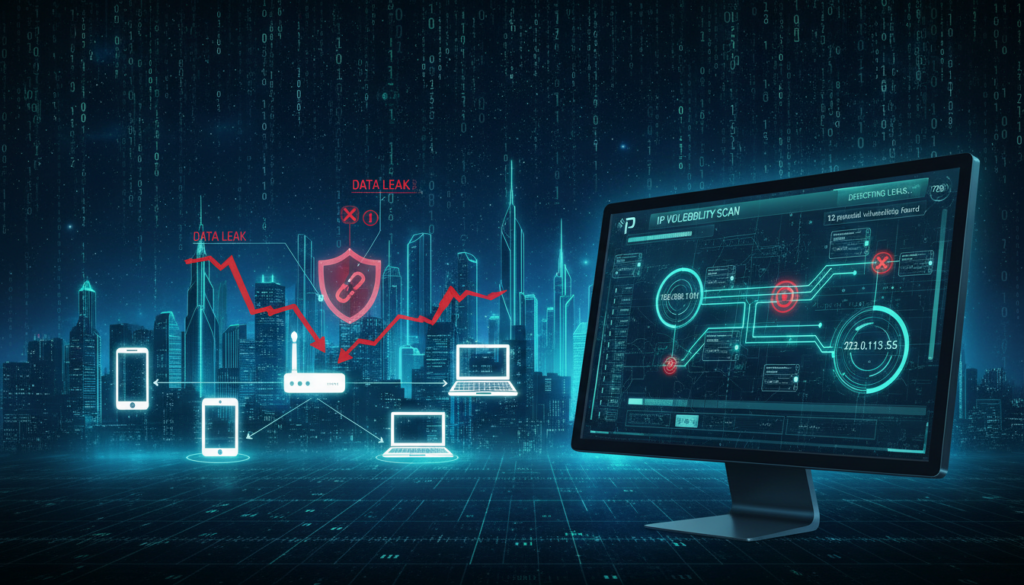
    This problem is frustrating. Your VPN seems to be working, but a quick ip vulnerability scan shows your real location. Here’s a checklist to help you find the leak.

    Checklist Item What to Check Quick Fix
    Kill Switch Is the VPN’s network kill switch enabled? This feature cuts internet access if the VPN disconnects. Enable the kill switch in your VPN app’s security settings.
    VPN Protocol Are you using the recommended protocol? Some protocols are more secure than others. Switch to OpenVPN or WireGuard in your VPN app settings.
    DNS Leak Your device might be using your ISP’s DNS servers instead of the VPN’s. Force your VPN app to use its own DNS servers. Check for DNS leaks online.
    IPv6 Leak Your VPN might only protect IPv4 traffic, leaving IPv6 traffic exposed. Disable IPv6 in your device’s network settings or use a VPN that blocks IPv6.

    If your VPN has “leak protection” or “network lock,” make sure it’s on. A detailed ip vulnerability scan will check all these, not just “what is my IP.”

    Dealing with Persistent WebRTC Leaks

    WebRTC leaks can show your real IP even with a VPN. The first step is to disable WebRTC in your browser. But, this might not solve the problem.

    First, use an online test to check for WebRTC leaks. If you still have a leak, try these steps:

    • Browser Flags: For Chrome or Edge, type chrome://flags in the address bar, search for “WebRTC,” and disable it. This is a power-user fix.
    • Browser Extensions: Add-ons like uBlock Origin or “WebRTC Leak Prevent” can block WebRTC requests at the browser level.
    • Disable IPv6: Many WebRTC leaks happen because WebRTC can reveal your IPv6 address. Disable IPv6 on your device or in your browser’s flags to close this leak.

    For the best protection, use a browser that isolates WebRTC by default. A privacy-focused fork of Firefox is a good choice. Run a detailed ip vulnerability scan after making these changes.

    9. Advanced Detection: Manual Tests for Power Users

    Automated online ip checkers and vulnerability scans are great starting points. But for a deeper look, you need to dig deeper. Tech-savvy users can uncover more by running manual tests. This gives a detailed view of your network’s path and possible ip vulnerability spots.

    Forget the simple “pass/fail” of an online ip checker. Manual tests show the how and why of your connection. Two key tools are essential: one for tracing your data’s path and another for checking your DNS.

    1. Tracing Your Connection Path with Traceroute

    When you visit a website, your data doesn’t go straight there. It goes through many network devices. The traceroute (Mac/Linux) or tracert (Windows) command shows this path. It’s especially useful for checking if your VPN is working right.

    • On Windows: Open Command Prompt and type tracert 8.8.8.8.
    • On Mac/Linux: Open Terminal and type traceroute 8.8.8.8.

    The output lists each “hop” your data makes. If your VPN’s IP is the first hop, your traffic is safe. But if it’s your local router or ISP’s gateway, your real IP is exposed. This manual check is the best way to see your connection’s true path.

    2. Probing DNS with Nslookup and Dig

    Your DNS resolver is very important. For a vulnerability scan of your DNS, manual tools are best. They show where your DNS requests are going, revealing if your VPN is leaking DNS.

    • nslookup (Windows/Mac/Linux): Open a command prompt and type nslookup seowriting.ai. The “Server” and “Address” lines show which DNS server is resolving your queries. It should be your VPN’s DNS, not your ISP’s.
    • dig (Mac/Linux): More detailed, dig seowriting.ai shows the whole query process, revealing the path and the final resolved IP.

    If the DNS server in the response is your ISP’s or a public one like 8.8.8.8, and not your VPN’s, you have a DNS leak. This manual check confirms what automated online ip checkers might only suggest.

    Why Bother with Manual Tests?

    Automated tools are good for a quick ip vulnerability scan, but they can be wrong. Manual tests with tracert and nslookup give you the real truth. They show the exact route and server resolving your queries. For the power user, this is the difference between knowing you’re protected and understanding why you’re protected. It turns a simple online ip checker result into a detailed map of your connection’s security.

    10. Conclusion: Taking Control of Your Digital Identity

    Your IP address is like a key to your digital home. We’ve learned how an IP leak can risk your privacy. But, we can manage this risk by being proactive about digital privacy.

    Start by making IP leak tests a regular habit. Use the tools and websites we’ve talked about. Also, make sure your privacy tools are set up right. A VPN’s strength depends on its settings.

    It’s important to configure your VPN and browser to block leaks. This is a crucial step. Digital privacy is not just a one-time thing. It’s something you need to keep working on.

    This knowledge makes us more aware and in control. We know how to stop IP leaks and how to set up our tools right. By doing regular checks, we take control of our digital privacy.

    Your journey to a safer online life begins with these steps. Test your connection, set up your tools, and browse with confidence. You are now in charge of your digital identity.


    FAQ

    What is an IP leak in simple terms?

    An IP leak is when your device’s real internet address is exposed online. This happens even when you’re using a VPN. It’s like your digital home address being visible on a package you thought was anonymous. This can risk your privacy and security.

    How can I quickly check for an IP leak?

    Use a free, trusted IP leak testing website like ipleak.net or BrowserLeaks.com. Visit the site with and without your VPN. The tool will show your IP address and location. If it shows your real ISP and location with your VPN on, you have a leak. Regularly checking for IP leaks is important for security.

    What’s the most common cause of an IP leak?

    Common causes include WebRTC vulnerabilities in browsers and DNS leaks. WebRTC can bypass your VPN. DNS leaks happen when your device’s domain name requests go to your ISP’s servers instead of your VPN’s. A misconfigured VPN without a kill switch is also a major cause.

    My VPN is connected, but a leak test shows my real IP. What should I do first?

    First, make sure your VPN’s kill switch is on. This cuts your internet if the VPN drops. Then, try switching your VPN protocol to OpenVPN or WireGuard, which are more secure. Also, ensure your VPN app uses its own DNS servers, not your ISP’s. If the leak continues, contact your VPN provider’s support.

    How do I prevent WebRTC leaks in my browser?

    For Chrome and Edge, install a browser extension like “WebRTC Network Limiter” or “uBlock Origin”. For Firefox, disable WebRTC in `about:config`. Set `media.peerconnection.enabled` to `false`. Using a privacy-focused browser like Brave can also prevent WebRTC leaks.

    Are free online IP checkers safe to use?

    Reputable sites like DNSLeakTest.com, IPLeak.net, and BrowserLeaks.com are safe. They show what data is leaking from your browser to them. Avoid unknown sites. For ongoing monitoring, use a trusted browser extension instead of websites.

    What is a DNS leak, and how is it different from an IP leak?

    A DNS leak is a type of IP leak. It exposes your device’s domain name queries, not just your IP address. If these queries go to your ISP’s servers instead of your VPN’s, your ISP can see your browsing history. To prevent DNS leaks, use a secure DNS provider like Cloudflare or NextDNS.

    How often should I test my connection for IP leaks?

    Test your connection for IP leaks whenever you set up a new VPN, install a new browser, or change network settings. After that, test monthly for ongoing security. Also, test immediately if you notice changes in your internet experience, like seeing ads in your local language while connected to a foreign VPN server.
  • The Dangers of Unsecured Public Wi-Fi: How V2Nodes Protects You.

    The Dangers of Unsecured Public Wi-Fi: How V2Nodes Protects You.

    I’ve used many “free” networks in coffee shops, airports, and hotels. That easy login screen seems like a blessing when you need to check email or finish work. But, this convenience comes with a hidden cost—your personal privacy.

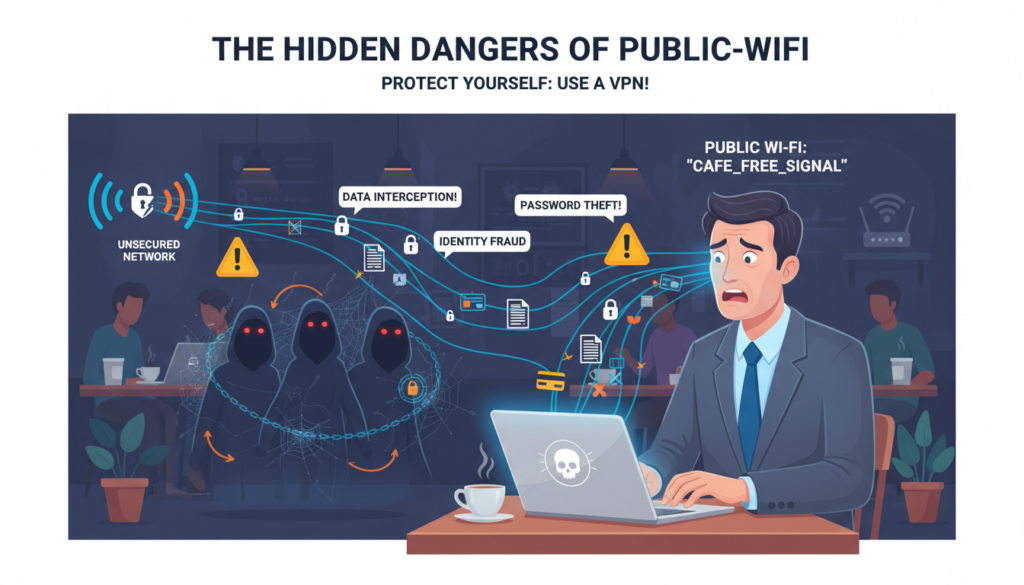
    These open networks are often not secure at all. When you connect, you’re sharing your digital life with others on the network. Your login details, financial info, and private messages can be caught by bad actors.

    That’s why I trust V2Nodes. It makes a secure, encrypted path for all my online activities. Whether I’m browsing or banking, my data stays safe from unwanted eyes. It turns risky public connections into private, safe paths.

    Key Takeaways

    • Free public Wi-Fi networks often lack basic security protections
    • Your sensitive personal data can be easily intercepted on unsecured connections
    • Cybercriminals frequently target these networks to steal information
    • Simple browsing on public networks exposes more data than most people realize
    • Encryption services like V2Nodes create a protective barrier for your online activity
    • Protecting your digital privacy requires proactive security measures
    • Secure connections are essential for both work and personal internet use

    Why “Free Wi-Fi” Could Cost You Everything

    We see the sign for free internet and connect without a second thought. It feels like a small victory, a modern convenience we’ve come to expect. Yet, this automatic habit hides a dangerous contradiction. The very thing that promises connection and convenience can become a gateway for theft and intrusion. Understanding this paradox is the first step in guarding against the very real risks of using public wifi.

    The Allure and Danger of Public Hotspots

    Public Wi-Fi networks are everywhere—from coffee shops and airports to hotels and libraries. Their appeal is obvious: instant, cost-free access in a world that runs on data. We’re driven by urgency and convenience, often prioritizing getting online over considering how secure that connection might be.

    Why We Take Unnecessary Risks

    Our brains are wired to seek reward and avoid immediate inconvenience. When you’re in a hurry to send an email or check a map, the future threat of cybercrime feels abstract. The present benefit of free access feels concrete. This cognitive bias leads us to click “connect” on networks named “Free Airport WiFi” or “Coffee_Shop_Guest,” ignoring the glaring red flags.

    We also operate under a false sense of security. Many believe that if a place is reputable, its Wi-Fi must be safe. Or we think that simply having a password on the network (like in a hotel) means our data is protected. These assumptions are tragically incorrect and form the bedrock of our vulnerability.

    risks of using public wifi psychology

    That free connection isn’t free. The price is your privacy and security. When you use an unsecured public hotspot, you may be paying with:

    • Your Financial Data: Credit card numbers, bank login details, and payment app info can be intercepted.
    • Your Personal Identity: Login credentials for email, social media, and cloud accounts are up for grabs.
    • Your Professional Information: Sensitive work emails, confidential documents, and corporate network access can be compromised.
    • Your Digital Footprint: Every website you visit, every search you make, can be monitored and logged by a malicious actor on the same network.

    The real cost isn’t just stolen data; it’s the aftermath—spending months repairing your credit, recovering hijacked accounts, and dealing with the stress of a data breach. This is the hidden bill presented by “free” internet.

    My Personal Wake-Up Call

    I learned this lesson not from a textbook, but from a heart-stopping moment of my own. It transformed my understanding of digital security from a theoretical concern into a personal mandate.

    A Personal Story of Data Vulnerability

    A few years ago, I was working remotely from a well-known hotel lounge. I connected to the official “Hotel_Guest” network, entered the provided password, and thought I was secure. I spent an hour reviewing financial statements and sending emails with sensitive attachments.

    Later that day, I received a fraud alert from my bank for a small, unfamiliar online purchase. It was a test. The criminals had gotten my card details from that session. I immediately realized the hotel’s Wi-Fi, while password-protected for access, did not encrypt the data traveling across it. My information was broadcast in plain text for anyone on that network to scoop up. I was lucky the bank caught it early, but the violation I felt was profound.

    What I Learned From My Own Close Call

    That incident was my ultimate wake-up call. It taught me three critical lessons that define my approach to cybersecurity today:

    1. A Password is Not a Shield: A network login password only controls who can join the network. It does nothing to scramble or protect the data you send once you’re connected.
    2. Complacency is the Greatest Risk: I was in a “trusted” environment and doing “normal” work. Hackers prey on this exact sense of normalcy and trust.
    3. Proactive Protection is Non-Negotiable: Relying on the security of a public network is a gamble. True safety requires you to bring your own security with you, creating a private tunnel for your data no matter where you are.

    This personal brush with the risks of using public wifi shifted my mindset completely. It moved me from hoping for safety to actively engineering it for every connection I make.

    The Hidden Dangers of Public Wifi Dangers: What You Don’t See Can Hurt You

    Understanding the dangers of public hotspots is key to staying safe on public wifi. The threats aren’t always obvious. They are often silent, automated processes that happen in the background. I’ll explain three common and dangerous attacks. Knowing how they work makes you safer.

    Man-in-the-Middle Attacks: The Invisible Threat

    Imagine a private conversation where a stranger secretly listens and alters what you say. A Man-in-the-Middle (MitM) attack is like this. The hacker positions themselves between your device and the internet.

    How Hackers Intercept Your Data in Real-Time

    When you connect to a compromised router, the attacker can redirect your traffic. Every website request, login attempt, and message you send passes through their hands. They see everything before it reaches its intended destination.

    They use tools to decrypt weak security or exploit software flaws. Your data is captured, analyzed, and sometimes even modified. An attacker could change a bank transfer amount or the recipient’s details before the information reaches the bank’s server.

    Real Examples of Data Interception

    I’ve read reports of hackers in crowded coffee shops using cheap, portable devices to launch these attacks. In one case, they intercepted login credentials for a corporate email account. In another, they captured credit card details during an online purchase. The users had no idea their session was compromised until it was too late.

    Public spaces with many connected users are prime targets. The hacker’s goal is often credential harvesting or financial theft. They rely on the fact that most people assume a public network is just slow, not hostile.

    Evil Twin Networks: When Free Wi-Fi Isn’t What It Seems

    This attack preys on trust and convenience. A hacker sets up a rogue Wi-Fi hotspot with a name that looks legitimate. It might be called “Free Airport WiFi” instead of the official “Airport_Partner_WiFi,” or “Starbucks_Guest” right next to a real Starbucks.

    How to Spot Malicious Hotspots

    Vigilance is your best defense. First, always verify the official network name with staff at the location. If you see two very similar names, that’s a major red flag. Second, be wary of networks that require no password at all when others do.

    Third, if you connect and immediately get prompts to “update software” or enter personal details to access the internet, disconnect immediately. Legitimate public networks rarely ask for such information upfront. This practice is fundamental to staying safe on public wifi.

    The Airport and Hotel Wi-Fi Trap

    These are high-risk zones. Travelers are tired, in a hurry, and desperate to connect. Hackers know this. They set up powerful portable routers that broadcast strong signals with names like “Airport_Free_WiFi” or “Hotel_Guest.”

    Once connected, all your internet traffic flows through the hacker’s device. They can steal booking confirmations, frequent flyer logins, and even passport details if you fill out a form. I always double-check the exact network spelling provided at the hotel front desk or on airport signage.

    Packet Sniffing: Your Data Laid Bare

    Data travels across networks in small chunks called “packets.” On a secure, encrypted connection, these packets are scrambled. On an open public Wi-Fi network, they can be sent in plain, readable text. Packet sniffing is simply using software to collect and read these unencrypted packets.

    What Information Hackers Can Steal

    The range of data vulnerable to sniffing is alarming. It goes far beyond just website addresses. The table below breaks down the common types of information exposed:

    Data Type Specific Examples Potential Consequence
    Login Credentials Usernames & passwords for email, social media, banking sites (if not using HTTPS fully). Account takeover, identity theft, financial loss.
    Personal Messages Contents of emails, instant messages, and social media DMs sent in plain text. Privacy invasion, blackmail, corporate espionage.
    Browsing History Every URL of every website and page you visit. Profiling of habits, interests, and potential vulnerabilities.
    Session Cookies Digital keys that keep you logged into websites like Amazon or Facebook. Session hijacking, where a hacker can access your accounts without your password.
    Financial Information Credit card numbers, CVV codes, and billing addresses entered on non-secure forms. Direct financial fraud and unauthorized purchases.

    Tools That Make This Scarily Easy for Attackers

    You don’t need to be a coding genius to perform packet sniffing. Free, widely available software like Wireshark provides a user-friendly interface. A hacker can simply run it on a laptop connected to the same public network, start a capture, and watch the data stream in.

    They can apply filters to look specifically for passwords, cookies, or credit card numbers. This automation makes large-scale data theft possible with minimal effort. It underscores why a basic connection is not a safe connection.

    staying safe on public wifi data interception diagram

    These hidden dangers—interception, impersonation, and sniffing—form the core threat model of public Wi-Fi. They work because the network itself lacks security. In the next section, I’ll show exactly how this exposed data becomes a tool for further attacks against you.

    How Your Personal Information Becomes Public Property

    Understanding attacks is one thing, but seeing their personal impact is another. The dangers of public Wi-Fi become real when you see what’s at risk. This turns a vague threat into a real, personal danger.

    Unencrypted Data: Your Digital Life in Plain Text

    Connecting to an unsecured network without protection makes your data very vulnerable. It’s like sending a postcard instead of a sealed box. Anyone with the right tools can read it as it passes by.

    What Hackers Actually See

    Without security, a hacker can see a shockingly clear picture of your online life. They can see the websites you visit, articles you read, and search terms. If you’re not using HTTPS, they can see the data you submit to forms before it’s encrypted.

    The Most Vulnerable Types of Data

    Not all data is the same to hackers. The most sought-after information includes:

    • Login Credentials: Usernames and passwords for email, social media, and banking sites are the ultimate prize.
    • Financial Information: Credit card numbers, bank details, or payment information entered on a non-HTTPS page.
    • Personal Communications: The content of emails, private messages, and even unencrypted chat messages can be intercepted.
    • Browsing History & Habits: Your digital footprint reveals your interests, location history, and daily habits.

    This is the core of thesecurity threats on public wifi. It turns browsing into a data leak.

    Session Hijacking: When Your Login Goes Wrong

    Even if your password is safe, your active session might not be. Session hijacking is a sophisticated attack where a thief steals the “key” that keeps you logged into a website, like your email or social media account.

    How Attackers Take Over Your Accounts

    When you log into a website, the server gives your browser a “session cookie” or token. On an unsecured network, an attacker can use a packet sniffer to intercept this unique token. Once they have it, they can impersonate your browser, effectively becoming you on that site. They don’t need your password; they already have the keys to the door.

    Real-World Examples of Account Takeovers

    This isn’t just theory. Account takeovers from security threats on public wifi happen regularly. For instance, a business traveler using hotel Wi-Fi to check a corporate email account could have their session hijacked. The attacker, now logged in as the user, can read sensitive emails, access cloud storage, or even launch further attacks from the compromised account. Another common scenario involves social media accounts being hijacked on airport or café Wi-Fi, used to spread spam or scam the victim’s contacts.

    In short, on an open network, your data isn’t just at risk of being seen—it can be stolen and used. Your email, your social media, and even your identity can be hijacked because a single, unencrypted session was left exposed. This is the real-world impact of the security threats on public wifi, turning a convenience into a critical vulnerability.

    How V2Nodes Creates Your Personal Digital Fortress

    We’ll see how V2Nodes builds a safe space for you online. It starts with knowing the dangers and ends with a secure place for all your web activities.

    The Encryption Shield: Military-Grade Protection

    V2Nodes uses top-notch encryption to keep you safe. This tech turns your data into unreadable code as it goes out. It’s like a strong digital lock on your info.

    Even if hackers try to grab your data, they’ll only get jumbled text. This is your first line of defense against online threats.

    V2Nodes employs AES-256 encryption, a favorite among security pros. The “256” means the encryption key is super long and hard to crack. So, every message you send is wrapped in a strong digital shield.

    This makes your data a complex code that’s nearly impossible to break. It keeps your sensitive info safe from prying eyes.

    How Your Data Stays Private End-to-End

    End-to-end encryption is the top choice for keeping data private. With V2Nodes, your data is encrypted before it leaves your device. It travels safely through public Wi-Fi, only to be unlocked at the V2Nodes server.

    This way, your data is never readable on public networks. Even your ISP can’t see what you’re doing online. It’s a big step towards safe browsing on public Wi-Fi.

    The Secure Tunnel: Your Data’s Armored Car

    Encryption is like the lock, but the secure tunnel is the vehicle that carries your data. When you connect to V2Nodes, it creates a private tunnel between you and a V2Nodes server. All your internet traffic goes through this safe path, hidden from others on the public Wi-Fi.

    From Your Device to V2Nodes Servers

    Here’s how it works: When you want to visit a website, your request is encrypted and sent through the tunnel. The V2Nodes server then makes the request to the internet for you. The website sees the request coming from the V2Nodes server, not your device.

    This not only encrypts your data but also hides your true IP address and location.

    Why This Tunnel Is Hack-Proof

    The tunnel by V2Nodes is wrapped in layers of security. It uses strong protocols like OpenVPN and WireGuard®. These are designed to stop eavesdropping and man-in-the-middle attacks.

    Even if you’re on a fake hotspot, your data stays safe inside the encrypted tunnel. It’s hidden from hackers and snoopers on the same network.

    V2Nodes Features That Make You Invisible Online

    Security on public Wi-Fi isn’t just about building walls. It’s about becoming a ghost. When you connect through V2Nodes, you’re not just shielded; you actively disappear from the view of snoops and hackers. This invisibility is powered by a suite of specific, high-performance features. Each one works in concert to achieve a single goal: protecting your data on public wifi by making your online presence untraceable and secure.

    Military-Grade Encryption Explained

    Think of encryption as a complex, unbreakable code. V2Nodes uses AES-256 encryption, the same standard trusted by governments and security agencies worldwide. It scrambles every single bit of data leaving your device into a meaningless jumble of characters. To anyone intercepting it on a public network, it looks like digital noise. This is the fundamental layer that turns your sensitive information into a secret language only your device and the secure server can understand.

    AES-256 vs. Other Encryption Standards

    Not all encryption is created equal. The strength of an encryption cipher is often measured by its key size—the number of possible combinations a hacker would need to try to break it. AES-256 stands at the top of this hierarchy.

    Encryption Standard Key Size (Bits) Primary Use & Security Level Vulnerability to Brute Force
    AES-256 256 Military, government, top-tier financial data. Considered quantum-resistant. Virtually impossible with current technology. Would take billions of years.
    AES-128 128 Common for general commercial security and online banking. Very strong. Extremely difficult, but theoretically less future-proof than 256-bit.
    Blowfish 32-448 Older systems, some legacy software. Largely deprecated for new systems. Known vulnerabilities make it unsuitable for modern high-security needs.
    DES (Data Encryption Standard) 56 Historical standard. Completely obsolete and easily broken. Can be broken in minutes with modern computing power.

    Why This Level of Security Matters

    You might wonder if such strong encryption is overkill for checking email at a café. It’s not. Cybercriminals use automated tools that constantly scan public networks for any weakness. A lesser encryption standard is a weaker link they can exploit. By employing AES-256, V2Nodes ensures there is no weak link. This eliminates the risk of your login credentials, personal messages, or banking details being deciphered, which is the core of protecting your data on public wifi.

    The Kill Switch: Your Safety Net

    Encryption is your armor, but what if the armor momentarily fails? A Kill Switch is your critical safety net. It continuously monitors the secure connection between your device and the V2Nodes server. If that connection drops unexpectedly—even for a split second—the Kill Switch instantly blocks all internet traffic to and from your device.

    How It Protects You From Exposure

    Without a Kill Switch, a dropped VPN connection would cause your device to revert to its normal, unprotected internet connection. On public Wi-Fi, this means your real IP address and unencrypted data would be exposed. The Kill Switch prevents this by acting as a circuit breaker. It stops all data flow until the secure VPN tunnel is fully re-established. This guarantees that your identity and activity are never accidentally leaked onto the insecure network.

    Real-Time Protection Features

    The V2Nodes Kill Switch operates in real-time, offering proactive protection:

    • Instant Reaction: The block happens faster than any app or website can send identifying data.
    • Application-Level Control: You can choose to block all traffic or only specific, sensitive applications.
    • Persistent Security: It remains active in the background, ensuring safety even if you forget to manually reconnect.

    This feature is non-negotiable for true security. It turns a potential moment of vulnerability into a managed safety event, solidifying the process of protecting your data on public wifi.

    Global Server Network Advantage

    Security isn’t just about technology; it’s also about strategy. V2Nodes operates a vast network of servers spread across numerous countries. This geographic diversity is a powerful tool for enhancing your privacy and connection stability.

    Why Server Location Matters for Security

    Connecting to a server in a different country or region does more than just allow access to geo-restricted content. It strategically distances your online activity from your physical location. If you’re in New York on a public Wi-Fi, but your connection exits through a server in Amsterdam, any tracker or eavesdropper will see the Amsterdam server’s location. This severs the direct link between your identity on the public network and your actual browsing activity, adding a crucial layer of obfuscation.

    How Multiple Servers Increase Your Protection

    A large server network provides two key security benefits:

    1. Load Distribution and Speed: Traffic is spread across many servers, preventing any single one from becoming a bottleneck. This maintains fast encryption speeds, so you don’t disable your VPN out of frustration—a common security mistake.
    2. Redundancy and Reliability: If one server experiences issues, you can instantly switch to another without interrupting your secure session. This resilience means your protected tunnel is always available, keeping you invisible.

    By combining military-grade encryption, a failsafe Kill Switch, and a strategic global network, V2Nodes doesn’t just defend you. It redefines your relationship with public Wi-Fi, transforming you from a visible target into a ghost in the machine, fully focused on protecting your data on public wifi.

    Step-by-Step: Your Complete Public Wi-Fi Safety Protocol

    This guide turns awareness into action, giving you control over your digital safety. We’ve discussed the dangers of unsecured public wifi and how V2Nodes protects you. Now, let’s build your personal defense system. Follow these steps to secure every connection.

    Each step is simple and designed for beginners. You don’t need technical expertise to stay safe. I’ll guide you from choosing your plan to testing your setup. Your security becomes automatic with this protocol.

    Getting Started with V2Nodes: A Beginner’s Guide

    Starting with V2Nodes takes just minutes. The process is streamlined for immediate protection. I remember my first setup – it was surprisingly straightforward. Let me show you how easy it can be.

    Choosing the Right V2Nodes Plan

    V2Nodes offers three main plans to match different needs. Your choice depends on how often you use public networks.

    • Basic Plan: Perfect for occasional travelers who need protection at cafes and airports.
    • Plus Plan: Ideal for regular business travelers with multiple devices.
    • Pro Plan: Best for digital nomads and remote workers always on public Wi-Fi.

    I recommend the Plus Plan for most users. It balances cost with comprehensive features. The Pro Plan adds advanced security layers for high-risk situations. Choose based on your exposure to public networks.

    Installation and Setup Made Simple

    Once you select your plan, installation follows these clear steps:

    1. Download the V2Nodes app from your device’s official app store
    2. Create your account using a strong, unique password
    3. Select your preferred payment method for subscription
    4. Launch the app and log in with your credentials
    5. Allow necessary permissions for the VPN to function properly

    The interface guides you through each stage. I completed my setup in under five minutes. The app remembers your preferences for future connections. You’re now ready to configure optimal protection.

    Optimal Settings for Maximum Protection

    Default settings provide good security, but optimized settings deliver maximum protection. These adjustments ensure you’re always protected against evolving threats. I’ve tested these configurations across various networks.

    Configuring for Different Network Types

    Different public networks require specific security approaches. Your V2Nodes app can adapt to each environment.

    For open coffee shop networks, enable these settings:

    • Always-on VPN connection
    • Kill Switch activated
    • Highest encryption level selected
    • Automatic server selection based on speed

    For airport and hotel networks, add these configurations:

    • DNS leak protection enabled
    • WebRTC blocking turned on
    • Split tunneling disabled for full protection
    • Protocol set to WireGuard for best performance

    These settings create layers of defense. Each network type presents unique dangers of unsecured public wifi. Your configuration should match the threat level.

    Testing Your Security Setup

    Never assume your protection is working. Regular testing confirms your security measures are active. I test my setup every time I connect to a new network.

    Follow this testing protocol:

    1. Connect to the public Wi-Fi network first
    2. Activate your V2Nodes connection
    3. Visit a DNS leak test website (like dnsleaktest.com)
    4. Verify your IP address shows the VPN server location
    5. Check that no DNS requests show your actual ISP
    6. Confirm the kill switch works by briefly disabling VPN

    This testing takes two minutes but provides peace of mind. You’ll know exactly when you’re protected. The process becomes routine with practice.

    Your complete safety protocol is now established. From plan selection to configuration testing, you have control. This system works automatically once set up correctly. You can connect to any public network with confidence.

    Beyond Coffee Shops: Other Wi-Fi Danger Zones

    Cafes are not the only places with big wifi hotspot security risks. Hotels and airports are also risky, even though we trust them. Public transport is another danger zone. Knowing these places is key to staying safe.

    Hotels and Airports: The Risk Multipliers

    These places attract many valuable targets. Business travelers and tourists with credit cards are common. The many devices make it easy for hackers to hide.

    Why Hotel Wi-Fi Is Particularly Dangerous

    Hotel networks are complex, managed by third parties. The login you see might not be real. I’ve seen setups where guests could see each other’s files.

    One password for the whole hotel means everyone is at risk if it’s hacked. Hotels don’t update their networks as often as companies do. This leaves them open to attacks.

    Airport Wi-Fi: A Hacker’s Playground

    Airports are full of people in a rush. They’re easy targets for hackers. Fake SSIDs look just like real ones, making it hard to tell the difference.

    These areas are open to physical and digital snooping. Connecting to an unsecured hotspot means your data is exposed to anyone with bad intentions.

    Public Transportation Networks

    Wi-Fi on trains and buses is common. But, it comes with wifi hotspot security risks. The network can drop security when it changes towers.

    Trains, Buses, and Their Hidden Dangers

    Trains have one big hotspot for everyone. If it’s not secure, hackers can see all your data. These systems focus on coverage, not security.

    How to Stay Safe While Traveling

    Travel safety starts with being proactive. Never think a network is safe just because it’s from a known company. Use a VPN like V2Nodes to encrypt your data.

    Here’s what I do in danger zones:

    • Always use a VPN before connecting. Turn on V2Nodes *before* joining any Wi-Fi.
    • Verify the official network name. Check with staff for the exact SSID at hotels and airports. Avoid similar but wrong names.
    • Disable file sharing. Turn off public folder sharing to avoid sharing on a shared network.
    • Use your mobile hotspot as a backup. For sensitive tasks, your cellular data is safer than public Wi-Fi.

    By knowing these wifi hotspot security risks, you can stay safe everywhere. The threats grow with your travels, so does your need for protection.

    V2Nodes in Action: Real-World Protection Scenarios

    In the world of business and remote work, a single bad connection can ruin months of work. Public Wi-Fi has long been a risk for professionals on the move. But what does real protection look like? The following case studies show V2Nodes as a key shield for professionals everywhere.

    Case Study: The Business Traveler

    Imagine a sales director, Sarah, using airport lounge Wi-Fi before a big meeting. Her laptop has sensitive merger details. This is common for business travelers working from airports, hotels, and conference centers.

    Protecting Corporate Data on the Go

    Sarah needs to stay connected. Before V2Nodes, public logins were risky. Corporate firewalls and email filters don’t work outside the office. Her device, full of sales data, is a target on public Wi-Fi.

    With V2Nodes, her situation changes. Its military-grade encryption protects her data like a personal detail. It creates a secure tunnel for her data. Even if the network is compromised, her emails and financial data stay private. It’s not just a VPN; it’s a mobile vault for her company’s secrets.

    How V2Nodes Prevented a Major Breach

    A colleague at a tech conference last year connected to what seemed like the hotel’s Wi-Fi. It was an “evil twin” network set up by a competitor. His device connected, and his login credentials were exposed for a few seconds.

    “Without my V2Nodes connection, I would have handed over the keys to our entire development roadmap. The secure tunnel prevented any data from leaving my device without encryption, making the intercepted data useless to the attacker.”

    V2Nodes didn’t just encrypt data; its Kill Switch feature cut off the internet if the secure tunnel was broken. This stopped any data leaks. This is the difference between a scare and a major breach.

    Case Study: The Remote Worker

    The rise of remote work has changed security. The office is now anywhere with Wi-Fi, and so are threats.

    Secure Coffee Shop Working

    Take Alex, a freelance graphic designer. His office is a local café. He handles client logos and designs. Public Wi-Fi is a risk for data capture.

    When Alex connects to the café’s Wi-Fi, his data is visible. But with V2Nodes, his data is encrypted. The café’s network sees only scrambled data. His client’s designs stay confidential, even if the network is compromised.

    Client Data Protection in Public Spaces

    For professionals like Alex, client trust is key. A data leak can harm their reputation. When Alex sends or receives data, it’s vulnerable on public Wi-Fi.

    V2Nodes protects client data:

    • End-to-End Encryption: Data is scrambled before leaving Alex’s device, unreadable to interceptors.
    • Secure DNS: V2Nodes routes internet requests through secure DNS servers, preventing fake login pages.
    • Network Lock (Kill Switch): If the secure connection drops, the Kill Switch blocks all internet traffic, preventing leaks.

    This isn’t just about hiding browsing history. It’s about sending final files, sharing financial models, or sending manuscripts. V2Nodes keeps confidential work safe. In the remote work era, your security is your device. V2Nodes keeps it secure.

    Debunking Public Wi-Fi Security Myths

    It’s time to debunk common myths about public Wi-Fi security. Many people rely on outdated or wrong information, leading to data breaches. Let’s tackle three myths that risk your personal and financial info every time you connect.

    Users often believe false security myths. This is like leaving your door unlocked in a busy area. Let’s reveal the truth behind these misconceptions.

    Myth 1: “I Only Check Email, So I’m Safe”

    This myth is dangerous. Many think checking email or social media makes them safe. But, this is not true.

    Why Email Is More Vulnerable Than You Think

    Your email is a key to your digital world. Hackers can get your login details when you check email on public Wi-Fi. They can then access your bank and social media accounts.

    Think about what’s in your email. Bank statements, login confirmations, and sensitive info are all at risk on unsecured networks.

    “The most secure password is useless if it’s sent over an unsecured network.”

    Myth 2: “Secure Websites (HTTPS) Are Enough”

    Trusting only the padlock icon is a half-truth. HTTPS encrypts data with a website, but not your whole connection.

    The Danger of Mixed Content and HTTP Pages

    Many sites have mixed content, with some parts loaded over HTTP. This lets attackers inject malware or track you. Your ISP can also see which sites you visit, even on HTTPS sites.

    A VPN like V2Nodes encrypts all your traffic. This secures your connections, including DNS requests, and keeps your browsing habits private.

    Myth 3: “My Phone Handles Security Automatically”

    We trust our phones too much. Auto-connect features are a major security risk, not a benefit.

    The Risks of Automatic Wi-Fi Connections

    Your device might auto-connect to networks, including fake ones. Attackers can set up fake hotspots. A VPN with an automatic kill switch, like V2Nodes, is key to prevent data leaks.

    To understand these myths, let’s look at common misconceptions versus reality:

    Common Myth Reality Check
    “I have nothing to hide, so I’m not a target.” Hackers use automated bots that don’t discriminate. They target all devices on a network, looking for any vulnerability.
    “The coffee shop’s Wi-Fi is password-protected, so it’s safe.” A password on a public Wi-Fi network only restricts who can join the network, not who can see the data traveling across it. The traffic is often still unencrypted.
    “My device’s firewall and antivirus will protect me.” Firewalls and antivirus software are crucial, but they don’t encrypt your internet traffic. They can’t stop a man-in-the-middle attack on an unsecured network.

    Believing these myths can lead to security breaches. The solution isn’t to avoid public Wi-Fi. Instead, use it wisely with a reliable VPN.

    V2Nodes creates a secure tunnel around your data. This makes myths irrelevant. You can browse, bank, and communicate safely, knowing your data is protected.

    Conclusion: Your Action Plan for Wi-Fi Security

    We’ve seen the dangers of public Wi-Fi. From hackers to fake hotspots, your data is at risk. Knowing the risks is just the start. Taking action is what keeps you safe.

    V2Nodes is your shield against these threats. It creates a secure tunnel for your data. With top-notch encryption and servers worldwide, you’re protected.

    Here’s what you need to do. Always use V2Nodes when you’re on public Wi-Fi. Keep it running on all your devices for ongoing safety. And don’t forget to use strong, unique passwords. Remember, security is an ongoing effort.

    Public Wi-Fi dangers are real, but you’re ready. Protect your online world now. Visit V2Nodes to secure your connection.

    FAQ

    What are the main dangers of using unsecured public Wi-Fi?

    Using unsecured public Wi-Fi can be risky. Hackers might intercept your data through Man-in-the-Middle (MitM) attacks. They could also connect to fake “Evil Twin” hotspots or “sniff” your data. This can lead to stolen passwords, financial info, and personal data. It’s important to know these dangers before using public Wi-Fi.

    How does V2Nodes specifically protect my data on public Wi-Fi?

    V2Nodes creates a secure tunnel for your internet traffic. When you connect to public Wi-Fi, your data is encrypted with AES-256 encryption. This makes your online activity and real IP address invisible to hackers, protecting your data.

    Is it safe to check my email or bank account on public Wi-Fi if I use V2Nodes?

    Yes, it’s much safer. V2Nodes encrypts all your traffic. So, even if you check your bank account on public Wi-Fi, hackers will only see encrypted data. This protects sensitive information like login credentials and financial details.

    I only use secure (HTTPS) websites. Do I still need a VPN like V2Nodes on public Wi-Fi?

    A> HTTPS is important, but it’s not enough. A VPN like V2Nodes adds extra protection. It encrypts all your traffic, not just your browser session. It also hides your real IP address and location, offering better security against public Wi-Fi risks.

    How does V2Nodes protect me from “Evil Twin” hotspots?

    An “Evil Twin” is a fake Wi-Fi network that looks real. V2Nodes can’t stop you from connecting to it, but it makes the threat less harmful. Even if you connect to a hacker’s network, V2Nodes encrypts your data. Hackers will only see encrypted data, keeping your information safe.

    What is the “Kill Switch” and why is it important for public Wi-Fi security?

    The Kill Switch is a key feature. If your VPN connection drops, it blocks all internet traffic. This prevents your real IP address and unencrypted data from being exposed, keeping your data safe.

    I mostly use my phone on public Wi-Fi. Are the risks the same, and how does V2Nodes help?

    Yes, the risks are the same, and phones are just as vulnerable. V2Nodes encrypts all data from your mobile apps and browsers. This protects your texts, emails, and app data when using public hotspots, making it a crucial part of mobile security.

    Is using a VPN like V2Nodes legal, and will it slow down my connection?

    Using a VPN for privacy and security is legal in most places. Modern VPNs like V2Nodes are fast and don’t slow down your connection much. The encryption adds a small overhead, but it’s worth it for the security on public Wi-Fi.
  • VPN vs. Proxy vs. V2Ray: Which Is Actually the Most Secure?

    VPN vs. Proxy vs. V2Ray: Which Is Actually the Most Secure?

    In today’s world, keeping your online data safe is essential. The tools we use to protect our privacy are our first defense. Many wonder: what is the most secure option for protecting my online activity?

    The debate centers on three main technologies: virtual private networks (VPNs), proxy servers, and V2Ray. Each has its own strengths.

    The differences between a VPN and a proxy might seem small at first. But they represent different ways to secure and protect your online activity. A simple proxy might be enough for a casual user. But someone in a restricted area might need something more.

    This guide will help you understand the differences between VPN and proxy services. We’ll also look at V2Ray as a modern option. You’ll see that the “most secure” choice depends on your specific needs for privacy, speed, and control.

    Key Takeaways

    • Different tools serve different purposes: proxies are for simple tasks, VPNs for general privacy, and advanced tools like V2Ray for complex needs.
    • True online security is a combination of the right tool and secure user practices.
    • The “most secure” option is not a single tool, but the one correctly configured for your specific threat model.
    • Understanding the core function of each technology is the first step to making an informed choice.
    • No single tool can guarantee absolute anonymity; a layered approach to security is best.

    VPN vs. Proxy vs. V2Ray: The Privacy Trio Defined

    In today’s world, three key tools protect our online privacy: VPNs, proxy servers, and V2Ray. They all send your internet traffic through a server, but they work differently. Knowing how they differ is key to choosing the right one for you.

    A Virtual Private Network (VPN) makes a secure tunnel between you and a server. This tunnel hides all your online activities. Your ISP, network admins, and hackers on public Wi-Fi see only encrypted data.

    A proxy server is a simple middleman between you and the internet. It handles traffic for specific apps, like your browser, but not your whole device. It hides your IP address but doesn’t encrypt your data.

    V2Ray is a more advanced tool for getting past censorship. It’s open-source and supports many protocols. V2Ray is great at making your traffic look like normal HTTPS to avoid network restrictions.

    vpn proxy comparison privacy tools

    Why Online Privacy Tools Are No Longer Optional

    Privacy is now a must in the digital world. We’re constantly watched by companies and governments wanting our data. Privacy tools are crucial for internet users today.

    Laws like GDPR and CCPA focus on data handling, not stopping surveillance. Your ISP in the US can monitor and sell your browsing history. This creates a permanent record of your online activities.

    Public Wi-Fi is a big security risk. Hackers can easily steal your personal info without encryption. Without protection, your sensitive data travels openly.

    Privacy tools also help us access content and avoid censorship. Streaming services block content based on where you are. Schools and workplaces block websites. Privacy tools help us access the internet freely.

    Here’s why privacy tools are essential:

    • ISP Data Collection: Most US internet providers log and can share your browsing data with third parties
    • Public Wi-Fi Risks: Unencrypted connections allow easy interception of personal information
    • Geographic Restrictions: Content and services vary by location, limiting what you can access
    • Price Discrimination: Some websites change prices based on your location and browsing history
    • Censorship Circumvention: Necessary in restrictive environments for accessing information

    The vpn proxy comparison is more important than ever. It’s not just about privacy—it’s about finding the right tool for your needs. Whether you need basic protection, full encryption, or advanced obfuscation depends on your situation.

    Each tool addresses different privacy challenges. What was once optional is now essential for protecting our digital lives.

    Virtual Private Networks (VPNs): The Established Guardian

    For those wondering which is better VPN or proxy, understanding VPN technology first provides crucial context. Virtual Private Networks have become the mainstream choice for digital privacy. They offer a balanced approach to security that suits most users.

    VPNs create a protected connection between your device and the internet. This shield keeps your online activities private from prying eyes. Millions rely on VPN services daily for both personal and professional use.

    VPN secure tunnel encryption which is better vpn or proxy

    Before diving into the technical details, let’s establish what makes VPNs different. Unlike basic proxies, VPNs encrypt your entire internet connection. This comprehensive protection explains their popularity as all-purpose privacy tools.

    How a VPN Creates a Secure Tunnel

    Think of a VPN as building a private tunnel through the public internet. Your data travels through this encrypted pathway safely. No one outside can see what’s inside the tunnel.

    The process begins when you connect to a VPN server. Your device establishes an encrypted link with this server. All your internet traffic then routes through this secure connection.

    Encryption scrambles your data into unreadable code. Only your device and the VPN server hold the keys to decode it. This happens before your data reaches your internet service provider.

    We call this “encapsulation” – wrapping your data in protective layers. It’s like sending a secret letter inside a locked box. The box travels through public mail systems, but only the intended recipient can open it.

    VPN Security Protocols: OpenVPN, WireGuard, and IKEv2

    Different VPN protocols determine how your secure tunnel gets built. Each protocol has unique strengths for various situations. The right choice depends on your specific needs.

    OpenVPN remains the industry standard for reliability. This open-source protocol has undergone extensive security testing. It works consistently across different platforms and networks.

    OpenVPN uses strong encryption that has resisted years of attacks. Its flexibility allows customization for specific security requirements. Most premium VPN services offer OpenVPN as their default option.

    WireGuard represents the new generation of VPN protocols. It uses modern cryptography for exceptional speed and efficiency. The entire codebase is remarkably small and easy to audit.

    WireGuard’s simplicity translates to faster connection times. It maintains security while reducing battery drain on mobile devices. This protocol excels in situations where speed matters most.

    IKEv2 (Internet Key Exchange version 2) specializes in mobile stability. It handles network switches seamlessly – like moving from Wi-Fi to cellular data. Your VPN connection persists without dropping.

    This protocol automatically reconnects if your connection briefly interrupts. IKEv2 works particularly well with iOS and mobile operating systems. It’s the go-to choice for users who frequently change networks.

    Strengths of a VPN: All-Round Security

    VPNs deliver comprehensive protection that addresses multiple privacy concerns simultaneously. They’re designed as complete solutions rather than specialized tools. This explains why many users choose VPNs over simpler alternatives.

    The primary strength lies in end-to-end encryption. Every piece of data leaving your device gets encrypted. This includes your browsing history, messages, and even app data.

    VPNs also mask your real IP address effectively. Websites see the VPN server’s address instead of your personal one. This adds an important layer of anonymity to your online presence.

    Another advantage is the broad application support. VPNs protect all internet traffic from your device. You don’t need to configure individual applications separately.

    When evaluating which is better VPN or proxy, consider the consistent security model. VPNs maintain the same protection level across different activities. Whether you’re streaming, banking, or browsing, the encryption remains active.

    Most reputable VPN services operate strict no-logging policies. They don’t record your online activities or connection timestamps. This commitment to privacy completes the security package that makes VPNs the established guardian of digital privacy.

    Proxy Servers: The Basic Redirect

    Proxy servers are a basic way to keep your online activities private. They act as simple relays, forwarding your requests to websites. Your internet traffic doesn’t go straight to its destination. It first goes through a server called a proxy.

    The proxy then makes the request for you. Websites see the proxy’s IP address, not yours. This gives you some anonymity. But, this simplicity comes with big security risks.

    Many people mix up proxies with VPNs because both hide your IP address. The big difference is in how your data is handled. Proxies usually don’t encrypt your traffic all the way. They just send it through another proxy server location.

    How HTTP/HTTPS and SOCKS5 Proxies Work

    Not all proxies are the same. They handle your traffic in different ways. Knowing these differences helps you pick the right tool for your needs.

    HTTP proxies only work with web traffic. They intercept requests between your browser and websites. When you visit a webpage, your browser sends the request to the HTTP proxy instead of directly to the site.

    The proxy then gets the content and sends it back to you. This can cache pages to speed up loading times. But, HTTP proxies only work with web browsers. They don’t protect other apps or services on your device.

    HTTPS proxies add a security layer to the basic HTTP model. They establish an encrypted connection between your browser and the proxy server. This protects your data during the first part of the journey.

    Once your data reaches the proxy, it decrypts the information. Then it forwards your request to the destination website. The encryption only exists between you and the proxy, not all the way to the website.

    SOCKS5 proxies work at a different network level. They handle any type of internet traffic, not just web browsing. This includes email clients, file transfer programs, and gaming applications.

    SOCKS5 doesn’t interpret your data like HTTP proxies do. It simply passes everything through. This makes it more versatile but doesn’t provide additional security features. The protocol itself doesn’t include encryption.

    Proxy Type Primary Use Encryption Traffic Coverage Best For
    HTTP Proxy Web browsing only None by default Browser traffic only Basic web access control
    HTTPS Proxy Secure web browsing To proxy only Browser traffic only Public Wi-Fi web security
    SOCKS5 Proxy All application traffic None by default Any TCP/UDP traffic Gaming, torrenting, apps

    The Security Shortcomings of Proxies

    Proxies offer convenience but fall short for serious privacy needs. Their architectural limitations create several vulnerabilities. We need to understand these weaknesses before relying on proxies for protection.

    Lack of strong encryption represents the most significant gap. Most proxies don’t encrypt your data end-to-end. Even HTTPS proxies only encrypt between you and the proxy server.

    After your data leaves the proxy, it travels in the clear to the final destination. Anyone monitoring the network can potentially see your information. This includes your internet service provider or network administrators.

    Logging risks present another major concern. Proxy servers typically keep detailed logs of your activity. They record which websites you visit and what data you transfer.

    Many free proxy services monetize by selling these logs to advertisers. Even paid proxies often maintain connection records. You have little control over what happens to your data once it passes through their servers.

    Data leaks occur frequently with proxy configurations. DNS requests often bypass the proxy entirely. These requests reveal which websites you’re trying to access.

    WebRTC technology in browsers can also leak your real IP address. Most proxies don’t block these leaks effectively. Your anonymity disappears when these technical gaps expose your identity.

    Limited protection scope affects your overall security. Proxies typically work on a per-application basis. You must configure each program separately to use the proxy.

    If you forget to configure one application, all its traffic goes directly to the internet. This creates security inconsistencies across your device. Your protection depends entirely on your configuration diligence.

    The physical proxy server location also impacts your security. Servers in privacy-unfriendly jurisdictions may comply with data requests. They might share your information with government agencies or other entities.

    Proxies simply weren’t designed for comprehensive privacy protection. They solve specific technical problems like content filtering or basic IP masking. For high-stakes privacy situations, their limitations become dangerous vulnerabilities.

    V2Ray: The Specialist’s Tool for Obfuscation

    The V2Ray project fills a gap in privacy tools. It beats deep packet inspection systems that block standard VPN protocols. Unlike VPNs and proxies, V2Ray makes network traffic unrecognizable to surveillance.

    This makes V2Ray great for places with strict internet rules. Countries with tough internet controls use DPI to block privacy tools. V2Ray’s tricks help get past these blocks.

    Beyond a Simple Proxy: The V2Ray Project

    V2Ray started in areas with tight internet rules. It was made to get past smart blocks. Now, it’s a full, flexible platform.

    V2Ray is more than a proxy. It’s a toolkit for setting up privacy. Users can pick from many protocols for their needs.

    V2Ray changes traffic to look like normal web traffic. This makes it hard for network admins to detect. It’s all about traffic transformation.

    Many use V2Ray with VPNs for extra protection. This mix covers both encryption and hiding.

    VMess Protocol and Anti-Censorship Features

    The VMess protocol is V2Ray’s big innovation. It’s a secure way to talk that fights censorship. VMess has tricks to avoid being analyzed.

    VMess has cool features like:

    • Time-based authentication to stop replay attacks
    • Optional packet length changes for hiding traffic patterns
    • Support for TCP, mKCP, and WebSocket
    • Obfuscation built right in

    These features help beat DPI systems. DPI looks at traffic patterns and protocol signs. V2Ray’s tricks make this hard to spot.

    V2Ray also has other tricks for avoiding blocks:

    1. Transport layer camouflage: Makes traffic look like normal HTTPS or WebSocket
    2. Dynamic port switching: Changes ports to dodge blocks based on patterns
    3. TLS encryption wrapping: Adds extra TLS encryption to look like web traffic

    When we compare v2ray vs vpn security, we see they’re good at different things. VPNs encrypt your data. V2Ray hides that you’re using privacy tools.

    This is key in places with strict rules. Schools, workplaces, and countries with firewalls block VPNs. But V2Ray’s traffic can sneak past these blocks.

    Talking about v2ray vs vpn security shows we’re dealing with different threats. VPNs keep your data safe on public networks. V2Ray keeps your use of privacy tools secret.

    In censored areas, this is crucial. It’s not just about keeping your data safe. It’s about keeping your right to use privacy tools.

    Security and Privacy: The Core Comparison

    When we look at VPNs, proxies, and V2Ray, we see big differences in how they handle security and privacy. This comparison focuses on encryption, data handling, and how well they protect against threats. Knowing these differences helps you choose the best tool for your privacy needs.

    Encryption and Data Integrity

    Encryption is key for any privacy tool. VPNs use AES-256-GCM encryption, making your data unreadable to anyone watching. This keeps your data safe and ensures it’s not tampered with.

    Proxy servers don’t encrypt as much. They might not encrypt at all (HTTP proxies) or only encrypt your browser connection (HTTPS proxies). V2Ray uses strong encryption but makes its traffic look like normal HTTPS. This helps it avoid being blocked, unlike a VPN.

    Logging Policies and Anonymity

    What a provider does with your data matters a lot. A no-logs policy is the highest privacy standard. Good VPNs promise not to log your data and often get audited to prove it.

    Free proxies are often bad for privacy, logging and selling your data. Paid proxies might be better, but they’re not as secure as top VPNs. V2Ray’s privacy depends on who runs the server. Running your own server means you have total control over your data.

    Resilience to Blocking and Throttling

    How well these tools resist interference is very important. Governments and networks use DPI to block certain traffic. A VPN connection, while encrypted, can still be blocked by firewalls.

    V2Ray, especially with VMess protocol and WebSocket transport, is very good at avoiding blocks. It makes its traffic look like normal web traffic, making it hard to block. This is a big advantage in restricted networks.

    In summary, V2Ray is better for getting past censorship. But for general use, a VPN’s strong encryption and no-logging policies are safer. Proxies are not good enough for serious privacy needs.

    Performance and Speed: The Need for Speed

    Choosing privacy tools often means a trade-off between speed and security. Strong encryption and complex routes can slow us down. It’s important to know how VPNs, proxies, and V2Ray balance these needs.

    Performance varies a lot among these tools. Basic proxies might be fast but lack security. On the other hand, modern VPNs and well-set V2Ray can offer fast speeds and protection.

    Latency and Throughput Comparison

    Latency, or ping, shows how fast data gets to its destination. Throughput is the total bandwidth for data transfer. These two metrics affect our browsing experience.

    VPNs usually add 10-30% to our speed. Premium services like WireGuard or OpenVPN can reduce this. The encryption and server distance affect speed and latency.

    Basic proxies have low latency but no privacy. SOCKS5 proxies have little overhead but still lack privacy.

    V2Ray’s speed depends on its setup. With VMess and tuning, it can match VPN speeds. The v2ray vs vpn vs proxy speed debate focuses on V2Ray’s balance of speed and obfuscation.

    Here are typical performance profiles:

    • VPNs: Moderate encryption overhead, consistent performance, speed depends on protocol and server load
    • Proxies: Low latency impact, high throughput for unencrypted traffic, unpredictable for secure connections
    • V2Ray: Performance varies with configuration, can optimize for network conditions

    Stability and Server Network

    Connection stability is key for reliable use. A fast but unstable connection is worse than a slower but stable one.

    VPN providers invest in server infrastructure. Top services have thousands of servers worldwide. This network density improves speed and reliability.

    Proxy servers, especially free ones, are unstable. They have limited resources and often go down. Public proxy lists include many unreliable servers.

    V2Ray’s stability depends on the server quality. On premium VPS services, V2Ray connections are very stable. It has features to keep connections alive during network issues.

    Server network quality impacts performance in several ways:

    1. Geographic distribution: Closer servers mean lower latency
    2. Bandwidth capacity: Under-provisioned servers become bottlenecks during peak usage
    3. Network peering: Quality connections with major networks improve routing
    4. Maintenance standards: Regular updates prevent performance decline

    For the best v2ray vs vpn vs proxy speed experience, consider the technology and infrastructure. A well-configured V2Ray on a high-quality server can outperform a crowded VPN. But, setting this up requires technical skills most users don’t have.

    Modern VPNs have improved encryption performance. Through protocol updates and server optimization, the gap between secure and insecure connections is narrowing. The right choice balances speed and security needs.

    Ease of Use and Configuration

    How easy a privacy tool is to use can make all the difference. It’s important to balance simplicity with customization options.

    Setup and User-Friendliness

    Our three tools show big differences in ease of use. Commercial VPNs are the easiest for most people. You just download, log in, and click to connect.

    Proxy servers are also easy to set up. You just enter a server address and port in your browser or app settings. This makes them great for quick tasks, but they have big limitations.

    V2Ray is at the other end. It’s a command-line tool that needs manual JSON file editing. This is hard for non-tech users.

    Graphical clients help with V2Ray, but it’s still hard to learn. But, it offers deep control for tech-savvy users. They can tweak their connection for better stealth and performance.

    Platform and Device Support

    It’s important for your tools to work on all your devices. Here’s how they compare:

    • VPNs: They have the widest support. Top providers offer apps for Windows, macOS, iOS, Android, Linux, and even routers and smart TVs. This makes it easy to protect your whole household.
    • Proxies: They work in most browsers and some apps, but not system-wide. You have to set them up for each app.
    • V2Ray: It works on major desktops, but mobile support needs third-party clients. Setting it up on each device can be a challenge.

    For easy protection on all devices, a VPN is best. A proxy works for a single browser on one computer. V2Ray is for those who want deep control and are willing to set it up on each device.

    Cost Analysis and Value

    True value in online security is more than just money. It’s about avoiding hidden risks and the effort needed. The initial cost is just a small part of the story.

    We need to look at the whole picture to understand a tool’s true worth. This includes financial and operational aspects.

    Free vs. Paid Services: The Hidden Costs

    Free VPNs or proxies seem appealing. But they must make money somehow. This often means selling user data, showing ads, or limiting speed and data.

    Hidden costs can harm your privacy goals. A free VPN that logs and sells your data is not worth it. Slow connections make online activities frustrating.

    When a product is free, you are often the product being sold.

    Paid services are safer. They use your subscription to fund better security and support. You get a no-logs policy, fast connections, and reliable service.

    It’s better to pay a small monthly fee for security and privacy. Free tools might seem appealing but can cost you more in the long run.

    Total Cost of Ownership

    Looking at the total cost of ownership is important. This includes time, skill, and ongoing maintenance.

    Commercial VPNs are easy to use. You just install an app and connect. Updates are automatic, and the provider handles the servers.

    Setting up a V2Ray server is different. You need to:

    • Get and set up a VPS (Virtual Private Server).
    • Install and configure V2Ray software via command line.
    • Manage security updates and certificates.
    • Fix any connection problems yourself.

    This requires technical skills and a lot of time. It’s a big project for tech enthusiasts. But for most users, it’s too complex and costly.

    When choosing, consider the subscription cost against your time and the service’s reliability. Sometimes, paying more upfront saves you money in the long run.

    Use Case Scenarios: Which Tool for the Job?

    Testing privacy tools in real life shows their true worth. Each tool shines in different ways, depending on how you use the internet. We’ll look at four common situations to help you choose the right tool.

    Bypassing Geo-Restrictions (e.g., Streaming)

    Getting around geo-blocks on streaming sites is a big challenge. Your choice of tool can make a big difference in success and quality.

    A premium VPN service is usually the best choice. Top VPNs have servers just for streaming. They offer fast speeds and keep their IP addresses updated to avoid detection.

    Standard proxy servers often can’t get past these blocks. Even if they do, you might face problems or poor video quality.

    V2Ray can work for streaming, but it needs a lot of setup. For smooth streaming, VPNs are usually more reliable because they offer consistent speeds.

    Public Wi-Fi Security

    Using public Wi-Fi is risky. These networks are often targets for hackers and data thieves.

    For public Wi-Fi, a VPN is essential. It encrypts your data, keeping it safe from snoopers. This includes your login info, financial data, and messages.

    Basic proxies offer little protection for web browsing but leave other apps at risk. They don’t encrypt everything.

    V2Ray can secure connections, but it’s too complex for casual use. For public Wi-Fi, what matters most is a VPN that encrypts reliably and works automatically.

    High-Anonymity Browsing and Censorship Circumvention

    In places with strict internet controls, you need tools that can sneak past detection. You also want to keep your online activities private.

    In heavily censored areas, V2Ray is often the only choice. It hides your traffic as normal HTTPS, making it hard to block.

    Standard VPNs might get blocked in countries like China or Iran. Even if they work, they’re easier to spot and block.

    Proxies don’t protect against government-level surveillance. They lack strong encryption and can’t hide metadata well.

    For this use case, we recommend:

    • V2Ray with VMess protocol for users in restrictive regions
    • Specialized VPNs with obfuscation features for moderate censorship
    • Multi-hop configurations for extreme anonymity requirements

    Torrenting and P2P File Sharing

    Peer-to-peer file sharing needs privacy and fast speeds for downloads.

    VPNs with dedicated P2P servers are best for this. They encrypt your activity and support port forwarding. Look for providers with clear no-logging policies.

    For torrenting, VPNs are better than proxies. They keep your connection stable and protect your IP address.

    SOCKS5 proxies can handle torrent traffic, but they don’t protect your IP well. Your real IP might still be exposed.

    V2Ray can support torrenting, but setting it up for P2P networks is complex. It’s not practical for most users.

    No single tool is perfect for every situation. The safest choice depends on your needs and the threats you face.

    From these scenarios, we see VPNs are often the best choice for everyday use. V2Ray is better for high-risk situations. Proxies are useful for simple tasks but not much else.

    Next, match these recommendations to your online habits. Think about your main activities and choose the tool that offers security and performance for those tasks.

    Head-to-Head Comparison Table

    Exploring VPNs, proxies, and V2Ray shows their unique strengths. A side-by-side comparison highlights their main differences. This table gives a quick look at how these tools compare in key areas like privacy and performance.

    Criteria VPN Proxy V2Ray
    Security & Encryption High. Uses strong encryption like WireGuard or OpenVPN for all data. Low to None. Offers little to no encryption; works as a simple relay. HTTPS proxies add some security for web traffic. High & Configurable. Supports strong encryption and is often paired with TLS for extra security.
    Speed & Performance Speed can be good, but may slow down due to encryption and server distance. Fast for specific tasks, with little processing overhead. Speed varies based on setup and obfuscation level; can be fast but often slower due to advanced routing.
    Ease of Use Very Easy. Easy to use with one-click apps for all devices. Moderate. Requires browser or OS-level config; often needs manual setup. Advanced. Needs technical knowledge for setup and deployment.
    Anonymity Level High. Hides your real IP from servers and your ISP. Low to Medium. Hides your IP from the destination, but the proxy server sees your real IP. High. Offers strong anonymity and resistance to deep packet inspection when set up right.
    Bypassing Censorship Effective. Good for bypassing geo-blocks and some firewalls. Ineffective. Easily detected and blocked by deep packet inspection. Very Effective. Specializes in defeating censorship via traffic obfuscation and mimicking HTTPS traffic.
    Best For General privacy, public Wi-Fi security, accessing geo-blocked content, and secure remote work. Simple content filtering, bypassing basic IP blocks, or region-specific web access. High-risk environments, users in highly restrictive countries, or those needing maximum censorship circumvention.

    As one network security expert noted in a recent industry white paper,

    “The choice of a privacy tool isn’t just about the technology; it’s about matching the tool’s architecture to the specific threat model and use case. A VPN is a robust all-rounder, while a tool like V2Ray is a specialized scalpel for cutting through digital barriers.”

    This comparison shows no single tool is “best.” A VPN is great for most users, but knowing the differences is key to making a smart choice.

    Making Your Decision: A Step-by-Step Guide

    Choosing the right privacy tool can be tough. Find the best fit by matching your needs and comfort level.

    Don’t look for just one “best” tool. The right choice is the one that suits you best. This guide helps you find your match by considering different user profiles.

    For the Security-First User

    Your main goal is to keep your data safe from hackers and surveillance. You want strong encryption and a simple solution.

    If you’re all about security, a paid VPN is your go-to. It encrypts all your data automatically. This is great for online banking or public Wi-Fi.

    Look for a VPN with a strict no-logs policy and modern encryption like WireGuard. Free VPNs are not secure. Proxies lack encryption, and V2Ray needs more setup than you might want.

    For the Budget-Conscious User

    You’re looking for privacy without spending money. Free services seem appealing, but they come with trade-offs.

    For basic web anonymity or accessing blocked sites, a free proxy (HTTPS) works. It changes your IP address quickly.

    But remember, proxies don’t encrypt your data. For better security, consider a VPN with a free tier or a low-cost plan. The cost is worth it to avoid data risks. V2Ray is not beginner-friendly for free users.

    For the Tech-Savvy and Privacy-Focused

    You face tough censorship or tracking. You need strong protection and are okay with complex setups.

    For advanced anonymity, V2Ray is your tool. Its VMess protocol and transport layer camouflage are perfect for bypassing firewalls.

    Using V2Ray with a reliable server gives you a strong anti-censorship tool. A VPN might not work in your area, and a proxy is too simple. This option requires effort but offers great protection.

    Here’s a simple guide to help you choose:

    • If you need easy, all-around security for daily use → Choose a paid VPN.
    • If you need a quick, temporary IP change for basic tasks → A free HTTPS proxy may work.
    • If you face advanced blocking and have technical skills → Explore V2Ray configurations.

    Your choice depends on balancing security, ease, and cost with your personal needs.

    Conclusion: The Most Secure Choice for You

    Looking into VPN, proxy, and V2Ray shows a key fact. No one tool is the most secure for everyone. Your choice depends on your privacy needs and the threats you face.

    For the best protection, a top VPN like ExpressVPN or NordVPN is your best bet. They offer strong encryption, a wide server network, and easy-to-use apps. They’re great for safe web browsing, protecting public Wi-Fi, and streaming.

    Proxy servers are good for simple tasks. They hide your IP for web scraping or accessing content not available in your area. But, they don’t offer the same level of security as a VPN. Use proxies for tasks where you don’t need full security.

    V2Ray is for those who need extra security. It’s great for getting past strict censorship. Its special features help you bypass tough blocks.

    Think about how you use the internet every day. Decide what you need to protect and from whom. This helps you choose the right tool: VPN, proxy, or V2Ray. Making this choice helps build your digital shield.

    FAQ

    What is the main difference between a VPN and a proxy?

    A VPN and a proxy serve different purposes. A proxy just relays your internet traffic. It doesn’t encrypt your data and may not protect all your traffic. On the other hand, a VPN creates an encrypted tunnel for your entire internet connection. It secures all your traffic and hides your real IP address, offering better privacy and security.

    Which is more secure for my daily browsing: a VPN, a proxy, or V2Ray?

    For daily browsing, a VPN is the best choice. It offers strong encryption and protects all your device’s traffic. It also helps hide your IP address. Proxies are less secure and not good for sensitive activities. V2Ray is more complex and usually used for advanced scenarios like bypassing censorship.

    Is a proxy server safe for online banking or shopping?

    No, a standard proxy is not safe for online banking or shopping. Most proxies don’t encrypt your data fully. This means your login details and financial info could be exposed. Always use a trusted VPN service with a no-logs policy for sensitive activities to keep your data encrypted and private.

    How does V2Ray compare to a standard VPN for bypassing geo-restrictions?

    V2Ray is better at bypassing geo-restrictions in highly restrictive environments. It uses advanced obfuscation to evade blocks. While a VPN works well for most geo-unblocking, V2Ray is more effective in countries with aggressive censorship. It’s a specialist tool for advanced users in these scenarios.

    Will using a VPN, proxy, or V2Ray slow down my internet speed?

    A>Yes, using any of these can slow down your internet. A proxy might have a small impact for simple tasks but offers little security. A good VPN might slow speeds by 10-30% due to encryption. But premium services try to minimize this. V2Ray can be fast if set up well, but its speed depends on server quality and configuration. Generally, you trade some speed for security and privacy.

    Can I use a free proxy or VPN for my privacy needs?

    No, we advise against using free proxy or VPN services for sensitive activities. They often log and sell your data, inject ads, or use your device for botnets. For reliable security and privacy, a reputable paid VPN service with a strict no-logs policy is safer.

    I need to use public Wi-Fi. What should I use?

    Always use a VPN on public Wi-Fi. Public Wi-Fi is insecure, and a VPN encrypts your data. This protects your passwords, messages, and data from network snoopers. A proxy won’t encrypt all your traffic, and V2Ray is too complex for this scenario.

    For torrenting, is a VPN or a proxy better?

    A VPN is the best choice for torrenting. It encrypts all your traffic and hides your IP address from the swarm. This is crucial for privacy and security. A proxy is not enough as it may not encrypt all traffic or protect your identity from the swarm.

    Is V2Ray the most secure option overall?

    Not necessarily. V2Ray is powerful for obfuscation and defeating censorship. But “most secure” depends on the context. For most users, a well-configured VPN with a no-logs policy and modern protocols offers better security and privacy. V2Ray’s security and performance depend on its configuration, making it more for advanced users in restrictive environments.

    Which is the best tool for unblocking streaming services like Netflix?

    A premium VPN is the most reliable for unblocking geo-restricted content. Top-tier services like ExpressVPN, NordVPN, and Surfshark have servers to bypass streaming blocks. Proxies are often blocked, and V2Ray is not designed for this use case.

    How do I choose between a VPN, proxy, and V2Ray?

    Your choice depends on your needs and threat model. For most users, a paid VPN is the best all-rounder. Use a proxy for simple tasks. Consider V2Ray only if you’re a power user in a heavily censored region and can configure it. Always check the logging policy of any service you use.

  • Is V2Ray Safe? The Truth About Encryption and Data Privacy

    Is V2Ray Safe? The Truth About Encryption and Data Privacy

    You’ve probably heard about V2Ray and how it boosts online security. As you explore the digital world, keeping your data private is key. With more cyber threats, V2Ray is crucial for protecting your online actions.

    V2Ray aims to offer a secure and private connection. It uses top-notch encryption to shield your data. But does it really keep your online activities safe? This article explores V2Ray‘s safety features, including its encryption and data privacy. We’ll give you a full picture of what it can do.

    Key Takeaways

    • Understanding V2Ray and its purpose in online security.
    • The importance of data privacy in today’s digital age.
    • An overview of V2Ray encryption methods.
    • How V2Ray enhances your online safety.
    • The role of V2Ray in protecting your data.

    What Is V2Ray and How Does It Work?

    V2Ray is a key tool for keeping your internet use private. It helps you get around online blocks and keeps your data safe. Let’s look at where it came from and how it works.

    Origin and Development of V2Ray

    V2Ray started as an open-source project. This means developers from all over the world helped make it. It was created because people wanted better ways to protect their online privacy.

    Since then, V2Ray has grown. It now has many features that make it more secure and useful.

    Core Functionality and Architecture

    V2Ray is a platform that helps you connect to the internet safely. Its design is flexible, making it easy to set up.

    Protocol Implementation

    V2Ray uses different protocols, like VMess, for secure communication. VMess is fast and secure, making it great for users.

    V2Ray works at the network layer. This lets it secure your internet traffic. It’s important for avoiding blocks and keeping your data safe.

    Knowing how V2Ray works helps you see its value in protecting your online connection.

    Understanding V2Ray’s Encryption Protocols

    V2Ray is a secure proxy tool that uses encryption protocols like TLS and VMess. These protocols help keep your data private. V2Ray has a multi-layered encryption to protect your internet traffic from being intercepted or eavesdropped.

    TLS Encryption Implementation

    TLS (Transport Layer Security) is a protocol that encrypts your communications. V2Ray uses TLS to encrypt data between the client and server. This makes it hard for others to intercept and understand your information.

    Certificate Verification Process

    The TLS encryption process checks if the server is real. It makes sure you’re connecting to the right server, not a fake one. V2Ray supports different ways to verify certificates, including self-signed ones and those from trusted Certificate Authorities (CAs).

    VMess Protocol Security Analysis

    VMess is a special protocol for V2Ray. It adds more security and flexibility. It uses different encryption algorithms and authentication methods to keep your data safe and private.

    Authentication Mechanisms

    VMess has strong ways to stop unauthorized access to your data. It uses UUIDs and other crypto techniques to check if clients and servers are who they say they are. This ensures only the right people can see your encrypted data.

    In summary, V2Ray’s encryption protocols, like TLS and VMess, work together to give you a safe and private browsing experience. Knowing how these protocols work helps you understand the protection they offer for your online activities.

    Is V2Ray Safe for Daily Internet Usage?

    When you’re online, knowing if V2Ray is safe is key. V2Ray aims to keep your internet use private and secure. But, its success depends on several things.

    Data Protection Capabilities

    V2Ray’s ability to protect your data is a big deal. It uses end-to-end encryption to keep your info safe from others.

    Traffic Obfuscation Features

    V2Ray also hides your online actions with traffic obfuscation. This makes it hard for others to see what you’re doing online.

    Deep Packet Inspection Resistance

    V2Ray’s tricks are great against deep packet inspection (DPI). DPI tries to check and control your internet use. V2Ray’s tricks make it hard for DPI to catch your online moves.

    In short, V2Ray is a good choice for daily internet use. It keeps your data safe and your online actions hidden. Thanks to end-to-end encryption and its fight against DPI, V2Ray offers a secure way to surf the web.

    V2Ray’s Security Features: A Deep Dive

    V2Ray is a top tool for keeping your online privacy safe. It stands out because it supports many protocols. This makes it both versatile and secure.

    Multi-protocol Support Benefits

    V2Ray lets users pick the best protocol for their needs. You can choose from VMess, Shadowsocks, or SOCKS. This flexibility is key for staying secure in different networks.

    Multi-protocol support benefits include:

    • Enhanced flexibility in choosing protocols
    • Better adaptability to various network conditions
    • Improved security through diverse encryption methods

    Anti-detection Mechanisms

    V2Ray has smart ways to avoid being detected. These methods keep your data private and secure.

    Stealth Mode Operations

    Stealth Mode is a key anti-detection tool. It makes V2Ray traffic look like normal HTTPS. This makes it hard for censors to block V2Ray.

    Stealth Mode operations involve:

    • Disguising V2Ray traffic as HTTPS
    • Evading deep packet inspection
    • Enhancing user privacy in restricted environments

    Potential Security Vulnerabilities in V2Ray

    It’s important for users to know about V2Ray’s security issues. This tool is used for secure browsing. But, its security can be affected by different factors.

    Known Security Issues and CVEs

    V2Ray is open-source, so its security problems are shared publicly. These include Common Vulnerabilities and Exposures (CVEs). Some issues could let hackers see your data or stop your service.

    Developer Response to Vulnerabilities

    The V2Ray team quickly fixes security problems. When a CVE is found, they work fast to patch it. They first find the issue, then decide how bad it is, and finally fix it.

    Patch Implementation Timeline

    How long it takes to fix a problem depends on the issue’s severity. Serious problems get fixed quickly, in a few days. Less critical ones might take longer.

    Vulnerability Severity Average Response Time Patch Implementation Time
    Critical 2-3 days 5-7 days
    Medium 1-2 weeks 2-4 weeks
    Low 2-4 weeks 1-3 months

    Knowing these details helps users understand V2Ray’s security. This knowledge helps them decide if it’s safe to use.

    Case Study: V2Ray Implementation in High-Risk Environments

    V2Ray is becoming more popular in risky places because it offers strong security. This part looks at how it’s used in corporate settings and by journalists and activists.

    Corporate Security Implementation

    Many big companies in risky areas use V2Ray to keep their talks safe. For example, a global company in areas with tight internet rules uses V2Ray to:

    • Secure employee communications
    • Protect sensitive data transfers
    • Maintain access to critical online resources

    Journalist and Activist Usage Patterns

    Journalists and activists in places where the internet is limited also use V2Ray. It helps hide their online activities and keeps them safe from being found. It’s great for:

    • Secure communication
    • Anonymous browsing
    • Accessing blocked information

    Documented Protection Successes

    V2Ray has helped people avoid being watched and attacked online. For instance, a group of activists used it to plan without being caught by their enemies.

    V2Ray case study

    These stories show how well V2Ray works in dangerous situations. It’s a strong tool for keeping things safe and private.

    V2Ray vs. Traditional VPNs: Security Comparison

    Understanding the differences between V2Ray and traditional VPNs is key in the online security world. Your choice between these technologies greatly affects your data privacy and security.

    Encryption Strength Analysis

    V2Ray and traditional VPNs use different encryption methods. V2Ray uses the VMess protocol, known for its high security and flexibility. Traditional VPNs often use OpenVPN or IPSec.

    Protocol Security Benchmarks

    Studies show V2Ray’s VMess protocol is very secure. It includes encryption and authentication. It also has a strong record against detection and censorship.

    “V2Ray’s flexibility in protocol selection makes it a formidable tool against various forms of surveillance,” notes a cybersecurity expert.

    Privacy Policy Differences

    Privacy policies are a big difference between V2Ray and traditional VPNs. Traditional VPNs may log user activities, which is a privacy concern. V2Ray can be set up to log less, improving privacy.

    In conclusion, when comparing V2Ray and traditional VPNs, consider encryption strength and privacy policies. Your choice depends on your security needs and preferences.

    V2Ray vs. Other Proxy Tools: Shadowsocks, Trojan, and WireGuard

    Looking for a secure proxy solution? It’s key to know the differences between V2Ray, Shadowsocks, Trojan, and WireGuard. Each tool has its own strengths and weaknesses, especially in encryption methods and performance.

    Encryption Method Differences

    V2Ray and Shadowsocks use custom encryption protocols. V2Ray offers more flexibility in protocol setup. Trojan disguises its traffic as HTTPS, making it harder to detect. WireGuard uses ChaCha20 and Poly1305 cryptography, balancing security and performance.

    The encryption methods of these tools greatly affect their security. For example, V2Ray’s VMess protocol is for high security. Shadowsocks is known for its simplicity and speed.

    Performance vs. Security Trade-offs

    Choosing a proxy tool means weighing performance against security. V2Ray lets you customize to balance these. Shadowsocks is faster but may lack some security features compared to V2Ray.

    Real-world Speed and Protection Tests

    WireGuard has shown impressive speed in real-world tests. Its streamlined cryptography and efficient implementation make it fast. V2Ray and Shadowsocks perform differently based on their setup. Trojan is often slower because of its HTTPS disguise.

    A test showed V2Ray’s strong security but sometimes slow performance due to complex setup. Shadowsocks is faster but less secure. WireGuard offers a good balance of speed and security.

    Real-world Case Studies: V2Ray Security Incidents

    V2Ray is becoming more popular, and it’s key to look at real security incidents. This helps us learn how V2Ray handles security challenges. It gives us insights for those thinking of using it.

    Documented Breach Attempts

    In 2022, V2Ray servers faced a big attack. The goal was to use a known weakness. But, thanks to strong encryption and quick fixes by the developers, the attack failed.

    Attack Vector Analysis

    The attacks mostly tried to use old settings and known weaknesses. The most common way was trying to guess login details. Looking closely, we see that keeping things updated greatly lowers the risk of getting hacked.

    Attack Vector Success Rate Mitigation Strategy
    Brute-force login Low Strong password policies
    Exploiting known vulnerabilities Medium Regular software updates
    Outdated configurations High Regular configuration audits

    User Experience Reports

    Many users say V2Ray is secure and works well.

    “I’ve been using V2Ray for over a year now, and I’ve experienced no major security incidents,” a user reported on a popular tech forum.

    But, some users have had problems with staying connected. These were fixed by tweaking settings.

    V2Ray security incidents

    In summary, real-world examples show V2Ray can handle many security threats. By learning from these incidents and using best practices, users can make their experience even safer.

    Setting Up V2Ray Securely: Best Practices

    Setting up V2Ray securely means paying attention to both server and client settings. To use V2Ray safely, follow these steps.

    Server Configuration Recommendations

    First, set up your V2Ray server right. Choose a secure protocol like VMess. Also, make sure your server’s firewall only lets in needed traffic. Keep your server software up to date to avoid security holes.

    Hardening Techniques

    To make your V2Ray server even safer, think about traffic obfuscation. This makes your V2Ray traffic look like normal HTTPS. You can use V2Ray’s built-in features or third-party plugins for this.

    Client-side Security Settings

    On the client side, always use the newest version of your V2Ray client. Check the server’s identity before connecting to avoid attacks. Use strong authentication and update your client regularly.

    By following these tips for server and client settings, you can greatly improve your V2Ray security.

    Legal and Privacy Implications of Using V2Ray

    When you use V2Ray, knowing its legal and privacy sides is key. V2Ray, like other privacy tools, faces a complex legal world. This world changes a lot from country to country.

    Regulatory Considerations in the United States

    In the U.S., laws about privacy, data protection, and internet freedom shape V2Ray’s legal standing. It’s important for users to know about federal and state laws that could affect their use.

    Data Retention Policies

    Data retention policies are a big deal for V2Ray’s privacy. It’s crucial to understand how V2Ray deals with user data. This helps figure out its privacy level.

    Logging Practices Examination

    V2Ray’s logging practices are key to its data policies. How much V2Ray logs user activity affects privacy. Minimal logging is better for privacy.

    Think carefully about the legal and privacy sides before using V2Ray. Remember, laws can change, so keeping up is important.

    Conclusion: Is V2Ray the Right Choice for Your Privacy Needs?

    V2Ray is a powerful tool for keeping your online activities private. It has strong security features and encryption. But, you should think about if it fits your needs.

    V2Ray has many advanced features like multi-protocol support and anti-detection. These make it great for those who want better online security. Yet, you should also think about its possible weaknesses and legal issues.

    Deciding if V2Ray is for you depends on your personal needs. If you want a secure way to protect your online identity, V2Ray might be perfect. Remember, no tool is perfect, so staying updated is key.

    In the end, whether V2Ray is right for you depends on your privacy concerns. Knowing its strengths and weaknesses helps you decide if it’s the best choice for your online safety.

    FAQ

    Is V2Ray a VPN?

    No, V2Ray is not a traditional VPN. It’s a platform that supports many protocols like VMess and Shadowsocks. It offers a flexible way to bypass internet censorship and boost online security.

    How does V2Ray protect my data?

    V2Ray keeps your data safe with strong encryption. It uses TLS and VMess to make sure your internet traffic stays private and secure.

    Can V2Ray be used for torrenting?

    Yes, you can use V2Ray for torrenting. But, make sure to set it up right and know the laws about torrenting in your area.

    Is V2Ray faster than traditional VPNs?

    V2Ray’s speed can be as good as or even better than traditional VPNs. This depends on how you set it up, the protocol you use, and the server’s location.

    How do I set up V2Ray on my device?

    To set up V2Ray, first download and install a V2Ray client. Then, configure the server settings. Make sure you have the right credentials, like the server address and UUID.

    Can I use V2Ray on multiple devices?

    Yes, you can use V2Ray on many devices. This includes Windows, macOS, Linux, Android, and iOS. Just make sure you have the right client software.

    Does V2Ray keep logs of my internet activity?

    V2Ray’s logging policies vary by server. Some servers might keep logs, while others don’t. It’s important to pick a server provider you can trust.

    Can V2Ray bypass geo-restrictions?

    Yes, V2Ray is made to get around geo-restrictions and internet censorship. It lets you access content that’s blocked in your area.

    Is V2Ray compatible with all operating systems?

    V2Ray works with many operating systems. This includes Windows, macOS, Linux, Android, and iOS. You just need the right client apps.

    How does V2Ray compare to Shadowsocks?

    V2Ray and Shadowsocks both help bypass internet censorship. But V2Ray is more flexible and customizable. It supports many protocols, while Shadowsocks focuses mainly on the Shadowsocks protocol.

    Can I use V2Ray for streaming?

    Yes, you can use V2Ray for streaming. It can bypass geo-restrictions and provide a stable connection. But, the quality depends on the server’s bandwidth and your internet connection.

    What is the difference between V2Ray and WireGuard?

    V2Ray is a multi-protocol platform that focuses on bypassing censorship and enhancing security. WireGuard, on the other hand, is a fast, secure VPN protocol that focuses on simplicity and performance.